
Introduction
Most people assume that any couch stain can be handled with the right product and enough effort, but that instinct often leads to worse outcomes than the original problem. The urge to clean immediately—especially after a spill or when a smell appears—feels productive, but it’s during those first rushed moments that permanent damage usually happens. Couches are expensive, structurally complex, and often made from materials that react unpredictably to moisture, heat, and chemicals. Sometimes the safest decision is recognizing early that a couch falls outside the range of what home cleaning can safely accomplish, even if that means living with the stain a little longer or spending money you hadn’t planned to spend.
In many cases, the damage doesn’t come from the stain itself, but from rushing into cleaning without assessing the risk.
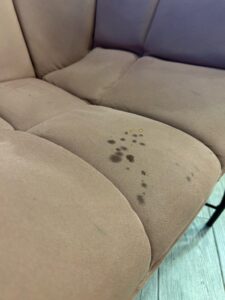
Understand the Material First
Before any cleaning attempt, the most important step is identifying what the couch is actually made of—not just guessing based on how it looks or feels. Many couches have no visible cleaning code, or the tag has been removed, or it’s tucked so far under the frame that people skip checking it entirely. That omission is one of the most common reasons couches end up ruined. A fabric that looks durable might be rayon or acetate, both of which can watermark, shrink, or disintegrate with plain water. Leather isn’t always leather—it might be bonded leather, which peels when cleaned with standard leather products, or it could be suede, which darkens and stiffens if it gets wet. This is especially true when different couch materials react unpredictably to moisture and cleaners.
Even when a tag exists, the codes (W, S, SW, X) are guidelines, not guarantees. An “W” code means water-based cleaners are generally safe, but it doesn’t account for older couches where the dye wasn’t colorfast, or for cushions with fillings that mold if they stay damp too long. If you’re unsure what the material is, or if the couch is vintage, delicate, or expensive, it’s worth pausing indefinitely before trying anything. There’s no shame in deciding that the risk of guessing wrong is greater than the inconvenience of the stain. These upholstery cleaning codes are used across the furniture industry, but they’re often misunderstood by homeowners.
Safe Methods That Often Work
For couches with a confirmed “W” or “SW” cleaning code and no unusual construction, light cleaning with a barely damp cloth and mild dish soap sometimes lifts surface dirt without causing harm. The method works best on fresh stains that haven’t set, and only when the fabric isn’t saturated—just lightly touched with moisture and blotted immediately. But this approach fails when people assume that wetter means cleaner. Oversaturating the fabric often pushes the stain deeper into the cushion foam, spreads it across a wider area, or leaves a water ring that’s more noticeable than the original mark. If the spot isn’t improving after two or three careful attempts, continuing usually makes things worse, not better.
Vacuuming with an upholstery attachment is one of the lowest-risk actions, especially for removing dust, pet hair, and dry debris. It’s effective for maintenance and often improves the appearance of a couch without any liquids involved. Still, vacuuming can damage certain fabrics—loose weaves, silks, or any material with a delicate nap can snag, pull, or create permanent texture changes. If the fabric feels fragile under your hand, or if you notice any pilling or loosening after the first pass, it’s worth stopping and reconsidering whether even this gentle method is appropriate.
Baking soda is frequently recommended for odor absorption, and it does help with some smells when sprinkled lightly, left for a few hours, and vacuumed up. But it doesn’t work on odors that have soaked into foam or wood framing, like pet urine or mildew. In those cases, the baking soda only masks the smell temporarily, and people often respond by adding more, scrubbing it in, or leaving it on too long—which can leave a white residue that’s difficult to remove or create a gritty texture in the fabric. If the smell returns within a day, the problem is deeper than surface cleaning can address, and continuing to treat it at home is unlikely to succeed.
Common Mistakes to Avoid
One of the most frequent mistakes is using too much cleaner because the instructions seem too cautious or because the stain isn’t disappearing fast enough. Upholstery doesn’t rinse the way clothing does, so any soap, detergent, or cleaning solution that goes into the fabric mostly stays there. Residue attracts dirt, makes the area feel stiff or sticky, and often creates a new stain that’s worse than the first. The instinct to scrub harder when a stain resists is understandable, but scrubbing damages fibers, spreads discoloration, and can even wear through the fabric entirely if it’s already weakened by age or sunlight exposure.
Another common error is assuming that if a product worked on carpet, it will work on a couch. Carpet fibers are generally thicker and more durable than upholstery fabric, and carpet cleaners often contain stronger chemicals or more moisture than upholstery can handle. Using a carpet cleaner on a couch often results in color fading, texture changes, or water damage to the internal cushion structure. Even products labeled “safe for upholstery” sometimes cause problems on specific fabrics—there’s no universal cleaner, and testing in a hidden spot doesn’t always reveal what will happen across a larger, more visible area.
Heat is another frequent cause of damage. People use hair dryers, irons, or steam cleaners thinking that faster drying or higher heat will improve results, but heat can set stains permanently, shrink fabric, warp foam, or cause dyes to bleed. Once heat damage occurs, it’s almost never reversible. If a cleaning attempt isn’t working at room temperature with minimal moisture, adding heat rarely solves the problem—it usually just makes the mistake permanent.
When to Stop and Call a Professional
If a couch is vintage, custom-made, or cost more than a few hundred dollars, it’s often safer to skip home cleaning entirely and go straight to a professional. The cost of professional cleaning may feel unnecessary, but it’s almost always less than the cost of replacing a ruined couch or living with damage that can’t be undone. Professionals have access to specialized equipment, pH-balanced products, and extraction tools that remove moisture and residue in ways that home methods can’t replicate. At that stage, continuing often causes stains to worsen, which is why some couch stains get worse after cleaning.
Certain situations are clear indicators that professional help is needed. If the stain involves oil, grease, ink, wine, or pet urine that’s soaked through to the cushion, home cleaning rarely works and often spreads the problem. If the couch has any “X” cleaning code, which means no water or solvent should be used, attempting anything at home is too risky. If the fabric feels delicate, shows any signs of previous damage, or has unknown fiber content, the margin for error is too small. And if a home cleaning attempt has already been made and the situation looks worse—whether that’s a bigger stain, a strange texture, or a lingering chemical smell—stopping immediately and calling someone with professional training is the most responsible choice. Continuing at that point usually just compounds the damage and makes professional restoration harder or impossible.
Final Thoughts
There’s no single method that works safely on every couch, and no amount of online advice can replace a careful assessment of the specific materials, age, and condition in front of you. Some couches are simply not designed to be cleaned at home, and recognizing that early prevents far more regret than any DIY attempt. The goal isn’t to fix every problem yourself—it’s to avoid making irreversible mistakes. Sometimes doing nothing, or doing very little, is the smarter decision. Trusting your hesitation and knowing when to stop matters more than any product, trick, or technique.