
It’s one of those moments that feels like bad luck—you clean a spill on your couch, let it air dry like you’re supposed to, and somehow end up with a visible ring or darkened patch that wasn’t there before. It seems backward, like doing the right thing led to the wrong result. But water rings after air drying aren’t rare, and they’re not always a sign you did something wrong. Sometimes they happen because of how certain fabrics hold moisture, how cleaning solutions interact with upholstery, or simply because the drying process itself redistributes whatever was already in the fabric. Understanding why this happens can help you avoid making it worse, and sometimes, help you realize when it’s better to leave things alone entirely.
The frustration usually comes from expecting air drying to be neutral—just a way to let water evaporate without consequence. But couches aren’t flat, absorbent towels. They’re layered, they trap moisture unevenly, and they often contain oils, dirt, or residue from previous cleaning attempts that you can’t see until water moves them around. Rushing to fix the ring or scrubbing harder often locks it in permanently, so slowing down and understanding what’s actually happening is usually the smarter move. This is especially true when moisture becomes trapped inside the couch instead of evaporating evenly, creating secondary problems that aren’t visible right away.
Understand the Material First
Not all couch fabrics dry the same way, and that difference is often the reason water rings appear in the first place. Different upholstery materials absorb and release moisture at different rates, which makes uneven drying a common issue.
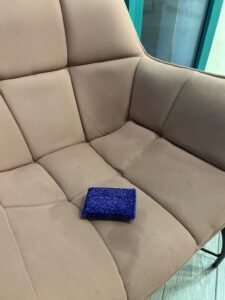
Microfiber, for example, tends to show watermarks easily because it’s dense and holds moisture in a way that creates visible boundaries as it dries. Cotton blends can do the same thing, especially if they’ve been treated with stain protectants or fabric finishes that aren’t evenly distributed. Velvet and chenille are even trickier—they have texture and direction, so when water dries, it can leave the fibers lying differently in the wet area versus the dry area, creating a shadow that looks like a stain even when nothing is actually stained.
If you’re not sure what your couch is made of, assuming it will behave predictably is risky. Some fabrics are more forgiving, but others will show every bit of moisture unevenly, and once that happens, trying to “fix” it by adding more water or rubbing can spread the problem across a larger area. It’s worth pausing before doing anything and asking whether the fabric itself is prone to this issue. Sometimes the safest choice is accepting a small, temporary mark rather than creating a larger, permanent one. 🛋️
Methods That Sometimes Help (And Sometimes Don’t)
One approach people try is blotting the area repeatedly with a dry towel to pull out as much moisture as possible before air drying begins. This can help in some cases, especially if the fabric responds well to pressure and the towel is actually absorbing water rather than just spreading it around. But if you press too hard or use a colored towel, you risk transferring dye or pushing the moisture deeper into the padding, where it takes much longer to dry and can create a musty smell or a more stubborn ring.
Another common method is using a fan or hairdryer on a cool setting to speed up drying. This works better than letting the couch sit in still air, but only if the airflow is even and you’re not concentrating heat in one spot. Uneven drying is often what causes the ring in the first place, so adding focused airflow without moving it around can make the problem more defined. Some people also try lightly misting the surrounding area to blend the wet spot into a larger section, hoping it all dries evenly. Once cleaning products are involved, the risk increases even more, especially if the cleaner isn’t suited to the fabric.
This sometimes works, but it also sometimes just creates a bigger water ring, especially if the fabric doesn’t absorb the mist uniformly.
The truth is, none of these methods are guaranteed. They depend on the fabric, how much water was used, what was in the water, and how the couch was manufactured. Pushing forward with a technique that isn’t working often makes things worse, so recognizing when a method isn’t helping—and stopping—is more valuable than committing to a fix that might backfire.
Common Mistakes That Feel Logical
The most common mistake is adding more water to try to “rinse out” the ring. It makes sense in theory—if the ring is caused by residue or uneven drying, spreading more water should dilute it. But in practice, this often just enlarges the problem or locks the residue deeper into the fibers. Once you’ve added water multiple times, the fabric can start to wear down, colors can shift, and the padding underneath can stay damp long enough to develop mildew. This is one of the reasons some couch stains actually get worse after cleaning instead of fading.
Another mistake is scrubbing the ring with soap or upholstery cleaner, thinking it needs to be “cleaned away.” But if the ring is just a drying pattern and not an actual stain, adding cleaner introduces new chemicals that also need to dry—and they can leave their own residue, creating a layered problem that’s even harder to reverse. People also tend to overestimate how much rubbing fabric can handle. What feels like gentle pressure can be enough to damage the weave or flatten the texture, especially on delicate materials.
When Doing Nothing Is the Safer Choice
Sometimes a water ring fades on its own after a day or two, especially if the room has good airflow and the fabric wasn’t already saturated with old residue. Giving it time without interference can be the least risky option, even if it feels uncomfortable to wait. If the ring is faint and the couch is in a low-traffic area, leaving it alone might prevent you from turning a minor visual issue into permanent damage.
There are also situations where professional cleaning is the only realistic option, and trying to handle it yourself first can make their job harder or even impossible. If the fabric is labeled “dry clean only” or if previous DIY attempts have already altered the texture, stopping early and accepting that some problems are beyond home remedies is a form of care, not failure. 🤔
Final Thoughts
Water rings on couches aren’t always fixable, and they’re not always caused by doing something wrong. Sometimes they’re just a result of how fabric, water, and air interact in ways we can’t fully control. There’s no universal method that works for every couch, and the instinct to keep trying until the problem is solved can often be the thing that makes it permanent. Slowing down, observing what’s actually happening, and knowing when to stop are all part of managing the situation responsibly. Sometimes the smartest decision is the one that involves doing less, not more.