
Some couches look sturdy enough to handle home cleaning, but appearances can be misleading. Certain materials, finishes, and constructions are far more sensitive than they seem. In these cases, attempting to clean at home can quietly cause damage that cannot be undone. This article focuses on recognizing when a couch is too delicate for DIY cleaning—and why choosing not to act is often the safest decision.
Warning Signs to Pause or Stop
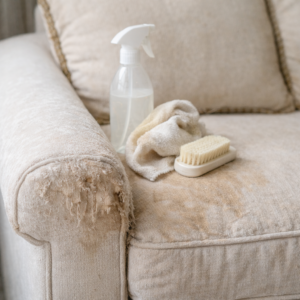
One of the first signs is when the couch reacts immediately to light contact. Fabric may darken, lose its softness, or change texture with minimal moisture or touch. These reactions are not a signal to continue more carefully; they are a clear reason to stop.
Another warning sign is uncertainty. If it is not clear how the material will react, that hesitation matters. When doubt appears before or during cleaning, pausing is a reasonable and protective choice rather than a missed opportunity. This hesitation is often the correct response, as described in When Pausing Mid-Cleaning Is Safer Than Continuing.
Why Delicate Couches Are Easily Damaged
Delicate couches are often made with fine fibers, special finishes, or layered constructions that do not tolerate stress well. This fragility aligns with conservation guidance on sensitive upholstered materials and layered construction. Even gentle cleaning can disturb these materials, especially when moisture or friction is involved. In situations like this, choosing restraint aligns with When Professional Cleaning Is Safer Than DIY for a Couch.
Once disturbed, delicate materials rarely return to their original state. Texture changes, discoloration, or stiffness can become permanent. Knowing this makes restraint more important than effort.
Materials That Don’t Tolerate DIY Cleaning Well
Some couches are designed more for appearance than durability. Their surfaces may be easily altered by touch, moisture, or pressure. Even well-intended home cleaning can overwhelm these materials.
Because these materials fail quietly rather than dramatically, damage may not be obvious right away. This delayed effect is why stopping early—before visible damage appears—is often the safest option.
Why “Gentle” Isn’t Always Gentle Enough
It’s common to assume that a careful approach makes home cleaning safe. With delicate couches, even minimal action can be too much. Light scrubbing, blotting, or repeated handling can still stress the fabric or structure. This sensitivity is explained further in Why Scrubbing Changes Couch Fabric Texture.
If a couch feels like it requires extreme caution, that alone is a signal. Choosing not to proceed is often more protective than trying to find the perfect gentle method.
When Doing Nothing Protects the Couch Best
There are situations where the safest action is no action at all. Leaving a delicate couch untouched avoids introducing risks that cleaning might create. This choice can preserve the couch’s appearance and feel far better than any attempt to improve it.
Doing nothing can feel uncomfortable, especially when a problem is visible. Still, restraint is sometimes the most responsible form of care.
Why Stopping Early Prevents Bigger Problems
Once damage occurs in delicate materials, options become limited. This narrowing of options is also discussed in When Repeated Cleaning Starts to Damage a Couch. Repairs are difficult, and changes are often permanent. Stopping before that point keeps more possibilities open.
Pausing also reduces pressure to decide quickly. That space allows for observation rather than reaction, which is especially important with sensitive materials.
FAQ
How can someone tell if a couch is too delicate to clean at home?
If the material reacts quickly, feels unusually sensitive, or creates uncertainty, those are strong reasons to stop.
Is it okay to leave a delicate couch uncleaned?
Yes. In many cases, leaving it alone causes less harm than attempting to clean it.
Does delicacy mean the couch is poorly made?
Not necessarily. Some couches prioritize appearance or feel over durability. That doesn’t make them defective, just sensitive.
Is stopping the same as neglecting the couch?
No. Stopping is often a deliberate choice to avoid damage. For delicate couches, restraint is a form of protection.