
A large spill on a couch can feel overwhelming, especially when it spreads fast and soaks in before there’s time to think. The urge to react immediately is understandable, but rushing often causes more damage than the spill itself. Slowing down, even for a moment, can change the outcome more than any quick action.
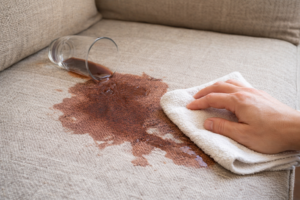
What to Do Immediately
The first response matters less than people think, and overreacting is often the bigger risk. A large spill usually looks worse in the first moments than it will later, which can push people into doing too much too fast. Pausing briefly helps prevent decisions that can’t be undone.
Focus on stopping the spread rather than fixing the stain. Movement, pressure, and friction can push liquid deeper into the fabric and padding. It’s often safer to limit contact with the area and avoid shifting cushions or pressing down aggressively. Even doing nothing for a short time can be better than acting on panic.
It also helps to accept that some moisture may already be inside the couch. Trying to force it out immediately can create new problems, so restraint at this stage is often a reasonable choice.
A Careful Cleaning Approach
Once the initial rush passes, a cautious approach becomes more important than speed. Large spills affect more than the surface fabric, and that hidden moisture can react unpredictably. Moisture that becomes trapped inside upholstered furniture can lead to slow evaporation and moisture retention. Acting gently reduces the chance of spreading the spill further or changing how the fabric looks and feels.
Light contact is generally safer than forceful action. Scrubbing, rubbing, or pressing can distort fibers or push liquid deeper. It’s often better to think in terms of minimizing harm rather than fully removing the spill right away. Not every spill needs to be solved in one attempt.
If uncertainty starts to creep in, that’s usually a sign to slow down even more. When the couch fabric looks different, feels damp in uneven areas, or reacts unexpectedly, stopping early can prevent long-term damage.
Common Mistakes That Feel Logical
Some reactions feel sensible in the moment but tend to cause problems later. Trying to dry the area quickly, for example, can lead to uneven moisture patterns that become visible after drying. This explains why couch stains sometimes look worse after drying, even when the spill seemed controlled at first. Adding more liquid to “even things out” often makes stains larger and harder to manage. This shows why over-wetting a couch causes long-term damage, even when the intention is to dilute the spill.
Another common mistake is treating the spill as a surface issue only. Large spills often reach padding and seams, areas that don’t respond well to repeated handling. Continuing to work the same area can make the couch look worse over time, even if it seems helpful at first.
It’s also tempting to keep going just because some effort has already been made. That pressure can lead to overcleaning, which is one of the most frequent causes of permanent couch damage. Choosing to stop is sometimes the safer option.
When This Approach Is Not Enough
Not every large spill can be handled safely at home. If the couch starts to smell unusual, feel stiff, or show discoloration after drying, those are signs that further action could make things worse. This helps explain why couch fabric feels clean but still smells after a large spill. At that point, continuing without a clear plan may increase the risk.
Spills that soak deeply or spread across multiple sections of the couch are especially unpredictable. The internal structure can hold moisture long after the surface feels dry.
This helps clarify how long moisture stays inside couch cushions, even after the surface feels dry. Ignoring that possibility can lead to problems that appear days later.
There’s no rule that says a spill must be fixed immediately. Waiting, reassessing, or choosing not to continue can be a reasonable decision when the risks start to outweigh the benefits.
FAQ
Should a large spill be handled right away?
Immediate action isn’t always necessary. In some cases, slowing down reduces the chance of spreading the spill or damaging the fabric.
Is it bad to press hard to absorb more liquid?
Pressing can force liquid deeper into the couch. Gentle contact or stopping altogether may be safer if the fabric reacts poorly.
Why does a spill sometimes look worse after drying?
Uneven moisture movement inside the couch can change how the fabric dries. This can happen even when the initial response seemed careful.
When is it better to stop and do nothing?
If the fabric starts to change texture, color, or smell, stopping early can prevent more serious damage. Sometimes restraint protects the couch better than continued effort.