
Vinegar is often recommended as a simple, natural way to clean floors. It’s inexpensive, widely available, and associated with gentler, chemical-free cleaning. At first, it can seem effective. Floors may look brighter, feel less sticky, and smell fresh after use. Over time, however, vinegar can create problems that don’t show up right away. Understanding why those issues develop helps explain how a cleaner that feels safe can quietly cause long-term damage.
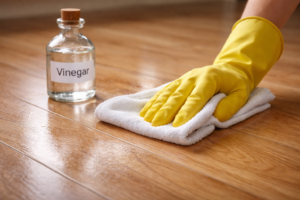
Why Vinegar Feels Like a Safe Choice
Vinegar’s reputation comes largely from its simplicity. It’s a common household item, not a specialized product with warning labels. That familiarity makes it feel less risky than store-bought cleaners. Because it’s diluted and doesn’t leave visible residue, early use often reinforces the idea that it’s harmless.
This sense of safety can discourage hesitation. When a floor looks good after cleaning, it’s natural to assume the method is working as intended. Slowing down to question that assumption can feel unnecessary, but it’s often where problems are avoided before they develop.
Acid Works Gradually, Not Dramatically
Vinegar is acidic. While that acidity helps break down grime, it also interacts with many floor materials in subtle ways. Unlike harsh cleaners that cause immediate damage, vinegar usually works slowly. Its effects accumulate over repeated use rather than appearing after a single cleaning.
On sealed surfaces, vinegar can gradually weaken finishes. On natural materials, it can affect the surface structure itself. Because these changes happen incrementally, they’re easy to overlook. Taking time to consider how often vinegar is used matters more than focusing on how mild it seems in the moment.
Early Results Can Be Misleading
After cleaning with vinegar, floors often look improved. Shine may increase temporarily, and dull spots can appear less noticeable. This improvement can mask what’s happening beneath the surface. Finishes may be thinning or becoming more porous even as they reflect light evenly.
When results look positive, it encourages repetition. Each cleaning reinforces the habit without signaling risk. Recognizing that short-term appearance doesn’t always reflect long-term condition can help interrupt that cycle before damage becomes visible.
This is similar to why hardwood floors can look fine after cleaning and then fail months later.
Different Floors React in Different Ways
Not all floors respond to vinegar equally. This mirrors why no single method works for every couch across different materials and conditions. Hardwood, laminate, stone, tile, and vinyl each have different tolerances. Even within the same category, variations in finish, age, and wear change how vinegar interacts with the surface.
A floor that tolerates vinegar for months may suddenly show signs of stress when conditions change. What seems safe in one room or home may behave differently in another. This variability is a reason to pause instead of assuming a universal solution applies everywhere.
Repetition Is Where Problems Begin
Occasional use may not cause obvious harm. The risk increases with regular use. Each cleaning introduces another exposure cycle. Over time, finishes can lose their protective qualities, making floors more vulnerable to moisture, scratches, and staining.
Because the damage builds slowly, it’s rarely linked back to vinegar. Floors may be described as “wearing out” or “aging naturally,” even when cleaning habits played a role. Reducing frequency or stopping altogether can sometimes stabilize a floor before damage becomes irreversible.
Vinegar and Protective Finishes
Many floors rely on finishes to protect the underlying material. Vinegar doesn’t usually strip these finishes outright. Instead, it can erode them gradually. As the finish thins, it becomes less effective at sealing the surface.
This creates a delayed problem. Once protection is compromised, everyday exposure to moisture and dirt has a greater impact. The floor may then deteriorate faster, even if vinegar use stops. Recognizing this risk earlier can prevent crossing that threshold.
Why Damage Often Appears Later
The delayed nature of vinegar-related damage makes it difficult to identify. Floors don’t usually fail immediately after cleaning. Instead, issues emerge months later as dullness, uneven sheen, or increased sensitivity to spills.
Because the time gap is large, cleaning choices aren’t always questioned. The connection feels indirect. Being aware that some cleaners cause delayed effects helps make sense of why problems seem to appear “out of nowhere.”
Natural Doesn’t Always Mean Neutral
The label “natural” is often equated with “safe.” In reality, natural substances can still be reactive. This is also why “safe for upholstery” labels can be misleading when reputation replaces material compatibility. Vinegar’s acidity is natural, but that doesn’t make it neutral to floor materials.
Assuming that natural cleaners are universally gentle can lead to overuse. Slowing down to consider how a substance interacts chemically with a surface is more protective than relying on its reputation alone.
Knowing When to Pause
One of the most effective ways to prevent long-term problems is knowing when to stop. If a floor begins to look dull more quickly, feels different underfoot, or responds unpredictably to moisture, those are signals to pause. This reflects why couch cleaning is more about restraint than technique when surfaces show early stress.
Continuing to clean out of habit can worsen underlying issues. Allowing time without intervention can reveal whether the floor stabilizes or continues to decline. That pause often provides more clarity than trying another “safe” solution.
Rethinking Convenience in Floor Care
Vinegar is appealing because it’s easy. It doesn’t require special products or instructions. That convenience can overshadow its limitations. Floors tend to last longest when care decisions prioritize compatibility and restraint over simplicity.
Reconsidering an easy solution doesn’t mean overcomplicating cleaning. It means recognizing that fewer interventions, chosen carefully, often preserve floors better than frequent, well-intentioned cleaning.
FAQ
Why is vinegar commonly recommended for floors?
Because it’s inexpensive, familiar, and effective at removing surface residue in the short term.
Does vinegar always damage floors?
Not always, but repeated use increases the risk of gradual damage, especially on finished or natural surfaces.
Why doesn’t damage show up right away?
Because vinegar’s effects are cumulative and often masked by finishes until protection weakens.
Are some floors more sensitive than others?
Yes. Material type, finish condition, and age all affect how a floor reacts.
What’s the safest approach if vinegar has been used regularly?
Reducing use or stopping allows you to observe how the floor responds without adding further stress.