
Floors can give reassuring feedback right after cleaning. They feel smooth underfoot, look brighter, and seem refreshed. That immediate response often signals success, encouraging the same approach to be repeated. Weeks or months later, however, signs of deterioration may begin to appear—dulling finishes, increased sensitivity to moisture, subtle movement, or uneven wear. Understanding why this happens helps explain how a floor can feel clean while quietly moving toward damage.
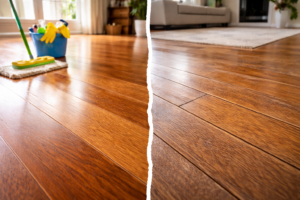
Cleanliness and Condition Are Not the Same
A clean floor is not necessarily a healthy one. Cleanliness describes what’s on the surface at a given moment, while condition reflects what’s happening within the materials over time. Many cleaning methods excel at removing residue without revealing how the surface or finish is responding underneath. It can be helpful to pause and remember that a pleasant tactile result doesn’t guarantee long-term stability.
Floors are designed to look uniform, which can mask early stress. That visual consistency makes it easy to overlook gradual changes until they accumulate. Slowing down before drawing conclusions can prevent confusing short-term cleanliness with lasting protection. This is similar to why hardwood floors can look fine after cleaning and then fail months later.
Why “Feeling Clean” Can Be Misleading
The sensation of cleanliness often comes from reduced friction and residue. A floor that no longer feels sticky or gritty can seem improved, even if the finish has been slightly thinned or softened. This can create a false sense of safety. It’s worth hesitating before assuming that smoothness equals resilience, especially when the effect repeats quickly after each cleaning.
As finishes change, they may temporarily reflect light more evenly, enhancing the impression of improvement. That effect can fade later, revealing wear that wasn’t obvious at first. This is one reason vinegar on floors can become a long-term problem despite early positive results. Allowing time between cleanings can make these patterns easier to notice.
Repetition Turns Mild Stress Into Real Wear
Single cleanings rarely cause immediate deterioration. The issue more often lies in repetition. Each cycle introduces some combination of moisture, friction, or chemical interaction. On its own, that stress may seem insignificant. Over time, however, repeated exposure can alter how a floor ages. This often happens when repeated floor cleaning breaks down protective finishes gradually.
This accumulation happens quietly. Because the floor feels fine after each cleaning, it’s natural to continue. Taking a step back—cleaning less often or pausing to observe—can be more protective than perfecting technique.
Finishes Can Mask Early Damage
Protective finishes are meant to absorb wear so the floor beneath doesn’t have to. They can continue to look intact while losing effectiveness. As a finish thins, it may still feel smooth and clean but offer less resistance to everyday stressors.
When deterioration finally becomes visible, it can seem sudden. In reality, the change began earlier. Recognizing that finishes can hide early damage helps explain why floors deteriorate “afterward,” not immediately. It’s often safer to stop and reassess while the finish still appears acceptable.
Moisture Moves Below the Surface
Even when a floor dries quickly, moisture can travel into seams, micro-gaps, or porous layers. That movement isn’t always detectable by touch. A dry-feeling surface doesn’t mean moisture hasn’t affected deeper layers.
Over time, repeated moisture exposure can weaken bonds or change how materials respond to environmental shifts. Pausing between cleanings allows moisture to dissipate more fully and reduces the chance of cumulative stress.
Environmental Changes Reveal Hidden Weakness
Floors don’t exist in a static environment. Temperature and humidity fluctuate, and daily use adds pressure. A floor that feels clean and stable in one season may react differently later. When conditions change, earlier stress can turn into visible deterioration.
This delayed reaction makes it harder to connect cause and effect. Waiting to see how a floor responds across time—rather than assuming early success—can clarify whether cleaning choices are contributing to later problems.
Over-Cleaning in the Name of Maintenance
Cleaning is often framed as maintenance, but more isn’t always better. Frequent cleaning can shorten the lifespan of finishes, even when products seem gentle. The goal of maintenance is preservation, not constant intervention.
Accepting slight variations in appearance can reduce the urge to correct every imperfection. Doing less, especially when a floor already feels clean, can be a form of protection rather than neglect.
Why Deterioration Is Often Misattributed
When floors begin to deteriorate, the cause is often blamed on age or normal wear. Cleaning habits may feel unrelated because the floor looked and felt fine for so long. This misattribution allows the same routine to continue, potentially accelerating decline.
Revisiting earlier assumptions—without panic—can help identify patterns. It’s reasonable to pause and reconsider methods that seemed successful at first.
Small Signs That Appear After the Fact
Early signs of deterioration are subtle: finishes dull more quickly, seams catch light differently, or the floor responds more noticeably to spills. These changes often appear after months, not days. They’re easy to ignore because they don’t immediately interfere with use. These subtle changes are often used to tell if floor damage is surface-level or structural.
Choosing to stop or slow down when these signs appear can prevent them from deepening. Waiting for obvious damage often means missing the window where stabilization is possible.
Patience as a Protective Strategy
Floors reward patience. Allowing time between cleanings reveals how materials truly respond. If a floor continues to look stable without frequent intervention, that’s valuable information. If it changes, the pattern becomes clearer.
Patience doesn’t mean inaction forever. It means resisting the urge to rely on immediate feedback alone. Slowing down can be the most effective way to preserve a floor that already feels clean.
Understanding Deterioration as a Process
Deterioration rarely begins after cleaning ends. It’s a process that starts quietly, often during periods when everything seems fine. The feeling of cleanliness can be part of what delays recognition.
Viewing floor care as a long-term relationship rather than a series of quick fixes shifts priorities. Protecting condition over time often requires restraint more than effort.
FAQ
Why do floors feel clean even when damage is developing?
Because surface smoothness and appearance can improve temporarily while finishes or materials weaken underneath.
Is feeling clean a bad sign?
Not necessarily, but it shouldn’t be the only indicator used to judge safety or effectiveness.
Does deterioration always come from cleaning?
No, but cleaning can contribute when combined with repetition, moisture, and environmental changes.
How long does it take for problems to appear?
There’s no set timeline. Changes often emerge gradually over months as conditions shift.
What’s the safest response when unsure?
Reducing frequency and observing how the floor responds over time can prevent unnecessary damage.