
Introduction
Cleaning a floor without outside help can feel like a responsible, cost-saving choice. Many products and tools are designed to make DIY cleaning seem straightforward and low risk. This assumption often fails as floors age, which is why how floor age changes what “safe cleaning” really means becomes easy to overlook. The problem is that some floors reach a point where personal effort introduces more uncertainty than control, and slowing down becomes important.
There are situations where professional cleaning is not about achieving a better shine, but about reducing the chance of permanent damage. Pausing before taking action can protect a floor that is already closer to its limits than it appears.
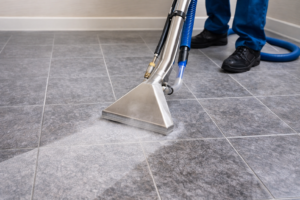
Warning Signs to Pause or Stop
One warning sign is when the floor’s response to cleaning becomes inconsistent. Areas may react differently to the same method, leaving uneven color, texture, or sheen. When results vary from section to section, continuing without a clear plan can make damage harder to track or contain.
Another sign is uncertainty about the floor’s construction or history. If it is unclear how the floor was installed, what finishes were applied, or how it has been cleaned in the past, DIY methods become more risky. Guessing under these conditions can push the floor past a safe threshold, so hesitation is reasonable.
Repeated attempts to correct small issues can also signal a need to stop. When each cleaning addresses one problem but creates another, the pattern suggests the floor may need a different level of care. In those moments, restraint can prevent a series of small decisions from turning into a larger failure.
Why DIY Cleaning Can Make Things Worse
DIY cleaning often relies on general guidance rather than floor-specific limits. Moisture levels, pressure, and chemical strength can be difficult to judge accurately without experience or specialized equipment. Even careful efforts may exceed what the floor can tolerate.
There is also the issue of cumulative stress. Each cleaning alters the floor slightly, whether through abrasion, moisture exposure, or residue buildup. Over time, these changes add up, and another DIY attempt may cross a line without obvious warning. When outcomes start to feel unpredictable, stopping can be safer than continuing.
Correcting mistakes can also be difficult once they occur. Some forms of damage cannot be reversed with additional cleaning and may become more noticeable after repeated attempts. In those cases, acting less can preserve the floor’s current condition rather than accelerate decline.
When Professional Cleaning Changes the Risk
Professional cleaning is not automatically better, but it can shift risk in specific situations. Professionals typically assess the floor before acting, which can reduce trial-and-error decisions. That evaluation alone can prevent unnecessary exposure to moisture or abrasion.
Another difference is control. Professional equipment is often designed to manage moisture extraction, pressure, or application more precisely. This does not eliminate risk, but it can reduce the chance of uneven treatment across the surface. When a floor is already vulnerable, that consistency matters.
Choosing professional help can also slow the decision-making process. Scheduling and assessment create a pause that discourages rushed fixes. That delay can be beneficial when the floor’s condition is unclear or already compromised.
Safer Alternatives to Consider
Doing nothing for a period of time can be a valid option. Allowing the floor to rest may reveal whether issues are stable or still developing. Waiting can feel uncomfortable, but it avoids adding new variables when outcomes are uncertain.
Basic, low-impact maintenance may also be safer than deep cleaning. Removing loose debris without moisture or chemicals limits further stress. Even then, stopping early rather than aiming for perfection can protect sensitive surfaces.
Another alternative is gathering information before acting. Reviewing care guidelines, past maintenance records, or installation details can change the decision entirely. Taking time to understand limits often reduces the urge to intervene immediately.
Why Doing Nothing Can Sometimes Be the Smartest Choice
Some floors reach a point where intervention carries more risk than benefit. At that stage, when doing nothing is safer than cleaning a floor again, professional assessment may reduce uncertainty more than another DIY attempt. Continued DIY cleaning may not improve appearance meaningfully and can shorten the floor’s usable life. Accepting minor imperfections can preserve overall condition longer than repeated attempts to correct them.
Doing nothing also preserves evidence of the floor’s current state. This can matter if questions arise later about defects, wear, or responsibility. Acting less keeps options open instead of narrowing them through irreversible changes.
Choosing professional cleaning, or choosing to wait, is not a failure to maintain a home. It can be a deliberate decision to reduce uncertainty when the floor has little margin for error. In many cases, restraint prevents a manageable situation from becoming permanent damage.
FAQ
How do I know when DIY cleaning is no longer safe?
When results become inconsistent, damage appears after drying, or uncertainty about the floor increases, stopping is often safer than continuing.
Does professional cleaning guarantee better results?
No method guarantees outcomes. Professional cleaning can reduce certain risks, but pausing or doing nothing may still be the safest option in some cases.
Is it wasteful to avoid cleaning when the floor looks dirty?
Not necessarily. Preserving structure can matter more than appearance when the floor is already stressed.
Can waiting really help?
Yes. Time can reveal whether issues are stable or worsening, and that information can guide safer decisions later.