
Introduction
Carpet damage is often expected to appear right away. If something goes wrong during cleaning, most people assume they will see it as soon as the carpet dries. When the carpet looks fine at first, it is easy to believe the cleaning was successful.
What is less understood is that many forms of carpet damage develop slowly. Changes can take days or even weeks to become noticeable, long after the cleaning feels finished. This delayed response is closely related to cases where carpet cleaning causes rippling, shrinking, or texture changes that only appear after drying and use. Slowing down to understand delayed reactions can prevent repeated cleaning that quietly makes the problem worse.
Why Immediate Results Can Be Misleading
Right after cleaning, carpets are usually at their most forgiving. Fibers are still flexible, moisture is evenly distributed, and tension changes have not fully settled. At this stage, problems can remain hidden, even if internal stress has already been introduced.
Surface appearance is especially deceptive. A carpet can look clean and uniform while deeper layers are adjusting in ways that are not yet visible. Pausing instead of assuming success allows time for these hidden processes to reveal themselves.
This delay is why immediate inspection is not always reliable. The absence of damage right away does not mean the carpet has returned to its previous condition.
How Moisture Continues to Act After Cleaning
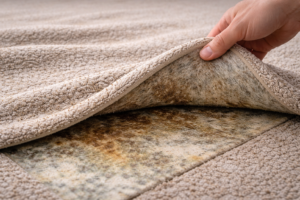
Moisture does not stop moving when cleaning ends. Even after the surface feels dry, water can remain in backing layers or padding. This ongoing behavior is explained in how moisture gets trapped under carpets and what that means long-term, where drying is incomplete below the surface. From there, it continues to migrate slowly through the carpet system.
As moisture redistributes, it can soften adhesives, relax backing materials, or weaken fibers over time. These changes happen gradually, not all at once. Waiting before additional cleaning helps avoid compounding these slow-moving effects.
Environmental conditions also play a role. Temperature changes, humidity shifts, and normal foot traffic interact with residual moisture, influencing how and when damage becomes visible.
The Role of Carpet Layers in Delayed Damage
Carpets are made of layers that respond at different speeds. Fibers react quickly, padding reacts slowly, and backing materials often respond somewhere in between. This mismatch is a key reason damage appears later.
Padding may stay damp long after the surface dries. As it releases moisture gradually, it can affect the carpet above, leading to texture changes, odors, or subtle movement. Recognizing this layered timing helps explain why problems do not appear all at once.
Backing materials can also change shape as they dry unevenly. Shrinking, rippling, or seam stress may not become obvious until the carpet has gone through several days of normal use.
Why Drying Can Trigger New Problems
Drying is not a neutral process. As moisture leaves the carpet, materials contract and regain stiffness. If this happens unevenly, stress concentrates in specific areas.
This is often when rippling, stiffness, or edge movement begins to show. While the carpet was damp, flexibility masked these weaknesses. Once dry, the structure reveals where balance was lost.
When changes worsen after drying instead of improving, it is usually a sign that internal adjustment is still happening. Continuing to clean at this stage can interrupt stabilization and increase damage.
How Residue Contributes to Delayed Reactions
Cleaning products do not always leave the carpet completely. Residue can remain within fibers or settle into lower layers, even when used carefully. Over time, this residue can change how the carpet behaves.
Residue attracts dirt and moisture from the air, slowly altering texture and appearance. Stiffness, darkening, or rapid re-soiling often develops days or weeks later, not immediately after cleaning.
Because residue-related changes are gradual, they are often blamed on normal wear rather than the earlier cleaning. Pausing before re-cleaning can prevent this cycle from repeating.
The Impact of Normal Use After Cleaning
Foot traffic plays a major role in delayed damage. Walking compresses fibers and padding that may still be adjusting internally. This pressure can reveal weaknesses that were not apparent at rest. This effect is stronger in aging materials, which helps explain why old carpets react worse to “gentle” cleaning over time.
Furniture placement, rolling chairs, and repeated paths across the carpet all interact with residual moisture or loosened backing. Over time, these stresses accumulate and make damage visible.
When changes appear only after the carpet returns to normal use, it is easy to overlook cleaning as the trigger. Understanding this interaction helps explain why timing can be misleading.
Why Repeated Cleaning Often Makes Things Worse
When damage shows up weeks later, the instinct is often to clean again. Unfortunately, this can reinforce the same conditions that caused the problem in the first place.
Adding more moisture before the carpet has fully stabilized can restart the adjustment process. Each cycle increases stress on already weakened layers. Hesitating before repeating cleaning can prevent long-term deterioration.
Doing less, rather than more, allows the carpet system to settle. This restraint can limit how far delayed damage progresses.
Signs That Damage Is Developing Slowly
Subtle texture changes are often the first sign. Areas may feel firmer, flatter, or less responsive underfoot. These changes are easy to miss unless attention is paid.
Odors returning after initial freshness is another indicator. This often points to moisture or residue still present below the surface. Uneven appearance, slight waves, or edge pullback can follow.
When these signs appear gradually, pausing before intervention can prevent escalation. Immediate action is not always the safest response.
Safer Alternatives to Consider
Observation is often the safest first step. Allowing time to pass without additional cleaning helps reveal whether changes are stabilizing or worsening.
Dry maintenance reduces risk while adjustments continue. Gentle vacuuming without moisture avoids interfering with internal drying or contraction.
Understanding the carpet’s cleaning history also matters. Knowing how recently and how often moisture was introduced can guide whether restraint is the better choice.
Why Doing Nothing Can Sometimes Be the Smartest Choice
Delayed damage means the carpet is still reacting. Intervening too quickly can interrupt stabilization and lock in changes that might otherwise remain limited.
Doing nothing allows moisture to fully dissipate and materials to reach equilibrium. This pause can prevent minor issues from becoming permanent structural damage.
Choosing not to act immediately is not neglect. It is a controlled response to a system that needs time rather than more input.
FAQ
Why didn’t I see damage right after cleaning?
Because moisture, residue, and structural stress often take time to redistribute and become visible.
Is delayed carpet damage common?
Yes. Many issues develop gradually as layers dry, adjust, and interact with normal use.
Should I clean again if problems appear weeks later?
Often no. Re-cleaning can restart the same process and worsen the damage.
How long should I wait before taking action?
Waiting until the carpet fully stabilizes can prevent unnecessary intervention and reduce long-term risk.