
Appliance problems often begin with a clear choice. A part fails, a symptom appears, and the response feels straightforward. Repairing the issue seems like a contained decision with a defined scope. It is often worth slowing down when that clarity fades, because some damage eventually moves beyond what a single repair can realistically address.
This article focuses on the gray zone where appliance damage has spread or shifted enough that no single repair decision fully captures the situation. Understanding this transition can help explain why familiar decision-making frameworks stop working.
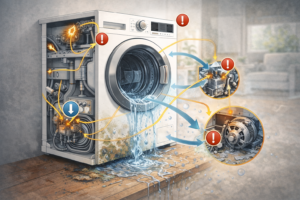
Why Early Repairs Feel Contained
In the early stages of damage, problems tend to appear isolated. One component misbehaves, and the rest of the appliance seems unchanged. This creates confidence that a targeted repair will restore normal operation.
That confidence is not unreasonable. Many issues do begin this way. Pausing only becomes important when new behaviors emerge after an initial fix or when the original problem no longer feels clearly defined.
Containment is often temporary, even when it feels complete.
How Damage Gradually Expands Its Influence
As an appliance continues operating with underlying stress, damage can spread to neighboring components. Loads shift, tolerances change, and compensation becomes more complex.
At this point, repairs no longer affect only one area. This shift often marks the point where a small appliance fault turns into a system failure rather than remaining isolated. Adjusting one part may change how another behaves. Slowing down to notice these interactions can reveal that the problem has become systemic rather than localized.
Expansion often happens through interaction, not sudden failure.
When Repairs Start Changing the Problem Instead of Solving It
A key signal that damage has crossed a threshold is when repairs alter symptoms without restoring stability. One issue disappears, but another appears. This pattern reflects situations where fixing the symptom makes the real appliance problem worse rather than restoring stability. Performance changes, but predictability does not return.
These outcomes can feel confusing. Pausing to recognize that the problem itself may be evolving can help avoid chasing symptoms instead of understanding scope.
When fixes reshape behavior, the decision landscape has shifted.
Why Cost and Effort Stop Being Reliable Guides
In early decisions, repair cost and effort often guide choices. A repair is judged worthwhile or not based on its size. Once damage spreads, these metrics lose clarity.
Multiple smaller efforts may add up without producing lasting improvement. Slowing down to reassess whether effort still maps to outcome can prevent decisions based on outdated assumptions.
Effort does not always equal progress.
How Uncertainty Signals a Different Decision Type
When damage is localized, decisions feel concrete. When damage spreads, uncertainty increases. Outcomes become harder to predict, and confidence drops even after action is taken.
This uncertainty is not just emotional; it reflects real complexity. Pausing to accept that the decision type has changed can prevent forcing simple answers onto a complex situation.
Uncertainty often indicates a boundary has been crossed.
When “One More Repair” Becomes a Pattern
Repeatedly choosing “one more repair” can signal that damage is no longer contained. Each decision may feel justified on its own, yet the overall trajectory trends toward instability. This trajectory mirrors how repeated minor appliance issues lead to sudden breakdown over time.
Slowing down to look at the pattern, rather than the latest issue, can help reveal whether the appliance is still within a manageable repair zone.
Patterns matter more than intentions.
Why Waiting for Failure Can Be Risky
In gray zones, it can feel reasonable to wait until something clearly breaks. However, when damage is already widespread, failure may carry broader consequences than expected.
Waiting does not pause progression. Pausing instead to reassess risk and scope can help avoid being forced into decisions under pressure.
Delay changes conditions, not outcomes.
When Doing Less Is a Valid Decision
Choosing not to repair immediately can feel counterintuitive. Yet in some cases, doing less preserves clarity while preventing further stress on already weakened systems.
This pause is not avoidance. It is a way to avoid compounding uncertainty while understanding catches up. Slowing down can keep options from narrowing prematurely.
Restraint can be a form of control.
Why This Stage Feels So Frustrating
This gray zone is frustrating because it sits between clear repair and clear failure. The appliance still works, but trust erodes. Decisions feel heavier, yet guidance feels thinner.
Recognizing that frustration is part of the transition can reduce pressure to resolve everything quickly. Pausing allows space to acknowledge that the situation has fundamentally changed.
Some decisions resist simplification.
FAQ
How can damage move beyond a single repair?
Through spreading stress, compensation, and interaction between components. Slowing down helps reveal this shift.
Why do repairs feel less effective over time?
Because the problem is no longer isolated. Fixes change symptoms without restoring stability.
Is it wrong to keep repairing an appliance in this stage?
Not always. The risk increases when repairs are treated as isolated decisions rather than part of a pattern.
What’s the safest response when unsure?
Restraint and reassessment. Doing less while observing can prevent decisions that narrow options too quickly.