
Isolated appliance fixes often feel logical. A specific symptom appears, a part is adjusted or replaced, and the problem seems addressed. In early stages, this approach can work. It is often worth slowing down when fixes stop producing lasting stability, because once damage has spread, isolated actions may no longer match the nature of the problem.
This article explores the gray zone where appliance damage has moved beyond a single point, making targeted fixes ineffective or even misleading. Understanding why this happens can help explain repeated frustration after “reasonable” repair attempts.
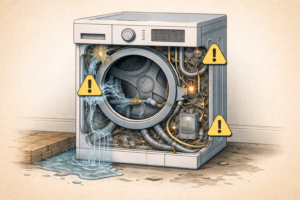
Why Isolated Fixes Make Sense at First
Most appliance problems begin locally. A noise comes from one area, a leak appears in one spot, or performance drops during a specific function. These signals encourage focused responses.
In contained situations, this logic holds. Pausing only becomes important when the same logic is applied after conditions have changed. What once was isolated may no longer be.
Early success can hide later mismatch.
How Damage Spreads Quietly
Damage rarely expands in dramatic steps. Stress redistributes, materials adapt, and components compensate for one another. These shifts often happen without clear symptoms. This is often the stage where a small appliance fault turns into a system failure rather than remaining isolated.
As damage spreads, the appliance may still present a single visible issue, even though multiple areas are now involved. Slowing down to consider unseen interactions can help explain why fixing one point no longer stabilizes the system.
Spread is often structural, not obvious.
When Fixes Address Symptoms, Not Scope
Isolated fixes usually target symptoms. When damage is contained, symptoms align closely with causes. After spread, symptoms become less representative.
A fix may quiet one behavior while pressure builds elsewhere. This dynamic mirrors cases where fixing the symptom makes the real appliance problem worse by masking broader conditions. This creates the impression of progress without restoring balance. Pausing to question whether a fix addresses scope rather than visibility can prevent false confidence.
Silence is not the same as resolution.
Why New Problems Appear After a “Successful” Fix
When damage has spread, changing one part of the system can reveal stress in another. A repair shifts loads, airflow, moisture paths, or timing, exposing weaknesses that were previously masked.
This can feel like a new failure caused by the fix itself. Slowing down to recognize that the fix revealed existing conditions—not created them—can reduce confusion.
Exposure is often mistaken for causation.
How Repeated Isolated Fixes Change the System
Each isolated fix slightly alters the appliance’s behavior. Over time, these changes accumulate, reshaping how the system responds to stress.
The original problem becomes harder to recognize as the context shifts. Pausing before applying yet another fix can help prevent the problem from being continuously redefined.
Every fix rewrites the environment.
Why Decision Fatigue Sets In
As isolated fixes fail, decisions feel heavier. Confidence drops, and outcomes become harder to predict. This fatigue is not just emotional; it reflects real complexity.
Slowing down to acknowledge that the problem has crossed into a different decision category can reduce pressure to “solve it” with another narrow action.
Fatigue often signals misalignment, not indecision.
When Waiting Feels Like the Only Option
After repeated unsuccessful fixes, waiting can feel like the least bad choice. The appliance still works, and further action feels risky or pointless.
While waiting does not stop progression, it can provide space to reassess scope. Pausing intentionally is different from drifting forward with the same assumptions.
Inaction can be strategic when awareness is active.
Why Broader Assessment Becomes Necessary
Once damage has spread, understanding the appliance in isolation becomes less useful. Interactions with surrounding systems, usage patterns, and accumulated changes matter more.
This does not mean every detail must be analyzed at once. Slowing down to widen perspective gradually can restore alignment between understanding and action.
Scope determines strategy.
When Doing Less Prevents Doing the Wrong Thing
In gray zones, additional isolated fixes can accelerate confusion. Each action changes conditions, making patterns harder to see.
Choosing to do less for a time can preserve information about how the appliance behaves without interference. Restraint can protect clarity when complexity is already high.
Sometimes the safest move is to stop adjusting.
Why These Situations Feel Unfair
It can feel unfair that reasonable fixes no longer work. The appliance did not suddenly fail, yet nothing seems to help.
Recognizing that the problem itself has changed—not that effort was misguided—can reduce frustration. Pausing to accept this shift can make next steps feel less reactive.
Changing problems require changing frames.
FAQ
Why do isolated fixes stop working after damage spreads?
Because symptoms no longer reflect a single cause. Slowing down helps reveal broader involvement.
Does this mean the fixes were wrong?
Not necessarily. They may have been appropriate earlier. The mismatch arises when conditions change.
Why do new issues appear after fixing one thing?
Because repairs redistribute stress. Pausing helps separate exposure from cause.
What’s the safest response when fixes keep failing?
Restraint and reassessment. Doing less while observing can prevent further misalignment.