
Appliance problems are usually noticed where the appliance sits. A machine runs differently, moisture appears nearby, or performance drops. Attention naturally stays focused on the device itself. It is often worth slowing down at this point, because appliance issues frequently set off secondary damage in the home that develops quietly and appears later.
Secondary damage does not happen by accident. It grows out of how appliances interact with surrounding materials, systems, and spaces over time. Understanding this relationship helps explain why a problem that starts small can eventually affect areas far beyond the appliance.
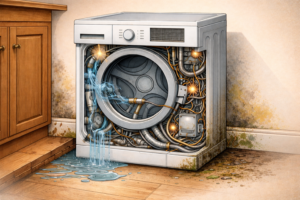
Why Damage Rarely Stays Confined to the Appliance
Appliances are embedded within the home. They rest on floors, connect to plumbing and electrical systems, and release heat, vibration, and moisture into enclosed spaces. When something goes wrong, these outputs often change.
A leak, imbalance, or inefficiency does not remain isolated. This pattern reflects why appliance water damage often spreads beyond the immediate area rather than remaining localized. It alters conditions around the appliance first, then spreads outward. Pausing to see the appliance as part of a larger system helps explain why damage rarely stays contained.
The appliance is a source, not a boundary.
How Moisture Creates Secondary Damage
Many appliance problems involve moisture, even when water is not visibly pooling. Slow leaks, condensation, or inefficient drainage can introduce repeated dampness into nearby materials.
Floors, cabinets, walls, and substructures absorb this moisture gradually. Over time, absorption weakens materials, loosens adhesives, and alters structural behavior. This process mirrors how repeated appliance moisture leads to hidden structural issues beneath visible surfaces. Slowing down to recognize moisture as a long-term influence—not a one-time event—clarifies why secondary damage develops.
Moisture works quietly and persistently.
Why Secondary Damage Appears Later
Secondary home damage often appears after the appliance problem feels familiar or stable. Early on, materials may cope with the new conditions. Surfaces look normal, and there is no obvious escalation.
As exposure continues, materials reach thresholds where visible changes occur. Warping, staining, softening, or odors may emerge suddenly. Pausing to remember that the delay reflects accumulation, not absence, can prevent misreading the timeline.
Late appearance does not mean late origin.
How Stress Redistribution Affects the Home
When an appliance malfunctions, stress patterns can shift. Vibrations may increase, loads may become uneven, or cycles may lengthen. These changes affect how forces move through floors and framing.
Over time, redistributed stress can cause secondary issues such as cracks, loosening, or misalignment in nearby structures. Slowing down to consider stress pathways helps explain damage that seems unrelated at first glance.
Stress travels along connections.
Why Secondary Damage Often Feels Unrelated
Secondary damage rarely looks like an appliance problem. It may show up as a wall issue, a floor change, or a cabinet concern. Because the symptom does not resemble the original appliance issue, the connection is often missed.
This disconnect encourages separate explanations for each symptom. Pausing to ask how the appliance’s behavior might influence the affected area can help reunite cause and effect.
Distance obscures relationships.
How Repetition Turns Minor Issues Into Broader Damage
A single appliance event may not cause noticeable harm. The risk grows with repetition. Each cycle of moisture, vibration, or inefficiency leaves a small mark, even if it seems to resolve afterward.
Over time, these small impacts accumulate. Materials lose resilience, and damage spreads more easily with each repetition. Slowing down to track frequency rather than severity can reveal why secondary damage becomes inevitable.
Repetition changes outcomes.
Why Repairs Don’t Always Stop Secondary Damage
Fixing an appliance symptom does not always reverse the conditions that caused secondary damage. A repair may restore performance while moisture remains trapped, materials stay weakened, or stress patterns persist.
This creates confusion when home damage continues despite a “successful” repair. Pausing to separate appliance function from environmental recovery can clarify why secondary effects linger.
Resolution in one area does not guarantee recovery in another.
How Home Layout Influences Damage Spread
The way an appliance is installed affects how secondary damage develops. Tight spaces, limited ventilation, and shared structural elements can trap moisture or concentrate stress.
In these conditions, damage spreads faster and farther. Slowing down to consider placement and surroundings helps explain why similar appliance issues produce different home impacts.
Context shapes consequence.
Why Secondary Damage Often Escalates Quickly
Once secondary damage becomes visible, it often progresses faster than expected. Materials that have been weakened over time respond poorly to new stress or exposure.
This acceleration can feel alarming. Pausing to recognize that the groundwork was laid earlier can make rapid changes feel more understandable and less mysterious.
Speed increases after thresholds are crossed.
When Doing Less Can Prevent Further Damage
When secondary damage is suspected, the urge to act immediately is strong. However, acting without understanding the pathways involved can spread damage further or hide important clues.
Stopping to reassess how the appliance interacts with the home can preserve clarity. Doing less for a moment can prevent accidental escalation while understanding catches up.
Restraint can limit unintended consequences.
Why Secondary Damage Is Often Underestimated
Secondary damage is underestimated because it develops indirectly. It does not announce itself clearly, and it rarely matches expectations about appliance problems.
Slowing down to widen the scope of attention—from appliance performance to home response—can reduce the chance of overlooking these effects.
What feels secondary can become primary over time.
FAQ
Why do appliance problems affect the home beyond the appliance itself?
Because appliances interact with surrounding materials and systems. Pausing to see these connections explains the spread.
Is secondary damage always caused by leaks?
No. Vibration, heat, and stress redistribution can also contribute. Moisture is common but not exclusive.
Why does secondary damage appear after the appliance issue feels stable?
Because damage accumulates quietly before becoming visible. The delay reflects material limits, not inactivity.
What’s the safest approach when secondary damage is suspected?
Restraint and observation. Doing less while reassessing connections can prevent further spread and misinterpretation.