
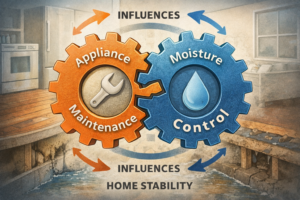
Appliance maintenance is often discussed in terms of efficiency, lifespan, or preventing breakdowns. Moisture control is usually treated as a separate concern, associated with ventilation, leaks, or weather. It is often worth slowing down here, because in practice these two areas are tightly connected. Appliance maintenance and moisture control influence each other in ways that are easy to overlook until damage has already developed.
Understanding this connection helps explain why well-maintained appliances can still contribute to moisture problems, and why moisture issues often persist even after appliance repairs.
Why Maintenance Is Commonly Framed as Mechanical
Maintenance tasks are usually defined by parts and performance. Filters are cleaned, components are adjusted, and visible wear is addressed. This framing encourages the idea that maintenance is internal to the appliance.
Moisture, on the other hand, is seen as an environmental issue. It feels external and diffuse. Pausing to question this separation can help reveal why addressing one without the other often leaves problems unresolved.
Categories simplify thinking, but they also hide overlap.
How Appliances Act as Moisture Sources
Many appliances handle water, heat, or humidity as part of normal operation. Washing machines, dishwashers, dryers, refrigerators, and HVAC components all interact with moisture in different ways.
When maintenance lapses, moisture handling becomes less controlled. This connection helps explain how appliance failures connect to moisture and mold issues even without visible leaks. Drainage may be incomplete, condensation may increase, or drying cycles may become less effective. Slowing down to see appliances as active moisture sources clarifies why maintenance directly affects moisture conditions.
Moisture is often a byproduct, not a failure.
Why Small Maintenance Issues Have Outsized Moisture Effects
Minor maintenance gaps rarely stop an appliance from working. Instead, they change how the appliance manages moisture. A slight inefficiency may leave small amounts of water behind or extend humid conditions.
These changes seem insignificant in isolation. This dynamic reflects when appliance maintenance becomes a home preservation issue rather than a purely mechanical concern. Over time, repetition amplifies their impact. Pausing to consider cumulative effects helps explain why moisture problems often appear disconnected from any single maintenance lapse.
Small deviations can have large environmental consequences.
How Moisture Persists Even After Repairs
Correcting a mechanical issue does not automatically remove moisture that has already been introduced. Materials around appliances can retain moisture long after surfaces appear dry.
This persistence creates confusion when moisture-related issues continue despite repairs. Slowing down to separate fixing the appliance from restoring surrounding conditions can prevent false conclusions about success.
Resolution is not always immediate or complete.
Why Moisture Control Depends on Consistency
Moisture problems often develop through inconsistency rather than extremes. Appliances that alternate between proper and improper moisture handling create fluctuating conditions that materials struggle to adapt to.
Maintenance that is irregular or reactive can reinforce this pattern. Pausing to recognize consistency as a form of moisture control can shift how maintenance is valued.
Stability matters more than perfection.
How Location Intensifies the Connection
Where an appliance is located strongly affects how maintenance and moisture interact. Tight spaces, enclosed cabinets, or poorly ventilated areas limit drying and airflow.
In these environments, even minor maintenance issues can have disproportionate moisture effects. Slowing down to consider location helps explain why similar appliances behave differently in different homes.
Context shapes impact.
Why Moisture Problems Are Often Misattributed
When moisture appears, attention often turns to leaks, weather, or building defects. Appliance maintenance is rarely the first suspect unless failure is obvious.
This misattribution happens because the connection is indirect. This indirect link is similar to when appliance leaks are a warning sign for larger home risks. Pausing to include appliance condition in moisture assessment can reduce the risk of chasing the wrong cause.
Indirect links are easy to dismiss.
How Preventive Maintenance Supports Moisture Balance
Preventive maintenance is often justified as a way to avoid breakdowns. Its role in moisture control is less visible but just as important.
By keeping drainage, airflow, and temperature regulation stable, maintenance supports balanced moisture conditions. Slowing down to recognize this role reframes maintenance as environmental management, not just mechanical care.
Prevention operates quietly.
When Doing Less Can Clarify the Relationship
In the face of moisture issues, the instinct may be to make rapid adjustments. However, frequent changes can obscure how appliances contribute to moisture patterns.
Pausing to observe how conditions behave without constant intervention can preserve clarity. Doing less temporarily can help reveal whether maintenance or moisture control is the primary driver.
Restraint can expose patterns.
Why Separation Creates Blind Spots
Treating appliance maintenance and moisture control as separate responsibilities creates gaps. Each issue may be partially addressed while the underlying interaction continues.
Slowing down to view them as a linked system can reduce these blind spots. Integration improves understanding even when immediate action is limited.
Divided attention weakens outcomes.
FAQ
Why can’t appliance maintenance be handled separately from moisture control?
Because appliances actively manage moisture. Pausing to see maintenance as part of moisture regulation explains the overlap.
Can good maintenance prevent all moisture problems?
No. Other factors matter. Maintenance reduces risk but does not eliminate environmental influences.
Why do moisture issues continue after appliance repairs?
Because moisture introduced earlier can persist. Fixing the appliance does not instantly restore materials.
What’s the safest approach when unsure?
Restraint and observation. Doing less while reassessing how maintenance and moisture interact can prevent misjudgment.