Appliance failures often feel sudden. A machine that worked yesterday stops functioning, leaks, or behaves unpredictably, and attention turns immediately to the appliance itself. It is often worth slowing down at this point, because some appliance failures do not originate solely within the machine. Instead, they reveal maintenance gaps in the home that have been accumulating quietly over time.
This article explores how appliance breakdowns can act as signals, exposing areas of deferred or uneven home maintenance that were previously easy to overlook.
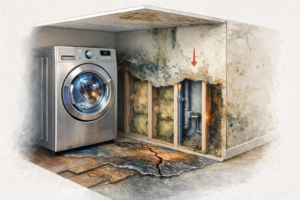
Why Appliance Failures Feel Isolated
Appliances are discrete and task-oriented. When they fail, the problem feels contained: something broke, and it needs fixing. This framing is reassuring because it suggests a clear cause and a clear solution.
However, this perspective can persist even when the failure reflects broader conditions. Pausing to ask whether the appliance is the only thing that changed can help widen understanding beyond the immediate malfunction.
Isolation often reflects perspective, not reality.
Review the Conditions Around a Failed Appliance
Before treating every breakdown as proof of poor home maintenance, separate routine upkeep from a possible machine defect. Check the manufacturer’s maintenance schedule and record when filters, lint screens, hoses, and accessible vents were last inspected or cleaned. For a washer, note whether the machine is level and whether hoses show visible wear; for a dryer, check the lint filter and accessible exhaust outlet for restrictions.
Look for visible leaks, damaged floor finishes, blocked ventilation, or repeated drainage problems, but do not open electrical or gas components. These observations help a qualified technician test possible causes; they do not establish that a household maintenance lapse caused the failure.
Why Appliances Expose What the Home Absorbs
Appliances are sensitive to their surroundings. They rely on stable support, predictable airflow, controlled moisture, and consistent utilities. When these conditions drift, appliances often react before structural or visible elements do.
In this way, an appliance failure can function like an indicator light rather than the primary problem. This perspective aligns with situations where appliance problems signal that the home needs broader attention. Pausing to interpret failure as feedback can shift focus from repair to understanding.
Sensitive systems reveal hidden strain.
When a Breakdown Highlights Uneven Attention
Maintenance is rarely distributed evenly across a home. Some areas receive frequent care, while others are addressed only when problems become obvious.
Appliances installed in overlooked spaces—tight cabinets, basements, or utility corners—are especially affected by this imbalance. Slowing down to notice where maintenance has been concentrated, and where it has not, can explain why certain failures occur.
Neglected spaces fail first.
Why Failures Often Seem Out of Proportion
It can feel confusing when a relatively small maintenance lapse leads to a major appliance failure. This mismatch happens because effects compound over time.
What appears to be a single missed task may represent years of gradual change. Pausing to account for accumulation helps reconcile why failure feels sudden but was long in the making.
Proportion reflects duration, not visibility.
How Past Workarounds Contribute to Failure
Temporary fixes and workarounds often become permanent without intention. Adjustments made to “get by” can alter how appliances operate or how stress is distributed.
Over time, these adaptations may push appliances outside their intended conditions. Slowing down to remember past compromises can illuminate why an appliance finally fails.
Temporary solutions leave permanent footprints.
Why Appliance Repair Doesn’t Close the Gap
Repairing or replacing an appliance addresses the immediate failure, but it does not resolve the conditions that contributed to it. This distinction reflects when appliance maintenance becomes a home preservation issue rather than a single repair task. Without addressing underlying maintenance gaps, similar problems may recur.
Pausing to distinguish between fixing the symptom and addressing the environment can prevent repeated cycles of failure and repair.
Repair restores function, not context.
How Failures Redefine What “Maintenance” Means
When appliance failures expose broader issues, maintenance stops being a checklist and becomes a pattern of care. Attention shifts from isolated tasks to how systems interact over time.
This reframing can feel uncomfortable because it lacks clear boundaries. Slowing down to accept maintenance as an ongoing process rather than a set of chores can clarify why gaps persist.
Maintenance is cumulative, not episodic.
Why These Gaps Are Easy to Ignore
Maintenance gaps are easy to ignore because they develop without clear warnings. Homes adapt gradually, and occupants adapt with them.
Appliance failure interrupts this adaptation, making the gap visible. Pausing to treat failure as information rather than inconvenience can preserve what it reveals.
Disruption brings clarity.
Build a Maintenance Record Instead of Guessing
Write down the appliance model, approximate age, fault symptoms, repair dates, and the last documented maintenance. Photograph accessible hose connections or floor damage only when it is safe. Compare this record with the manufacturer’s manual and ask the technician which maintenance task, if any, is relevant to the actual failure.
Do not postpone action when there is a burning smell, repeated breaker trips, a suspected gas leak, or water near electrical connections. Stop using the appliance and contact the appropriate qualified professional. A maintenance log is for diagnosis and prevention, not a reason to continue operating unsafe equipment.
Why These Moments Matter
Appliance failures that reveal maintenance gaps offer an opportunity to reassess patterns before further damage develops. They mark points where accumulated neglect becomes visible.
Slowing down to understand what the failure exposed—not just how to resolve it—can inform more balanced decisions going forward.
Signals lose value when rushed past.
FAQ
How can an appliance failure reveal home maintenance gaps?
Because appliances respond to environmental conditions. Pausing to examine those conditions can expose long-standing issues.
Does this mean the appliance wasn’t the real problem?
Not exactly. The appliance failed, but the environment may have contributed. Both matter.
Why do these gaps go unnoticed for so long?
Because change is gradual and familiarity normalizes it. Failure interrupts that normalization.
What’s the safest response when a failure seems revealing?
Restraint and reflection. Doing less while considering broader maintenance patterns can prevent repeating the cycle.