
After a couch seems to dry during the day, it is easy to assume the problem is finished. Sunlight, warmer air, or daytime airflow can make the fabric feel dry and comfortable by evening. Still, nighttime conditions often change in subtle ways that affect how moisture behaves. Pausing before assuming daytime drying is permanent can help explain why some couches seem to “backslide” overnight.
Why Daytime Drying Can Feel Final
Daytime drying often comes with clear signs of progress. The couch may feel lighter, less cool to the touch, and free of obvious dampness. These signals encourage confidence that moisture has fully left the couch. It can be tempting to treat these signs as a finish line rather than a temporary state.
However, couches are layered systems, not flat surfaces. Even when the surface responds quickly, deeper layers may still be adjusting. Slowing down and viewing daytime dryness as partial rather than complete can reduce false certainty.
How Nighttime Humidity Changes Conditions
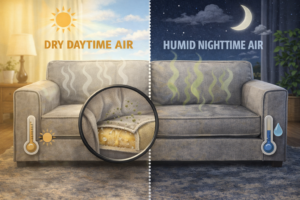
Nighttime air often holds more moisture than daytime air, especially as temperatures drop. Changes in humidity can affect how couch fabric and padding interact with moisture. As air cools, its relationship with moisture shifts, which can change how materials interact with the surrounding environment. A couch that released moisture during the day may encounter conditions that slow or reverse that movement at night.
Humidity does not need to feel extreme to matter. Even small increases can affect how moisture settles inside cushions. Assuming nighttime conditions are neutral can overlook these quieter changes.
Moisture Movement Is Not One-Way
Moisture inside a couch does not always move steadily outward. During the day, warmer conditions may encourage moisture to migrate toward the surface. At night, cooler and more humid air can slow evaporation or even allow moisture to redistribute inward.
This does not mean the couch becomes “wet again” in an obvious way. Instead, drying can stall or partially reverse. Recognizing that moisture movement can pause or shift helps explain why progress can feel inconsistent.
Why Cushions React More Than Fabric
Cushions are thicker and denser than outer fabric layers. This is why moisture inside couch cushions often remains longer than expected. They absorb moisture more deeply and release it more slowly. During the day, the surface fabric may dry while cushions remain in a holding pattern. At night, increased humidity can make it harder for that trapped moisture to continue moving out.
Because cushions are hidden, these changes are easy to miss. It can help to assume cushions lag behind surface fabric rather than expecting them to behave the same way.
Temperature Swings and Condensation Risk
Nighttime often brings cooler indoor temperatures, especially if windows are opened or heating cycles change. These temperature swings can create conditions where moisture behaves differently within the couch. In some cases, cooler surfaces can encourage moisture to linger rather than evaporate.
This does not always lead to visible condensation. The effect may be subtle, showing up later as odor or texture changes. Accepting that temperature shifts matter—even when nothing looks wrong—can encourage patience.
Why the Couch Can Feel Dry but Still Be Affected
A couch can feel dry to the touch while still being influenced by nighttime humidity. Comfort cues are based on surface conditions, not internal moisture balance. This gap can make it easy to resume normal use too soon.
It is reasonable to trust how something feels, but it is also reasonable to doubt that feeling when moisture is involved. Waiting longer than feels necessary often reduces the risk of hidden moisture lingering.
When Nighttime Humidity Matters Most
Nighttime humidity tends to matter more in certain situations: after thorough cleaning, in humid climates, or when airflow drops significantly overnight. In these cases, daytime gains are easier to undo. Recognizing these patterns can help set more realistic expectations.
Doing nothing at night can feel passive, but avoiding sudden changes can sometimes protect the progress already made. Stability often matters more than speed.
Accepting Slower, Uneven Progress
Drying a couch is rarely a straight line from wet to dry. It is often a series of advances and pauses shaped by daily environmental shifts. Accepting this uneven progress can reduce frustration and prevent overcorrection.
Resisting the urge to “fix” overnight changes immediately can keep the situation from becoming more complicated. Sometimes the safest response is simply allowing more time.
FAQ
Can nighttime humidity really reverse daytime drying?
It can slow or partially undo progress, even if it does not make the couch feel wet again. Waiting reduces guesswork.
Why does this happen more after cleaning?
Cleaning introduces more moisture into deeper layers, which take longer to stabilize. Nighttime conditions can affect that process.
Is this only a problem in very humid climates?
No. Even moderate humidity changes can matter, especially overnight when temperatures drop.
Should the couch be considered dry only after several days?
Often, yes. Allowing extra time helps account for daily and nightly changes rather than judging by one moment.
For a complete breakdown of how couch moisture moves, dries, and sometimes causes delayed odors, see our couch moisture and drying guide.