
When a couch starts to look or smell slightly off, repeated light cleanings can feel like a careful, low-risk response. Each small effort seems gentler than one thorough cleaning, and it can feel reassuring to address issues bit by bit. However, couches respond to moisture, friction, and residue in cumulative ways. Taking time to understand how repeated light cleanings affect a couch can help prevent slow, unnoticed damage.
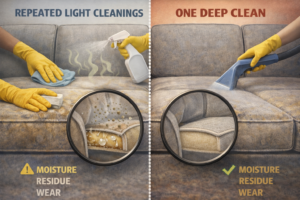
Why Repeated Light Cleaning Feels Safer
Light cleaning often feels controlled. A small amount of moisture, brief contact, and minimal disruption seem less risky than a single, more involved cleaning. This approach also spreads effort over time, which can feel easier to manage. It is understandable to believe that “less at once” means “less harm overall.”
Still, it can help to pause and question that assumption. A couch does not reset between cleanings. Each light cleaning adds to what is already inside the fabric and cushions, even if the surface looks fine afterward.
How Small Cleanings Add Up Over Time
Every cleaning introduces some combination of moisture, pressure, and residue. On its own, each instance may seem harmless. Over time, however, these inputs can accumulate. Repeated cleaning can gradually change how fabric absorbs and releases moisture. Moisture may not fully leave between cleanings, and residue can build up slowly rather than being removed.
Because the changes happen gradually, they are easy to miss. The couch may look acceptable after each cleaning, which reinforces the habit. Slowing down and considering the cumulative effect can prevent a pattern that quietly stresses the material.
Moisture Doesn’t Always Fully Reset
Light cleanings often rely on the idea that the couch dries completely between sessions. In reality, internal layers can retain small amounts of moisture longer than expected. Moisture inside couch cushions can remain even when the surface appears dry. When another cleaning happens before conditions fully stabilize, moisture can become layered rather than removed.
This does not always lead to obvious dampness. Instead, it can create a background level of moisture that affects odor, texture, or how the fabric responds later. Allowing more time between cleanings can reduce the chance of this overlap.
Friction and Fabric Fatigue
Repeated light cleanings also involve repeated contact with the fabric. Even gentle rubbing or blotting can stress fibers when it happens often. Repeated contact can slowly change fabric texture even without aggressive scrubbing. Over time, this can change how the fabric looks or feels, even if no single cleaning seemed aggressive.
Because fabric changes are gradual, it can be tempting to keep cleaning lightly to “fix” the surface. Pausing instead of repeating the cycle can help avoid compounding wear.
Residue Builds More Easily Than It Seems
Light cleanings sometimes remove surface dirt without fully removing what was introduced during cleaning. Residue from water, cleaning agents, or loosened debris can remain in small amounts. With repetition, these remnants can accumulate.
This buildup can make the couch feel stiff, attract more dirt, or contribute to lingering smells. Waiting rather than re-cleaning can give residue a chance to dissipate instead of being layered over.
One Thorough Cleaning Versus Many Small Ones
A single, more deliberate cleaning often allows moisture and residue to be managed in one cycle, rather than spread across many. While it may feel riskier upfront, it can reduce repeated disruption to the fabric and cushions. That said, even a deeper clean carries uncertainty.
The key difference is not “deep versus light,” but frequency versus recovery time. Allowing a couch to fully stabilize after any cleaning is often more important than how intense the cleaning felt.
When Repeated Light Cleaning Becomes Counterproductive
Repeated light cleaning can become counterproductive when it is used to chase minor changes—faint odors, slight discoloration, or texture differences that may resolve on their own. Each attempt to correct a small issue can introduce new stress.
It can be difficult to stop once a pattern forms. Accepting small imperfections for a while can sometimes preserve the couch better than constant adjustment.
When Stopping Is the Smarter Choice
If a couch has been cleaned multiple times in a short period, stopping can be the safer move. Giving the materials time to dry, release residue, and settle can prevent further change. Doing nothing for a while may feel uncomfortable, but it often avoids escalating the problem.
There is value in restraint. Letting the couch rest can reveal whether an issue is resolving on its own or truly needs attention.
FAQ
Are repeated light cleanings always harmful?
Not always, but they can become risky when they happen frequently without enough recovery time. Waiting reduces uncertainty.
Why does the couch seem to get worse despite gentle cleaning?
Cumulative moisture, residue, and friction can slowly change how the couch responds. These effects are often delayed.
Is one deep clean always better?
Not necessarily. The safer factor is allowing full drying and stabilization afterward, not the intensity alone.
How long should a couch rest between cleanings?
There is no universal answer. When in doubt, longer rest is usually safer than cleaning again too soon.