
When a couch stays damp longer than expected, the cleaning method often gets the blame. It is easy to focus on how much water was used or what technique was applied. However, indoor climate usually plays a larger role in how a couch dries than the cleaning itself. Understanding this can help explain why the same cleaning approach leads to very different results in different homes.
Why Cleaning Method Gets the Attention First
Cleaning is the most visible action in the process. Water is applied, fabric darkens, and the couch feels wet. Because of this clear cause-and-effect moment, it feels logical to assume that drying success depends mainly on how the couch was cleaned. This belief is reinforced when problems appear soon after cleaning.
Still, it can help to pause before drawing that conclusion. Cleaning happens once, while drying unfolds over hours or days under changing conditions. Slowing down to consider what happens after cleaning often reveals a different explanation.
Indoor Climate Is Constant, Cleaning Is Temporary
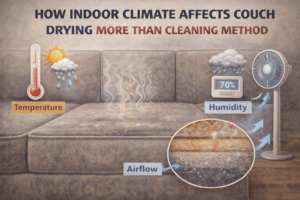
Cleaning introduces moisture, but indoor climate controls what happens to that moisture next. Temperature, humidity, and airflow continue influencing the couch long after cleaning is finished. Even a careful cleaning can lead to slow drying if the surrounding environment does not support moisture movement. Moisture inside couch cushions can remain long after cleaning is finished.
Unlike cleaning method, indoor climate does not switch off. It remains in place throughout the drying process. Accepting this can shift attention away from technique and toward conditions.
Temperature Shapes How Moisture Moves
Room temperature affects how quickly moisture can evaporate from a couch. Warmer air can hold more moisture, while cooler air can slow evaporation. However, temperature alone does not determine drying success. Sudden temperature changes can also alter how moisture behaves inside cushions.
Because temperature fluctuates naturally throughout the day and night, drying conditions are rarely stable. It is reasonable to assume that a couch may respond differently at different times, even without any further cleaning.
Humidity Often Matters More Than Expected
Humidity plays a major role in couch drying, even when it is not obvious. Air that already holds a lot of moisture has less capacity to accept more. Humidity levels directly affect how couch fabric and padding release moisture. In these conditions, moisture inside a couch may struggle to escape, regardless of how lightly it was cleaned.
Humidity can change quietly with weather, heating, cooling, or daily activities. Because it is harder to sense than temperature, it is often overlooked. Taking humidity into account can explain why drying seems inconsistent.
Airflow Is Not Just About Movement
Airflow helps carry moisture away, but not all airflow is equally useful. Airflow patterns strongly influence how moisture leaves a couch over time. Air that moves around a room may never pass through dense couch cushions. Some airflow patterns dry surfaces quickly while leaving internal layers unchanged.
It can be tempting to assume that any air movement is beneficial. Pausing to recognize the difference between surface airflow and internal airflow can prevent false confidence.
Why the Same Cleaning Dries Differently in Different Homes
Two identical couches cleaned the same way can dry very differently in separate homes. Differences in insulation, room size, heating habits, and outdoor conditions all affect indoor climate. These factors shape drying far more than minor variations in cleaning method.
Because these differences are built into the home, they are easy to forget. Accepting that drying is environment-dependent can reduce unnecessary changes to cleaning technique.
When Adjusting Cleaning Method Doesn’t Solve the Problem
When a couch dries slowly, it is common to clean less, use less water, or avoid certain methods. While this may reduce initial wetness, it does not change the underlying climate. As a result, drying issues may persist.
At this point, doing less can be wiser than constantly adjusting technique. Allowing the couch more time within stable conditions can be safer than repeated experimentation.
Why Patience Often Outperforms Precision
Precision in cleaning feels productive, but patience during drying is often more protective. Indoor climate works on its own schedule, and rushing against it can create uneven results. Waiting allows moisture to move gradually rather than being forced.
Choosing patience does not mean ignoring the couch. It means recognizing that drying is a process shaped by the environment, not just by what was done during cleaning.
FAQ
Does cleaning method matter at all?
Yes, but it usually matters less than indoor climate once cleaning is finished. Drying conditions often dominate the outcome.
Why does my couch dry faster sometimes than others?
Changes in temperature, humidity, and airflow can shift drying behavior even with the same cleaning approach.
Can a couch seem dry but still be affected by climate?
Yes. Surface dryness does not reflect internal moisture balance, which climate continues to influence.
Is it better to wait than to change cleaning methods repeatedly?
Often, yes. Allowing time within stable conditions can be safer than constant adjustments.