
When couch cushions stay damp longer than expected, the cleaning itself often gets the blame. In apartments, however, slower drying is frequently tied to the living environment rather than the cleaning method. Apartments create a set of conditions that can quietly slow how moisture leaves thick cushions. Understanding these conditions can help explain why drying feels delayed and uneven.
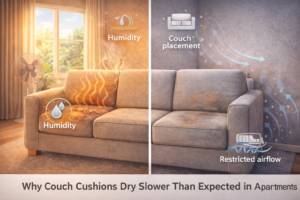
Why Apartment Drying Feels More Frustrating
Apartments are often smaller, more enclosed, and more controlled than detached homes. This can create an expectation that drying should be faster, not slower. When cushions remain heavy or cool to the touch, the result can feel surprising or even concerning.
It helps to pause before assuming something went wrong. Apartments behave differently from open houses, and those differences affect how moisture moves.
Limited Airflow in Enclosed Spaces
Airflow is one of the biggest factors in drying, and apartments often have less of it. Airflow patterns in enclosed spaces can slow how moisture leaves couch cushions. Windows may be smaller, fewer, or rarely opened. Hallways, interior rooms, and shared walls can restrict natural air movement.
When air does not circulate freely, moisture has fewer opportunities to escape from inside cushions. Even if the room feels comfortable, internal airflow may be minimal. Accepting that airflow is limited can make slower drying easier to understand.
Cushion Density Meets Apartment Conditions
Cushions are dense by design. They are built to compress and recover, which means they hold moisture more deeply than surface fabric. In apartments, where airflow and temperature shifts are often muted, this density becomes more noticeable.
Moisture inside cushions may have nowhere to go quickly. Moisture inside couch cushions often remains longer in dense materials. Instead of moving steadily outward, it can linger. Waiting longer than expected is often safer than assuming cushions should behave like thinner materials.
Stable Temperatures Can Slow Moisture Movement
Apartments often maintain fairly stable indoor temperatures. While this feels comfortable, it can slow drying. Moisture movement relies on change—temperature shifts that encourage evaporation and release. Indoor climate conditions often shape drying more than cleaning actions.
When temperatures remain constant, moisture may stall rather than migrate. This can make cushions feel “almost dry” for an extended period. Allowing time instead of trying to force change can reduce uneven results.
Humidity From Neighboring Units
In apartment buildings, indoor conditions are not fully isolated. Moisture from neighboring units, shared walls, and common systems can influence humidity levels. Even if one apartment feels dry, surrounding spaces may be contributing moisture indirectly.
This background humidity can limit how much moisture cushions are able to release. Because this influence is invisible, it is easy to underestimate. Slowing down expectations can prevent unnecessary adjustments.
Furniture Placement Limits Drying
Couches in apartments are often placed against walls or in corners to save space. This placement can restrict airflow behind and beneath cushions. Areas pressed against walls tend to dry more slowly than exposed surfaces.
Because furniture placement feels fixed, its impact is easy to overlook. Recognizing that placement affects drying can explain why certain cushions lag behind others.
Why Surface Dryness Is Misleading
In apartments, cushions may feel dry on the outside while still holding moisture inside. Stable temperatures and limited airflow can dry the surface quickly without resolving internal dampness. This mismatch can make drying feel stalled.
It is reasonable to trust how something feels, but it is also reasonable to doubt that feeling when cushions are involved. Waiting longer than surface cues suggest often avoids later issues.
When Repeated Adjustments Make Things Worse
When cushions dry slowly, it can be tempting to keep adjusting conditions—moving cushions, changing airflow, or re-cleaning. In apartments, these changes can introduce new imbalances without solving the underlying limits.
Doing less can be the safer option. Allowing cushions to dry at their own pace within stable conditions often prevents uneven moisture movement.
Accepting Apartment-Specific Drying Timelines
Apartments naturally create longer drying timelines for dense furniture. This does not mean something is wrong. It reflects the interaction between cushion structure and the environment.
Accepting that apartment drying is slower can reduce frustration and overcorrection. Patience often protects cushions better than active intervention.
FAQ
Is slow cushion drying normal in apartments?
Yes. Limited airflow, stable temperatures, and shared humidity make slower drying common.
Why do cushions feel dry but still seem heavy?
Surface dryness does not reflect internal moisture, which can linger longer in apartment conditions.
Should cushions be moved to speed drying?
Sometimes, but frequent movement can disrupt natural moisture release. Waiting is often safer.
Does slow drying mean damage is happening?
Not necessarily. Slow drying is common and often resolves with time rather than action.