
After a couch has been cleaned or exposed to moisture, there is often a moment when drying feels incomplete. The surface may be mostly dry, but something still feels off—coolness, heaviness, or a faint smell. At this point, many people try to “finish drying” the couch by taking extra action. They add heat, increase airflow, reposition cushions, or apply pressure to speed things along. This is a gray zone decision. It feels logical and responsible, yet it is one of the most common ways drying problems quietly get worse. Understanding why helps explain damage that develops despite good intentions.
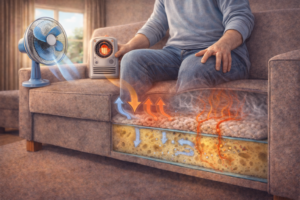
Why “Finishing Drying” Feels Necessary
Incomplete drying creates discomfort. Using a couch too soon often begins in the same uncertain stage where drying feels unfinished A couch that is almost dry but not quite feels unresolved. This discomfort pushes toward action. Doing something feels better than waiting, especially when there is no clear signal that waiting will help.
The problem is that this urge appears precisely when the couch is most sensitive. Internally, materials may still be adjusting, redistributing moisture, or slowly releasing it. Acting at this stage often interferes with those processes rather than helping them.
The Illusion of Control in Gray Zones
“Finishing drying” creates a sense of control. Turning on heat, aiming a fan, or pressing cushions feels like taking responsibility. These actions appear minor and safe because the couch already looks mostly dry.
In reality, this is a gray zone where cause and effect are unclear. The couch does not signal danger, but it also does not signal readiness. Acting in this space is not careless—it is based on incomplete feedback. That is why decision failures here are so common.
How Extra Heat Can Backfire
Adding heat is a frequent attempt to complete drying. Warmth seems like it should drive moisture out. On the surface, it often does. Fabric dries faster, reinforcing the belief that the action is working.
Internally, however, heat can make moisture more mobile rather than removing it. Instead of leaving the couch, moisture may spread to cooler or denser areas. This redistribution is invisible at first, which is why heat-related problems often appear later, not immediately.
Why More Airflow Is Not Always Better
Increasing airflow is another common tactic. Fans, open windows, or redirected vents feel harmless. Air is moving, so drying must be improving.
The issue is that airflow inside a room moves in paths, not evenly. Airflow patterns inside a room can redirect moisture instead of removing it. Strong airflow can pass over surfaces while bypassing internal cushion areas. It can also cool some zones while warming others, encouraging moisture to relocate rather than exit. When airflow is repeatedly adjusted, internal drying patterns become less stable, not more efficient.
Pressure and Manipulation Change Moisture Paths
Pressing cushions, flipping them, stacking them, or sitting briefly to “check” dryness all apply pressure. Pressure is not neutral when moisture is present. It changes where moisture goes.
These actions often push moisture deeper or sideways into areas that dry more slowly. Because the surface may already feel dry, the damage caused by pressure is not obvious at the time. The effect shows up later as uneven drying, odor, or texture changes.
Why Results Often Look Better Before They Get Worse
One reason “finishing drying” feels justified is that it often produces short-term improvement. The couch may feel drier, lighter, or warmer right after intervention. This reinforces the decision.
Long-term effects move on a different timeline. Moisture that was redistributed may take days or weeks to reveal itself. By then, the intervention feels distant and unrelated. This delay makes it difficult to connect action with outcome.
When Repeated Adjustments Compound the Problem
Drying rarely fails because of one action. It fails because of repeated small corrections. Each attempt to improve drying introduces new variables—pressure, heat changes, airflow shifts. Together, these interrupt the couch’s ability to reach internal balance.
At some point, the couch is no longer simply drying. It is responding to constant disturbance. In this state, doing less would have produced a better outcome than continued effort.
The Cost of Acting Without Clear Signals
The defining feature of this situation is uncertainty. There is no clear signal that action is needed, but also no clear signal that it is not. Acting feels proactive; waiting feels passive.
This is where decision failures occur. The cost of waiting feels immediate and annoying. The cost of acting feels theoretical. When consequences are delayed, the mind favors action—even when restraint would be safer.
Situations Where “Finishing Drying” Is Riskier
Trying to finish drying tends to cause more harm after deep cleaning, when cushions are thick or dense, or in spaces with limited airflow. In these cases, internal drying naturally takes longer, even if the surface dries quickly.
Because these factors are not always obvious, people apply the same finishing actions they would use in simpler situations. The mismatch between expectation and reality increases the chance of long-term issues.
Why Waiting Feels Wrong but Often Isn’t
Waiting after cleaning feels unproductive. The couch is there, mostly dry, and daily life wants to resume. Choosing not to act feels like neglect.
In reality, waiting is not inaction. It is allowing slow internal processes to complete without interference. In gray zones, restraint is often the most active form of protection.
Accepting That Some Damage Comes From Reasonable Choices
When “finishing drying” leads to damage, it is rarely due to ignorance or carelessness. It comes from reasonable decisions made without full visibility into internal conditions. Recognizing this reduces blame and improves future judgment.
Understanding that trying to help can sometimes hurt allows for more measured responses next time. In situations without clear signals, patience often outperforms effort.
FAQ
Why does the couch feel worse after I tried to dry it more?
Extra heat, airflow, or pressure can redistribute moisture internally rather than remove it.
Isn’t it better to do something than nothing?
Not always. When internal conditions are unstable, intervention can delay recovery.
How can I tell if drying just needs more time?
There is no clear indicator. When unsure, allowing more time usually carries less risk than acting.
Does this mean I should never adjust drying conditions?
No. It means repeated or forceful attempts to “finish” drying in uncertain stages often do more harm than good.