
Letting a couch “air out” often feels like the safest, least intrusive response after cleaning or noticing a mild odor. Windows are opened, cushions are left alone, and time is allowed to pass. This choice feels careful and patient. In many situations, however, this passive approach sits in a gray zone where harm can quietly increase instead of resolve. Understanding why “airing out” sometimes backfires helps explain problems that worsen despite good intentions.
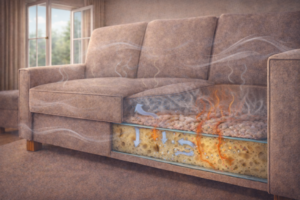
Why Airing Out Feels Like the Gentle Option
“Airing out” carries a sense of restraint. Nothing is forced, nothing is added, and no aggressive action is taken. Compared to scrubbing, heating, or re-cleaning, it feels respectful of the couch and the materials.
This sense of safety is powerful. When there are no clear warning signs, choosing not to intervene feels responsible. The problem is that passivity can still be a decision with consequences, especially when internal conditions are unstable.
The Assumption That Air Always Helps
Airing out is based on a simple idea: fresh air removes moisture and odors. While this is sometimes true at the surface, it does not describe how air actually behaves inside a room or inside a couch.
Air does not move evenly, and it does not automatically reach dense internal layers. Airflow patterns inside a room often leave furniture sitting in low-movement zones. Pausing to question whether air is actually interacting with the problem area can change how effective this approach really is.
How Passive Airflow Can Trap Moisture
In many homes, opening windows or leaving a room “to breathe” creates very little meaningful airflow. Air may exchange near openings while remaining still around furniture, especially in corners or against walls.
When a couch sits in these low-movement zones, moisture inside cushions may stay in place. Over time, this lingering moisture can become more concentrated rather than less. Doing nothing feels neutral, but it can quietly allow internal conditions to stagnate.
Why Odors Can Intensify While Airing Out
Odors are often assumed to fade with time and fresh air. In reality, odor-causing compounds can become more noticeable as moisture slowly redistributes or as temperature and humidity fluctuate. Seasonal changes often influence when couch odors become more noticeable.
A couch left to “air out” may go through cycles of warming, cooling, and humidity change. These cycles can activate odors that were previously dormant. Because no active step was taken, the worsening smell can feel confusing and unearned.
The False Security of Visible Dryness
Airing out often coincides with visible dryness. The couch looks fine, feels dry to the touch, and seems stable. This reinforces the belief that time is doing its job.
Internally, however, moisture can still be present and mobile. Surface cues are reassuring but incomplete. Trusting them too early can delay recognizing that the situation is not improving.
When Passivity Becomes a Form of Intervention
Choosing to do nothing is still a choice. While it avoids adding stress, it also avoids guiding conditions in a helpful direction. In some cases, passivity allows unfavorable factors—like high humidity, poor airflow, or temperature swings—to dominate.
This is where airing out crosses from patience into neglect of the system. Without intending to, the decision allows internal processes to move toward a worse outcome.
Why Timing Matters With Airing Out
Airing out is most likely to cause problems when done immediately after cleaning or during periods of slow drying. At these times, internal moisture is most sensitive to environmental influence.
Leaving the couch alone during this stage can allow moisture to settle deeper or spread internally. Waiting feels protective, but the timing makes the couch more vulnerable, not less.
The Quiet Escalation of Problems
One reason airing out is trusted is that problems often escalate quietly. There is no immediate failure. Instead, odors grow slightly stronger, cushions feel subtly different, or drying seems stalled.
Because these changes are gradual, they are easy to dismiss. By the time the issue is acknowledged, the period of passivity feels distant and disconnected from the result.
Why Airing Out Is Often Chosen Repeatedly
When airing out does not help, it is often repeated. More time is given. Windows are left open longer. Each extension feels reasonable because the approach is gentle.
This repetition can lock the couch into unfavorable conditions for an extended period. The longer internal imbalance persists, the harder it becomes to resolve without stronger intervention later.
Situations Where Airing Out Is Riskier
Letting a couch air out tends to be riskier in humid climates, small apartments, rooms with poor cross-ventilation, or after deep cleaning. In these settings, air exchange is limited and environmental swings are more pronounced.
Because these factors are not always obvious, airing out is applied universally. The mismatch between expectation and environment increases the chance of quiet worsening.
Why Doing Nothing Feels Right—Even When It Isn’t
Airing out aligns with a desire to avoid mistakes. It feels like the least risky option when information is incomplete. Acting feels like it could cause harm; waiting feels safe.
This is the core gray zone. The risk of passivity is hidden and delayed, while the risk of action feels immediate. Recognizing this bias helps explain why well-meaning choices sometimes lead to worse outcomes.
Accepting That Passive Choices Have Effects
Not all damage comes from doing too much. Some damage comes from doing nothing at the wrong time. Accepting this does not mean rushing to act, but it does mean questioning whether passivity is truly neutral.
Understanding when airing out helps and when it quietly harms allows for more balanced decisions. In uncertain situations, restraint should still be intentional, not automatic.
FAQ
Is airing out always bad for a couch?
No. In some conditions, it can help. The risk appears when airflow is limited or internal moisture is still unstable.
Why did the odor get worse even though I did nothing?
Environmental changes and internal moisture movement can intensify odors over time without new actions.
How can I tell if airing out is working?
There is often no clear signal. If conditions remain unchanged, time alone may not be helping.
Is it better to wait or intervene?
There is no universal answer. In gray zones, understanding the environment matters more than choosing action or inaction by default.