
When a couch has been exposed to moisture, it can feel dry on the surface long before it is fully dry inside. Questions about whether it is safe to sit too early often focus on surface dryness rather than what is happening deeper inside the couch. Sitting on it during this period often seems harmless, especially if nothing feels damp. Still, internal drying does not always follow the same timeline as surface drying, and everyday use can influence that process in subtle ways.
Before treating the couch as “back to normal,” it helps to slow down and consider how pressure and movement may affect what is happening below the fabric.
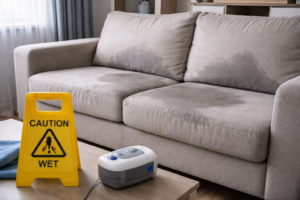
What to Do Immediately
The simplest response is often to reduce use rather than test it. Avoiding sitting, even briefly, limits pressure on the cushions and reduces changes inside layers that are still stabilizing. This can feel overly cautious, but doing less at this stage often preserves more options later.
If sitting cannot be avoided, choosing not to linger and avoiding the same spot repeatedly can reduce stress on the internal materials. It is reasonable to pause and reassess rather than assume that one short use means the couch is ready for normal activity.
A Careful Use Approach
Sitting affects more than the surface. Weight and body heat can compress padding and influence how moisture moves internally. This does not mean that every use causes harm, but it does mean that internal drying may slow or become uneven when the couch is used too soon.
A cautious approach focuses on minimizing interaction rather than correcting anything. Lighter, less frequent contact tends to interfere less than full use. If there is uncertainty, choosing to wait longer instead of pushing through discomfort or inconvenience is often the calmer option.
It is also helpful to notice changes after use. Odor changes after sitting are often discussed as early signals that internal conditions have not fully stabilized. If the couch smells stronger, feels warmer in certain areas, or seems different after sitting, that can be a sign to stop rather than continue experimenting.
Common Mistakes That Feel Logical
A common assumption is that sitting helps a couch “air out. This belief is especially common after fresh water spills, where the absence of visible dampness makes continued use feel harmless.” In practice, sitting usually adds pressure and warmth, not airflow. This can slow internal drying or shift moisture into areas that were previously less affected.
Another mistake is relying on how the fabric feels by hand. A dry surface can give a false sense of completion, even when internal layers are still adjusting. Returning to normal use too quickly often feels reasonable, yet it removes the chance to let the couch settle on its own. Small warning signs like mild odors are often easier to pause on early than to deal with once they become persistent.
It is understandable to want confirmation that everything is fine. Still, treating uncertainty as a reason to pause rather than a problem to solve can prevent unnecessary complications.
When This Approach Is Not Enough
If the couch continues to change after each use—such as developing stronger odors, uneven firmness, or recurring dampness—sitting is unlikely to help internal drying. At that point, continuing normal use may slow recovery rather than support it.
There are also situations where time and reduced use are the only realistic options. Trying to “finish” drying through use can create new patterns of moisture movement that are harder to reverse. Choosing to stop interacting and reassess later is often safer than pushing forward out of frustration.
Accepting that drying does not always follow a predictable schedule can be difficult, but forcing a timeline rarely improves outcomes.
FAQ
Does sitting always slow down internal drying?
Not always, but it can. Pressure and warmth from sitting can interfere with how moisture naturally dissipates inside a couch. When unsure, less use generally interferes less.
If the couch feels completely dry, does sitting matter?
Surface dryness does not reflect internal conditions. Sitting can still change️ffect deeper layers even when nothing feels damp. Pausing use is often the safer assumption.
Can occasional sitting cause long-term issues?
Occasional use may not cause visible problems, but repeated use during internal drying can create uneven results. Stopping early is usually easier than correcting changes later.
How do you know when sitting is a bad idea?
If the couch changes after use—such as stronger smells or altered feel—that is often a signal to stop. Listening to those early signs and slowing down can help avoid deeper issues.
Internal drying is not always visible or intuitive. When in doubt, choosing restraint over reassurance often gives the couch the best chance to stabilize without added stress.