
When a couch is in the process of drying, it can be tempting to treat nighttime use the same as daytime use. The couch may look unchanged, and the room may feel comfortable enough. Still, drying conditions often shift between day and night in ways that are easy to overlook. Discussions about whether sitting slows internal drying often focus on timing rather than how conditions change throughout the day.
Before assuming that timing does not matter, it helps to slow down and consider how nighttime conditions can subtly affect what is happening inside the couch.
What to Do Immediately
If a couch is still drying, limiting nighttime use is often the simplest and least disruptive choice. Nighttime typically brings reduced airflow and fewer environmental changes, which can affect how moisture behaves internally. Avoiding use during these hours can prevent added pressure when the couch is already adjusting.
It may feel unnecessary to leave the couch unused overnight, especially if it felt fine earlier. Still, choosing not to sit can be a deliberate pause rather than an overreaction.
A Careful Use Approach
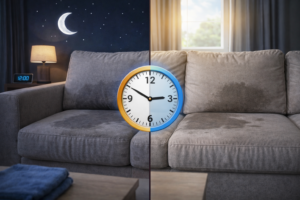
Using a couch during the day and at night does not always create the same conditions. During the day, rooms tend to experience more natural airflow, temperature variation, and incidental movement. At night, those factors often drop, even if the room feels comfortable.
A careful approach means recognizing that nighttime use can combine pressure from sitting with a more static environment. Repeated sitting under low-activity conditions can influence where remaining moisture settles inside the cushions. This combination may slow internal changes or make them less even. Reducing use at night, even if daytime use seems acceptable, can limit unnecessary interference.
If nighttime use cannot be avoided, keeping contact brief and avoiding repeated sitting in one spot can reduce stress on internal layers. Pausing use altogether is still a reasonable option when uncertainty remains.
Common Mistakes That Feel Logical
A common mistake is assuming that drying continues the same way around the clock. This assumption is especially common after fresh water spills, where the couch may seem fine by evening but still react differently overnight. In reality, nighttime conditions often differ enough to matter. Less airflow and more stable temperatures can allow moisture to linger where it might otherwise shift or dissipate.
Another mistake is treating nighttime use as harmless because it is quieter or less frequent. Even short periods of sitting can apply pressure when the couch has fewer opportunities to recover afterward. Wanting to relax at night is understandable, but comfort does not always align with what is safest for a drying couch.
Choosing restraint can feel inconvenient, yet it often preserves flexibility for the following day.
When This Approach Is Not Enough
If the couch feels different after nighttime use—such as developing stronger odors, feeling cooler or heavier in certain areas, or recovering more slowly—nighttime sitting may be interfering with internal drying. In those cases, continuing the same pattern is unlikely to help.
There are situations where the safest response is simply to stop nighttime use altogether and reassess later. Trying to balance convenience and caution at the same time can lead to mixed results. Accepting a temporary pause is often easier than addressing changes that appear after repeated nighttime use.
Letting the couch rest overnight without added pressure can sometimes be the least complicated choice.
FAQ
Is nighttime use always riskier than daytime use?
Not always, but it can be. Nighttime conditions often reduce airflow and recovery time, which can matter during drying. When unsure, avoiding nighttime use usually interferes less.
If the couch felt fine during the day, why would night be different?
Daytime environments often change more naturally. At night, conditions tend to stay stable, which can affect how moisture settles internally. Pausing use can help avoid that uncertainty.
Does short nighttime sitting make a difference?
It can. Even brief pressure applied when the couch has limited recovery afterward may influence internal layers. Choosing not to sit is often the simpler option.
How do you know nighttime use is a problem?
If changes appear after overnight use—such as odors or slower cushion recovery—that is often a signal to stop. Responding early by slowing down is usually easier than correcting issues later.
Drying does not always happen evenly or predictably. When timing is the variable, choosing to give the couch the night off can reduce unnecessary risk without requiring any active intervention.