
It is common for a couch to seem fine shortly after cleaning or moisture exposure, only to develop a stronger odor days later. This delayed reaction can feel confusing and frustrating, especially when the fabric feels dry and looks unchanged. The shift is not usually sudden; it is the result of processes that continue quietly after visible drying appears complete.
Understanding this pattern requires stepping back from the surface and looking at how couches behave as systems rather than simple fabrics. Slowing down expectations often makes these changes easier to interpret.
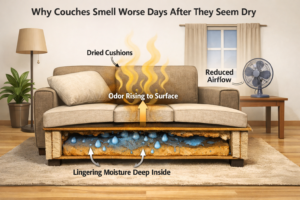
The Difference Between Surface Dry and System Dry
A couch can feel dry to the touch while still holding moisture internally. This is closely related to situations where fabric feels clean even though odor remains trapped below the surface. Fabric dries first because it is exposed to air, light, and movement. Internal layers—such as padding, foam, and structural materials—change more slowly.
When a couch is declared “dry” too early, it is often based on surface cues alone. Internally, moisture may still be redistributing, settling, or reacting with materials. Taking a pause instead of assuming completion can prevent surprise later.
It helps to accept that dryness is not a single moment but a gradual process that unfolds unevenly.
Why Odors Often Appear Later
Odors that show up days later are usually not new. Many delayed smells follow the same pattern seen when odors return days after a couch has been cleaned. They are often present earlier but muted. As internal moisture shifts, it can activate smells that were previously trapped or diluted.
In the first days after cleaning, airflow and evaporation can temporarily suppress odor intensity. Once that activity slows, remaining moisture may interact with residues, materials, or absorbed contaminants, making smells more noticeable. This delayed effect can feel misleading, but it follows a predictable pattern.
Rather than reacting immediately to the smell itself, it can be helpful to pause and consider what has changed in the system overall.
Internal Moisture Movement Over Time
Moisture inside a couch does not simply disappear. It moves. Gravity, pressure, temperature changes, and daily activity can cause moisture to migrate deeper or concentrate in certain areas.
As moisture settles, it can create localized conditions where odors become stronger. These changes often happen quietly, without visible signs. It is reasonable to feel caught off guard, but the delay itself is often the clue that internal drying was incomplete.
Allowing time without additional stress or use can sometimes reveal whether conditions are stabilizing or still shifting.
The Role of Reduced Airflow After Cleaning
Right after cleaning, airflow is often higher than usual. Windows may be open, fans running, and cushions repositioned. This environment can temporarily mask odors.
Once the room returns to normal, airflow decreases. That change can make lingering smells more noticeable, even if nothing else has changed. The couch did not suddenly get worse; the environment simply stopped compensating.
Recognizing this transition can help avoid the urge to take immediate corrective action that may not be necessary.
Common Misinterpretations That Add Confusion
One common assumption is that worsening odor means something new has gone wrong. In many cases, it means the earlier drying phase was incomplete rather than unsuccessful.
Another mistake is trying to “use the couch back to normal” to force the issue. Normal use often adds pressure and warmth, which can intensify odor release instead of resolving it. It can feel proactive, but it often increases variability rather than reducing it.
Pausing use, even briefly, can be more informative than trying to push through uncertainty.
Why Time Can Make Smells More Noticeable
Time allows internal conditions to reveal themselves. As moisture stabilizes, odors that were previously masked may become clearer. This does not always mean the situation is worsening; it may simply be becoming more apparent.
This stage can feel discouraging, especially after waiting patiently for drying. Still, reacting too quickly can interfere with the system’s ability to settle on its own. Allowing a bit more time before making decisions often leads to better clarity.
Doing less during this phase is sometimes the most controlled response available.
When Smells Signal Ongoing Internal Issues
Not all delayed odors resolve on their own. If smells continue to intensify, spread, or change in character over time, it can indicate that moisture is still active internally.
In those cases, continued normal use rarely improves the outcome. Choosing to reduce interaction and reassess later can prevent further disruption. It is reasonable to stop and acknowledge that the couch may need more time than expected.
Recognizing limits early often prevents frustration later.
Why This Pattern Is So Common
Couches are complex assemblies of materials, each responding differently to moisture. Cleaning addresses the surface, but the internal system follows its own timeline. Because these changes are mostly invisible, delayed odors are one of the few signals that something is still happening.
Understanding this can make the experience feel less like a failure and more like a natural part of post-cleaning reality. Adjusting expectations, rather than escalating action, is often the calmer choice.
FAQ
Why did the couch smell fine at first?
Early airflow and evaporation can suppress odors temporarily. As conditions normalize, lingering internal moisture may make smells more noticeable.
Does a delayed smell mean the couch wasn’t cleaned properly?
Not necessarily. It often means internal layers are still adjusting. This can happen even when surface cleaning was effective.
Should the couch be used to help the smell go away?
Use usually adds pressure and warmth, which can intensify odors. Pausing use often interferes less with internal stabilization.
How long should you wait before deciding something is wrong?
There is no fixed timeline. Watching whether odors stabilize, fade, or worsen over time can provide clearer signals than acting immediately.
Delayed couch odors can feel like a setback, but they are often part of a longer process rather than a sudden problem. When uncertainty appears days later, slowing down and observing often provides more useful information than reacting right away.