
After cleaning, drying, or everyday use, a couch can change in small ways. The cushions may feel slightly different, the fabric may relax unevenly, or a faint scent may linger without fully disappearing. These changes often feel like problems that should be fixed. The instinct is to correct, restore, or reverse them. In many gray-zone situations, however, accepting minor changes is safer than trying to force the couch back to a previous state. Understanding why restraint can be protective helps explain why some attempts to “fix” small issues create bigger ones.
Why Small Changes Trigger a Need to Act
Furniture is expected to be stable. When something shifts—even slightly—it creates discomfort. A couch that feels different than it did before draws attention, and attention invites action.
This reaction is understandable. Small changes feel like early warnings. The challenge is that not all changes indicate damage. Some are normal adjustments in materials responding to moisture, pressure, or time. Acting too quickly can interrupt a process that would otherwise settle on its own.
The Gray Zone Between Flaw and Adaptation
Minor couch changes often sit in an unclear space. They are noticeable but not severe. The couch is usable, but not identical to before. This ambiguity creates decision pressure.
Fighting these changes feels proactive. Accepting them can feel careless. In reality, this gray zone often favors patience. Pausing allows it to become clearer whether the change is stabilizing or worsening.
How Materials Naturally Set Over Time
Cushion materials, fabrics, and padding are not rigid systems. They compress, relax, and reshape with use and environmental exposure. After cleaning or moisture exposure, these materials may take time to settle into a new equilibrium.
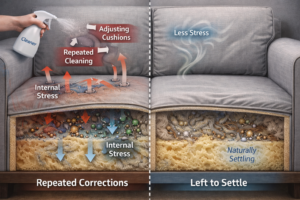
Trying to force them back—through repeated cleaning, aggressive drying, or constant adjustment—can prevent this settling. Allowing materials to finish adjusting often leads to better long-term stability than constant interference.
When Fighting Changes Adds Stress
Corrective actions often introduce new stress. Extra cleaning adds moisture. Attempts to neutralize small issues can sometimes lock problems in instead of resolving them. Repositioning cushions changes pressure patterns. Adding heat or airflow can move moisture unpredictably.
These efforts are meant to restore control, but they can compound internal disruption. Accepting a minor change avoids stacking interventions on top of an already adjusting system.
The False Promise of “Getting It Back to Normal”
There is comfort in the idea of returning a couch to its exact previous state. This expectation drives many corrective attempts. The problem is that “normal” is not always a fixed point.
Once materials have adjusted, forcing them backward may not be possible without cost. Accepting a slightly different feel or appearance can be safer than chasing a version of the couch that no longer exists.
Why Minor Imperfections Are Easier Than Major Fixes
Small changes that are accepted early often remain small. When they are fought, they can escalate. Repeated intervention increases the chance of moisture retention, odor binding, or material fatigue.
Choosing acceptance does not mean ignoring real problems. It means recognizing when the cost of intervention outweighs the benefit. Slowing down can prevent a minor imperfection from becoming a repair project.
The Role of Time in Clarifying Risk
Time is not always an enemy. In some cases, it is a diagnostic tool. Minor changes that stabilize or fade over time are often harmless adaptations. Waiting can help reveal whether small changes are stabilizing or quietly becoming locked in.
By contrast, changes that worsen despite acceptance provide clearer signals that action may be needed. Acting later with better information is often safer than acting early out of discomfort.
Why Acceptance Feels Like Giving Up
Accepting changes can feel emotionally difficult. It feels like settling or lowering standards. This emotional resistance drives people to “fix” things that may not need fixing.
Reframing acceptance as a protective choice rather than a passive one helps. Choosing not to intervene can be an intentional decision to reduce risk.
Situations Where Acceptance Is Usually Safer
Acceptance tends to be safer when changes are subtle, when there are no strong odors, when the couch is structurally sound, and when conditions are stable. In these cases, observation often does more good than action.
This does not apply when there are clear signs of worsening damage. The challenge is distinguishing between discomfort with change and evidence of harm.
When Fighting Changes Becomes a Pattern
Once corrective behavior starts, it often repeats. Normal use combined with repeated corrections can quietly increase stress on the couch. Each small change triggers another attempt to fix. Over time, the couch is subjected to ongoing stress without recovery periods.
Breaking this pattern requires tolerance for imperfection. Allowing the couch to exist in a slightly altered state can interrupt cycles that cause cumulative damage.
Accepting Change as Part of Ownership
Furniture changes with use. This is part of ownership, not failure. Expecting absolute consistency increases the likelihood of unnecessary intervention.
Accepting minor couch changes does not mean abandoning care. It means recognizing when care looks like restraint rather than action.
Understanding the Difference Between Care and Control
Care focuses on long-term condition. Control focuses on immediate appearance and feel. In gray zones, prioritizing care over control usually leads to better outcomes.
Letting go of control can feel risky, but it often reduces hidden stress on the couch. Doing less, intentionally, can be a form of maintenance.
FAQ
Does accepting changes mean ignoring problems?
No. It means monitoring without immediately intervening when changes are minor and stable.
How can I tell if a change is harmless?
Harmless changes tend to stabilize over time rather than escalate.
Is it okay if the couch never feels exactly the same?
Yes. Slight differences are often normal and not a sign of damage.
When should changes be addressed instead of accepted?
When they worsen, spread, or are accompanied by strong odors or structural issues.