
After cleaning a couch or dealing with lingering dampness, turning on the air conditioner can feel like a sensible way to control moisture. Air conditioning is often associated with drying and comfort, so it seems like a helpful step. However, cooling a room changes how moisture behaves inside thick furniture, sometimes in ways that are easy to overlook. Pausing before relying on air conditioning alone can reduce the risk of moisture staying where it is hardest to remove.
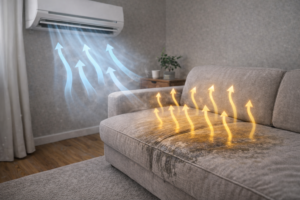
Why Air Conditioning Feels Like a Safe Drying Option
Air conditioners are designed to remove humidity from indoor air, which creates the impression that they naturally help things dry. When a room feels cooler and less sticky, it can seem like moisture problems are being solved. This makes using air conditioning after couch cleaning feel calm and controlled rather than risky. Still, it helps to slow down and remember that couches dry differently than open surfaces.
A couch is not just fabric exposed to air. It is a layered structure, and those layers do not respond to cooling in the same way the room does.
How Cooling Changes Moisture Movement Inside Cushions
Air conditioning lowers air temperature, which affects how moisture evaporates. Cooler air can slow evaporation at the surface of the couch, especially if airflow is gentle. When surface evaporation slows, moisture inside cushions may not move outward as expected. Instead, it can remain suspended within padding layers. Moisture inside couch cushions can stay much longer than surface dryness suggests.
Cooling can also create temperature differences between the couch interior and the surrounding air. These differences can encourage moisture to settle rather than escape. It is often safer to allow moisture to migrate gradually than to assume cooler air will pull it out.
The Role of Airflow Versus Temperature
Air conditioning often circulates air in a broad pattern rather than directly through couch cushions. While the room may feel evenly cooled, airflow near the couch surface can be limited. Without enough movement at the fabric level, internal moisture may have little incentive to leave. Airflow patterns often matter more than room temperature when it comes to drying couches.
It can be tempting to adjust settings or wait for the room to feel “dry enough.” However, changing conditions repeatedly can make moisture behavior less predictable. Doing less and allowing steady conditions can sometimes be the safer approach.
Why Cushions Are Especially Vulnerable
Cushions are thicker and denser than outer fabric layers. They absorb moisture more deeply and release it more slowly. Cushion construction plays a major role in how moisture is retained and released. When air conditioning cools the surface quickly, cushions may stay damp internally even as the couch feels comfortable to use. This mismatch between comfort and dryness is easy to misread.
Because cushion construction is not visible, it is reasonable to assume moisture may still be present longer than expected. Waiting rather than relying on comfort cues can prevent later issues.
When Air Conditioning Can Make Things Worse
Air conditioning can be more problematic when cushions are already damp, airflow is indirect, or the system runs continuously at low temperatures. In these situations, moisture can become stable rather than mobile. Odors or subtle changes may appear later, long after the couch seemed fine.
Choosing not to rely solely on air conditioning can feel passive, but it often avoids locking moisture into hidden areas.
FAQ
Does air conditioning always trap moisture in couches?
Not always, but there is no clear way to tell when it helps versus when it slows drying. Caution reduces uncertainty.
Why does the couch feel dry but still smell later?
Comfortable temperature does not mean internal dryness. Moisture can remain inside cushions even when the surface feels normal.
Is stronger cooling better than mild cooling?
Lower temperatures change moisture behavior further. Assuming stronger cooling is safer can lead to uneven results.
Is it okay to wait without adjusting anything?
Yes. Allowing time for moisture to move naturally is often safer than trying to manage it actively.