
When a couch stays damp or develops odors after cleaning, airflow is often mentioned as a solution. “More air” sounds simple, but airflow inside real rooms is rarely even or straightforward. Air moves in patterns shaped by walls, furniture, vents, and temperature differences. These patterns strongly influence how moisture behaves inside a couch. Slowing down to understand airflow as a system, rather than a single action, can clarify why moisture lingers in some areas and not others.
Why Airflow Is Often Oversimplified
Airflow is commonly thought of as movement you can feel—air from a fan, an open window, or a vent. When air is moving, it feels like drying should be happening. This makes it easy to assume that any airflow is helpful airflow. Airflow affects couch drying and odor behavior in more complex ways than it appears. Still, it is worth pausing before accepting that assumption.
A couch is not a flat surface. It is a layered object sitting within a complex room environment. Air can move around a couch without meaningfully interacting with the areas where moisture is trapped. Recognizing this difference helps explain why visible airflow does not always produce expected results.
Air Moves in Paths, Not Evenly
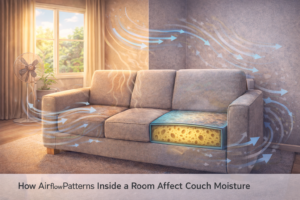
Inside a room, air tends to follow paths of least resistance. It moves around obstacles, along ceilings, and across open spaces. Corners, low areas, and spaces behind furniture often receive far less movement. A couch placed against a wall or in a corner may sit partly outside the main airflow paths.
This means moisture may escape quickly from exposed areas while remaining trapped in sheltered zones. It can be tempting to assume the whole couch is drying because part of it is. Taking time to consider where air actually travels can prevent that false sense of completion.
Surface Airflow Versus Cushion Airflow
Airflow that passes over the surface of a couch does not automatically reach inside the cushions. Cushions are dense and designed to resist air movement. Even strong airflow in the room may barely penetrate beyond the fabric layer.
This creates a common mismatch: the couch feels dry to the touch, but internal moisture remains. Moisture inside couch cushions often remains long after surface dryness is felt. Slowing down and separating surface conditions from internal conditions can reduce confusion about why drying feels incomplete.
How Furniture Placement Shapes Airflow
Where a couch sits in a room has a major effect on airflow. Furniture placed close to walls, under windows, or near large objects can block or redirect air movement. Even small changes in placement can create pockets of still air around certain cushions.
Because furniture placement feels permanent and familiar, its influence is easy to overlook. Pausing to acknowledge that placement shapes airflow can explain why one side of a couch dries differently from another.
Heating and Cooling Change Airflow Patterns
Heating and cooling systems constantly alter airflow patterns. Warm air rises, cool air sinks, and vents push air in specific directions. As systems cycle on and off, airflow paths shift subtly throughout the day. Heating cycles can subtly alter airflow paths and moisture movement inside furniture.
These shifts can move moisture around rather than remove it. A cushion may dry during one part of the cycle and stall during another. Recognizing that airflow is dynamic—not fixed—can make uneven drying feel more predictable.
Why Strong Airflow Can Still Miss Moisture
Even strong airflow can bypass the areas where moisture is most concentrated. Air may rush across open parts of the room while barely interacting with compressed cushions or areas pressed against the couch frame. In these cases, adding more airflow does not solve the problem.
It can feel counterintuitive to slow down when airflow seems insufficient. Still, accepting that more force is not always more effective can prevent repeated adjustments that do little to help.
Airflow Can Redistribute Moisture
Airflow does not only remove moisture; it can also redistribute it. Moving air can cool certain areas faster than others or push moisture toward less ventilated zones. Over time, this can concentrate moisture in specific parts of the couch.
Because this redistribution is subtle, it often goes unnoticed until odors or texture changes appear later. Waiting rather than constantly redirecting airflow can allow moisture to leave more evenly.
Why One Fan or Window Rarely Fixes Everything
Using a fan or opening a window often targets a single airflow direction. While this can help some areas, it may leave others unaffected. In some cases, it creates competing airflow paths that cancel each other out.
It is understandable to try different airflow setups. However, frequent changes can make moisture behavior harder to predict. Allowing conditions to remain stable for longer periods often produces clearer results.
When Doing Less Helps More
Airflow works over time, not instantly. Giving moisture time to respond to consistent conditions is often safer than trying to manage every detail. Overcorrecting airflow can interrupt natural drying patterns inside cushions.
Choosing to do less does not mean ignoring the problem. It means allowing airflow patterns to work gradually rather than forcing quick results that may only affect the surface.
Accepting Airflow as Part of a Larger System
Airflow is only one part of the environment influencing couch moisture. Temperature, humidity, cushion structure, and placement all interact with it. Treating airflow as a standalone solution can lead to frustration.
Seeing airflow as part of a larger system encourages patience and restraint. When moisture behavior is viewed systemically, uneven or slow drying becomes easier to understand and less alarming.
FAQ
Does more airflow always mean faster drying?
Not necessarily. Airflow must reach the right areas to be effective. More movement does not guarantee better results.
Why does one side of the couch dry faster than the other?
Airflow paths, furniture placement, and room layout can create uneven exposure across the couch.
Can airflow make moisture move instead of disappear?
Yes. Airflow can redistribute moisture, especially when conditions change frequently.
Is it better to leave airflow consistent rather than adjusting it often?
Often, yes. Stable conditions give moisture time to move out naturally without being redirected.