
Appliance problems are often treated as isolated events. A machine behaves oddly, performance drops, or a symptom appears, and attention turns directly to that appliance. In many cases, this approach is reasonable. However, there are situations where focusing only on the appliance narrows understanding too much. It is often worth slowing down here, because some appliance issues are shaped as much by the home environment as by the appliance itself.
This article examines cases where appliance symptoms point beyond the machine and into broader home systems. Comparing these possibilities helps explain why some problems persist despite attention to the appliance alone.
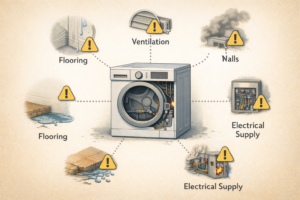
Why Appliance-Centered Thinking Feels Natural
Appliances are discrete objects with clear functions. When something goes wrong, it feels logical to assume the cause is contained within the machine. This assumption reflects situations where a washing machine problem isn’t the washer at all, but another system influencing behavior. This framing simplifies decisions and limits the scope of concern.
The appliance is also the most visible and accessible element. Surrounding systems—floors, walls, ventilation, plumbing, or electrical supply—fade into the background. Pausing to question whether the appliance is the whole story can prevent early conclusions from becoming fixed.
What is most visible often receives the most blame.
How Home Systems Influence Appliance Behavior
Appliances do not operate independently. They rely on stable flooring, consistent power, proper drainage, airflow, and surrounding materials. When these systems change, appliance behavior can change with them. This broader influence becomes clearer when appliance problems begin impacting indoor air quality rather than remaining isolated.
A symptom that looks mechanical may be a response to shifting conditions around the appliance. Slowing down to consider these dependencies can reveal influences that are easy to overlook when attention stays narrowly focused.
The appliance reacts to its environment as much as it drives it.
When Symptoms Don’t Match Typical Appliance Patterns
One signal that a broader assessment may be needed is when symptoms behave inconsistently. Problems that appear, disappear, or change form without a clear pattern often resist appliance-only explanations. This resistance is common when waiting too long changes the nature of appliance problems and blurs cause and effect.
These irregularities may reflect fluctuating conditions elsewhere in the home. Pausing to compare symptom timing with environmental factors can help identify whether the appliance is responding rather than failing.
Inconsistency is often a clue, not a complication.
Comparing Internal Faults to External Influences
Internal appliance faults tend to progress in recognizable ways. Performance usually degrades steadily, noises repeat predictably, and behavior aligns with specific functions.
External influences often produce more diffuse effects. The appliance may function normally under some conditions and struggle under others. Slowing down to compare these patterns can help distinguish between an internal failure and a broader system interaction.
Patterns reveal more than individual events.
Why Appliance Repairs Sometimes Don’t Resolve the Issue
When repairs address only the appliance, symptoms may change without disappearing. A part is replaced, and performance improves briefly, but the problem returns in a different form.
This can be frustrating and confusing. Pausing to consider whether the repair interacted with an unresolved external condition can explain why the issue persists despite effort.
Fixes that don’t stabilize behavior often point outward.
How Environmental Changes Go Unnoticed
Homes change gradually. Floors settle, ventilation patterns shift, moisture accumulates, and usage habits evolve. These changes rarely announce themselves clearly.
Because they are slow and distributed, they are easy to miss. Slowing down to consider what has changed in the home—not just in the appliance—can broaden understanding of current behavior.
Gradual change often hides in plain sight.
When Multiple Appliances Show Related Symptoms
Another indicator of a broader issue is when more than one appliance shows similar or related problems. While coincidence is possible, shared symptoms may reflect shared conditions.
Pausing to notice connections across appliances can help shift perspective from isolated failure to system-level influence.
One problem may be a signal; several may be a pattern.
Why Broader Assessment Feels Overwhelming
Expanding focus beyond a single appliance can feel daunting. The scope becomes less defined, and clear answers feel harder to reach. This discomfort often pushes attention back toward the appliance alone.
Recognizing this reaction can help manage it. Slowing down does not require solving everything at once. It only requires acknowledging that the situation may be larger than initially assumed.
Uncertainty grows with scope, but so does accuracy.
When Doing Less Preserves Clarity
In some cases, repeatedly adjusting or repairing an appliance can obscure the broader picture. Each change alters conditions slightly, making patterns harder to see.
Pausing active intervention can preserve information about how the appliance behaves within the home environment. Doing less for a time can support clearer assessment.
Restraint can protect insight.
Why These Situations Are Often Misdiagnosed
Misdiagnosis occurs not because of negligence, but because appliance-only explanations are simpler and more familiar. Broader assessments require stepping outside the object that seems to be failing.
Slowing down to compare appliance faults with home-level influences can reduce the risk of chasing the wrong cause.
Misdiagnosis often reflects narrowed framing, not lack of effort.
FAQ
When should appliance problems be viewed in a broader context?
When symptoms are inconsistent, recurring, or resistant to direct fixes. Pausing to widen perspective can help.
Does this mean the appliance isn’t at fault at all?
Not necessarily. The appliance may still be affected, but not as the sole cause. Slowing down helps clarify roles.
Why is it hard to notice home-level influences?
Because they change gradually and lack clear boundaries. Awareness grows with comparison over time.
What’s the safest response when unsure?
Restraint and observation. Doing less while reassessing the scope can prevent compounding misunderstanding.