
Appliance problems are often explained away as normal aging. A change in sound, performance, or efficiency may be attributed to “wear and tear” without much hesitation. This explanation feels reasonable, especially for older appliances. It is often worth slowing down here, because labeling an issue as natural wear can quietly close off further understanding.
This article explores why wear-and-tear explanations are so common, and why they often miss the real cause of appliance problems. Understanding this tendency can help prevent assumptions that simplify decisions while overlooking important signals.
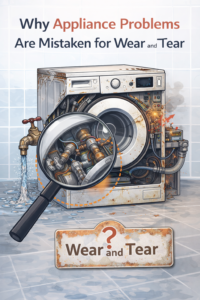
Why Wear and Tear Feels Like the Safest Explanation
Wear and tear is familiar and non-threatening. It suggests gradual decline rather than a specific failure. Because it does not point to a clear action, it can feel emotionally easier to accept.
This explanation also aligns with expectations. Appliances are known to age, so changes seem inevitable rather than noteworthy. Pausing before accepting this narrative can help distinguish between expected aging and something more specific unfolding.
A familiar explanation is not always an accurate one.
How Gradual Changes Mask Specific Problems
Many appliance issues develop slowly. Minor inefficiencies, small leaks, or subtle noises can emerge without a clear starting point. This gradual onset makes it harder to identify a distinct cause.
Because wear and tear also implies gradual change, it becomes a convenient umbrella explanation. Slowing down to ask what exactly changed, rather than how old the appliance is, can reveal more useful information.
Gradual does not automatically mean general.
Why Age Becomes a Stand-In for Diagnosis
Once an appliance reaches a certain age, age itself often becomes the diagnosis. This mindset ignores the fact that appliance damage rarely stays at the same severity level as conditions continue to shift. New symptoms are interpreted through that lens, even if they are unrelated to normal aging.
This shortcut reduces the need for closer observation. While understandable, it can obscure issues that would be treated differently if they appeared earlier in the appliance’s life. Pausing to separate age from behavior can prevent misattribution.
Age explains context, not cause.
How Inconsistent Behavior Gets Labeled as Wear
Wear and tear is often assumed to be consistent and predictable. In practice, many issues labeled this way behave inconsistently—appearing, disappearing, or changing form.
These inconsistencies are sometimes dismissed as quirks of an aging appliance. Slowing down to notice variability can be important, because true wear tends to be steadier than sudden shifts.
Unpredictability is a clue, not a distraction.
Why “Still Works” Reinforces the Misdiagnosis
As long as an appliance continues to operate, problems are often minimized. This reaction mirrors situations where fixing the symptom makes the real appliance problem worse by masking deeper issues. If it still completes cycles or turns on, wear and tear feels like an adequate explanation.
This mindset can delay recognition that internal conditions have changed. Pausing to consider how the appliance works, not just whether it works, can provide a clearer picture.
Functionality does not equal stability.
How Normalization Reduces Attention
Repeated exposure to small issues can normalize them. What once felt unusual begins to feel expected. Over time, this normalization supports the wear-and-tear narrative.
When attention drops, patterns become harder to spot. Slowing down periodically to reassess what has become “normal” can help reset perspective.
Familiar problems still deserve scrutiny.
Why Wear and Tear Explains Too Much
One reason wear and tear is overused is that it can explain almost anything. Noise, leaks, inefficiency, and delays all fit under the same label.
Because it is so broad, it rarely prompts deeper questions. Pausing to narrow the explanation—to identify which parts or interactions might be involved—can reveal whether wear is truly the driver.
Broad explanations hide specific causes.
How Misdiagnosis Changes Decisions
Once an issue is labeled as wear and tear, decisions shift. Repairs may seem pointless, continued use may feel justified, or replacement may feel inevitable.
These decisions can be reasonable, but they are still based on an assumption. Slowing down before locking into that assumption can keep options open longer.
A label shapes the choices that follow.
When Wear and Tear Is Part of the Story, Not All of It
Wear does play a role in many appliance problems. Components fatigue, materials degrade, and tolerances change. The issue arises when wear is treated as the whole explanation rather than one factor.
Recognizing this distinction can refine responses. Pausing to ask what wear has made possible, rather than what wear alone has caused, can shift understanding.
Wear creates conditions; it does not explain every outcome.
When Reassessment Becomes Important
If an appliance’s behavior changes faster than expected, or in ways that don’t align with gradual decline, reassessment matters. Continuing to rely on a wear-and-tear explanation in these moments can increase risk.
Reassessment does not require immediate action. It can simply involve slowing down and acknowledging that the situation may be different than first assumed.
Changing behavior deserves renewed attention.
FAQ
Why is wear and tear such a common explanation for appliance problems?
Because it fits expectations and reduces uncertainty. Pausing to look beyond familiarity can reveal more specific causes.
Are older appliances more likely to have wear-related issues?
Yes, but age alone does not explain all problems. Slowing down to examine behavior can clarify the role age is actually playing.
Can wear and tear hide more serious issues?
It can. Broad explanations sometimes delay recognition of specific failures. Hesitation before settling on a label can help.
When should wear and tear be questioned?
When problems change quickly, behave inconsistently, or affect multiple functions. In those moments, doing less and reassessing can be the safer response.