
Appliance problems are usually treated as contained events. A machine behaves unexpectedly, a repair is considered, and attention stays focused on restoring function. This approach works when the issue truly belongs to the appliance alone. It is often worth slowing down, however, when appliance problems begin to feel persistent, inconsistent, or oddly resistant to reasonable fixes, because in some cases the appliance is signaling a need for broader attention within the home.
This article explores the gray zone where appliance issues are no longer the root problem, but indicators of wider conditions that deserve consideration.
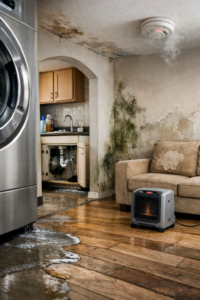
Why Appliances Are Often Treated as the Problem
Appliances are visible, discrete, and familiar. When something goes wrong, they provide a clear target for concern. This clarity is reassuring, because it suggests a specific task with a defined outcome.
This framing makes sense early on. Pausing becomes important when appliance-focused thinking continues even as symptoms no longer behave like typical appliance failures. What feels like persistence may actually be misplacement of focus.
Clear targets can hide wider context.
How Appliances Reflect Their Environment
Appliances do not operate in isolation. They rely on stable floors, consistent power, controlled moisture, and predictable airflow. Changes in these surrounding conditions can influence how an appliance behaves. This perspective aligns with situations where appliance issues require a broader home assessment rather than isolated troubleshooting.
When the home environment shifts, appliances may be among the first elements to show stress. Slowing down to consider whether the appliance is reacting rather than failing can help reframe the issue.
The appliance often responds before the home speaks clearly.
When Problems Appear Unrelated but Share a Pattern
A key signal that broader attention is needed is when appliance issues appear unrelated yet follow a pattern. Different machines may behave oddly, or the same appliance may show changing symptoms over time.
These patterns suggest that the underlying condition is not tied to a single component. Pausing to observe similarities rather than chasing individual fixes can reveal a shared influence.
Patterns point outward, not inward.
Why Fixes Feel Temporarily Effective
In gray zones, appliance repairs may appear to work at first. Symptoms quiet down, performance improves, and confidence returns. Over time, however, the issue resurfaces in a different form. This cycle reflects why isolated appliance fixes fail when damage has already spread beyond the original fault.
This cycle can indicate that repairs are adjusting to conditions rather than resolving them. Slowing down to question why fixes don’t hold can help identify when the appliance is compensating for something else.
Temporary relief is not the same as resolution.
How Environmental Stress Shows Up as Appliance Trouble
Environmental stresses such as moisture imbalance, structural movement, or inconsistent utilities often show up indirectly. Appliances, with their precision and sensitivity, may react before damage is obvious elsewhere. This reaction is common when appliance damage becomes a structural concern rather than a simple repair task.
This reaction can feel like malfunction when it is actually feedback. Pausing to interpret appliance trouble as information rather than failure can prevent misdirected effort.
Sensitive systems signal early.
Why Attention Often Stays Narrow Too Long
Once effort is invested in appliance repair, it becomes harder to shift perspective. Time, cost, and expectations reinforce the idea that the solution must still lie within the machine.
This commitment can delay recognition that the problem category has changed. Slowing down to allow reassessment—even when previous steps felt reasonable—can reduce the risk of escalation.
Momentum resists reframing.
When Appliance Behavior Becomes Inconsistent
Inconsistent behavior is another signal that broader attention may be needed. An appliance may work well under some conditions and poorly under others, without a clear mechanical explanation.
These fluctuations often reflect external influences rather than internal defects. Pausing to notice what changes when behavior changes can point beyond the appliance itself.
Inconsistency often originates outside the machine.
Why Broader Attention Feels Riskier
Shifting focus from a specific appliance to the home as a whole can feel overwhelming. Broader issues are less defined, harder to diagnose, and more uncertain.
This discomfort can keep attention locked on the appliance longer than appropriate. Slowing down to accept uncertainty as part of the process can make broader assessment feel more manageable.
Uncertainty is not failure; it is information.
When Doing Less Creates Clarity
In situations where appliance problems feel confusing, doing less can be revealing. Continued adjustments and repairs can mask patterns and alter conditions.
Pausing appliance use or delaying further fixes can preserve how the system behaves naturally. This restraint can provide clearer insight into whether the appliance is the problem or the messenger.
Less action can mean more understanding.
Why These Signals Are Easy to Miss
Appliance signals are easy to miss because they arrive in familiar forms: noises, leaks, errors, or inefficiencies. These feel routine and solvable.
Recognizing when these familiar signs are pointing to something unfamiliar requires slowing down and widening attention. Without that pause, signals are often treated as noise rather than information.
Familiar symptoms can carry unfamiliar meaning.
When the Appliance Is a Symptom, Not the Cause
The most important shift occurs when the appliance is understood as a symptom of broader conditions. This does not eliminate the appliance issue, but it changes its role in decision-making.
Slowing down to make this distinction can prevent repeated cycles of repair without progress. It allows the appliance problem to be seen in proportion to the larger system it reflects.
Symptoms communicate, even when they confuse.
FAQ
How can appliance problems indicate broader home issues?
Because appliances respond to environmental conditions. Pausing to consider these influences can reveal wider causes.
Does this mean appliance repairs are useless?
No. Repairs may still be necessary. The issue arises when repairs are treated as complete solutions despite recurring patterns.
Why do problems feel inconsistent in these cases?
Because external conditions fluctuate. Slowing down to observe context helps explain variation.
What’s the safest response when unsure?
Restraint and reassessment. Doing less while observing can prevent misdirected effort and clarify whether broader attention is needed.