
Appliance problems are usually noticed through performance changes. A cycle takes longer, a unit runs louder, or moisture appears where it shouldn’t. Air quality is rarely the first concern. It is often worth slowing down here, because some appliance issues quietly affect indoor air long before the connection feels obvious.
This article focuses on the gray zone where appliance problems begin influencing the air inside a home. These situations are rarely clear-cut. The appliance may still function, and the air may not seem dramatically different, yet subtle changes are already underway.
Why Air Quality Is Often Overlooked
Indoor air is invisible and gradual. Unlike a leak or a shutdown, changes in air quality do not announce themselves clearly. When an appliance problem arises, attention stays on what the appliance is doing wrong, not on how the surrounding environment is responding.
Because air quality changes are often slow and diffuse, they are easy to rationalize away. Pausing to consider air as part of the system can help widen understanding beyond the appliance itself.
What cannot be seen is often assumed to be unaffected.
How Moisture-Related Appliance Issues Affect Air
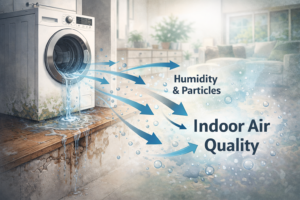
Many appliance problems involve moisture, even when water is not visibly present. Slow leaks, condensation, or trapped humidity can alter nearby materials. As moisture lingers, it can change how air moves and what it carries.
Damp materials may release odors, particles, or humidity back into the air. These changes are subtle at first and often attributed to general indoor conditions. Slowing down to connect moisture patterns with air changes can help reveal the link.
Air reflects what surrounding materials absorb and release.
Why “Still Working” Can Be Misleading
An appliance that still operates can create false reassurance. If cycles complete and controls respond, it feels reasonable to assume broader conditions remain safe.
However, air quality impacts do not require full appliance failure. An appliance can function while quietly altering humidity levels, airflow patterns, or material conditions nearby. Pausing before equating operation with containment can reduce blind spots.
Functionality does not guarantee neutrality.
How Small Changes Accumulate Indoors
Indoor air is shaped by repetition. A small moisture release, a minor airflow disruption, or a slight temperature shift may not matter once. Over time, repetition changes baseline conditions. These gradual shifts are similar to how repeated appliance moisture leads to hidden structural issues before they become obvious.
As these shifts accumulate, air quality can drift away from normal without a clear turning point. Slowing down to notice trends rather than events can make these changes easier to recognize.
Gradual change rarely triggers immediate concern.
Why Symptoms Often Feel Indirect
When air quality is affected, symptoms are often nonspecific. Stale odors, increased dust, or a persistent sense that the space feels “off” are common descriptions. These experiences rarely point directly to an appliance.
Because the symptoms are indirect, they are often attributed to weather, occupancy, or routine indoor variation. Pausing to question why changes align with appliance behavior can help bridge that gap.
Indirect effects are easy to dismiss, but they still matter.
How Appliance Location Influences Air Impact
Where an appliance sits plays a significant role. Appliances tucked into tight spaces, closets, or corners can trap moisture and restrict airflow. In these conditions, air quality impacts tend to concentrate and persist.
Limited ventilation allows changes to linger rather than dissipate. Slowing down to consider location can explain why some appliance issues affect air more than others.
Air problems often follow confinement, not severity.
When Air Quality Issues Lag Behind the Appliance Problem
In many cases, air quality changes appear after the appliance issue seems stable. The initial problem may feel resolved or at least unchanged, while the surrounding environment continues to respond.
This delay can break the perceived connection between cause and effect. Pausing to account for lag helps explain why air issues often feel separate or unrelated.
Timing differences obscure relationships.
Why Quick Fixes Can Shift the Risk
Addressing the most obvious appliance symptom can reduce visibility without reducing impact. A noise stops or moisture seems controlled, but underlying conditions may persist.
When symptoms are quieted, attention often drops. This mirrors situations where fixing the symptom makes the real appliance problem worse by masking ongoing conditions. Meanwhile, air quality effects may continue or even intensify. Slowing down after an apparent fix can help reassess whether conditions truly normalized.
Silence does not always mean resolution.
When Doing Less Can Be the Safer Choice
If air quality concerns emerge alongside appliance issues, the urge to act quickly is strong. However, acting without understanding the connection can lead to repeated adjustments that obscure the pattern.
Pausing to observe how air conditions respond over time can preserve clarity. Doing less for a moment can prevent decisions based on incomplete signals.
Restraint can protect awareness.
Why These Situations Sit in a Gray Zone
Appliance-related air quality impacts rarely offer clear thresholds. The space may remain usable, and the appliance may not appear dangerous. Yet something has shifted.
These gray zones are difficult because neither ignoring nor reacting aggressively feels right. Slowing down allows space to reassess without forcing a premature conclusion.
Gray zones exist because certainty is delayed.
FAQ
How can an appliance affect indoor air quality without obvious failure?
Through moisture, airflow changes, or gradual environmental shifts. Pausing to consider indirect effects helps clarify this connection.
Why do air quality symptoms feel so vague?
Because they develop slowly and affect the whole space. Slowing down expectations for clear signals can reduce confusion.
Is it always dangerous when appliances affect air quality?
Not always. The risk depends on duration and conditions. Restraint and observation can help determine significance.
What’s the biggest mistake in these situations?
Assuming the appliance and the air are separate systems. When uncertainty appears, doing less and reassessing can prevent escalation.