
When a couch is damaged, attention usually turns to the spill or accident that happened on it. What was spilled, how much, and how quickly it was cleaned tend to dominate the explanation. While those details matter, they often do not tell the full story. In many cases, the room the couch sits in has more influence on long-term damage than the spill itself. Slowing down to consider the environment can change how the situation is understood.
Why the Spill Gets Blamed First
Spills are visible, sudden, and easy to remember. A drink tips over, fabric darkens, and the connection between cause and effect feels obvious. Because the spill is the moment everything changed, it naturally becomes the focus of concern. It can feel reasonable to assume that without the spill, no damage would have occurred.
However, a spill is a brief event, while a room is a constant condition. Pausing to separate what happened in a moment from what happens over time can reveal a different source of the problem.
The Room Controls What Happens After the Spill
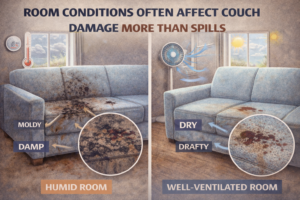
Once a spill occurs, the room takes over. Temperature, humidity, and airflow determine how moisture behaves after the initial accident. Two identical spills on identical couches can lead to very different outcomes depending on where those couches are located. Indoor climate often plays a larger role in drying outcomes than the spill itself. It can help to slow down and recognize that the spill starts the process, but the room shapes the result.
If moisture lingers, spreads, or settles unevenly, it is often because the room allows or encourages that behavior. The spill alone rarely explains why damage develops days or weeks later.
Humidity Turns Small Spills Into Bigger Problems
Humidity plays a quiet but powerful role in couch damage. In a room with higher humidity, moisture from a spill has less opportunity to escape. Humidity levels directly affect how couch fabric and padding retain moisture. Even a small amount of liquid can remain present longer than expected. Over time, this lingering moisture can affect padding, structure, or odor.
Because humidity is often invisible, it is easy to underestimate. Taking a moment to consider whether the room tends to feel damp or heavy can explain why a minor spill caused more trouble than expected.
Temperature Changes Affect Drying and Stress
Room temperature influences how materials respond after a spill. Warmer conditions can speed surface drying, while cooler conditions can slow evaporation. Rapid temperature changes can also cause uneven drying, where the surface behaves differently than deeper layers.
These effects are gradual and easy to miss. It can feel like the couch is fine once it looks dry, even though internal materials are still adjusting. Waiting longer before assuming recovery is complete can reduce misinterpretation.
Airflow Shapes Where Moisture Goes
Airflow does more than help things dry. Airflow patterns influence where moisture settles inside a couch. It also directs where moisture moves. In some rooms, air circulates across surfaces but barely reaches cushions or crevices. In others, drafts may cool certain areas while leaving others untouched.
This uneven airflow can cause moisture to settle in specific spots, leading to localized damage. Pausing to notice how air actually moves in the room, rather than assuming it moves evenly, can clarify why damage appears in certain areas.
Room Layout and Furniture Placement Matter
The position of a couch within a room also affects outcomes. Couches placed against exterior walls, near windows, or in corners may experience different temperatures and airflow than those in open areas. These micro-environments can influence drying and moisture retention.
Because furniture placement feels static and familiar, its impact is easy to overlook. Taking a step back to reconsider where the couch sits can explain why one area shows damage while another does not.
Why Similar Spills Lead to Different Results
People are often confused when one spill causes damage while another does not. The difference is frequently the room at the time of the spill. Seasonal changes, weather conditions, heating or cooling cycles, and daily activities all alter the indoor environment.
This variability means that the same spill can have different consequences on different days. Accepting this uncertainty can prevent overconfidence based on past experiences.
When Focusing on the Spill Misses the Point
Focusing only on the spill can lead to repeated frustration. Adjusting cleaning methods, blotting techniques, or products may not change the underlying issue if the room conditions remain the same. In these cases, doing more can feel productive while actually changing very little.
It can be wiser to pause and address expectations rather than actions. Recognizing the room’s role can reduce the urge to keep intervening.
Why Time Reveals the Room’s Influence
Couch damage often appears later, not immediately after a spill. Odors, stiffness, or structural changes may develop well after the initial event. This delay points away from the spill itself and toward ongoing conditions in the room.
Allowing time to pass before drawing conclusions can help connect cause and effect more accurately. Rushing to blame the spill alone can obscure the real pattern.
Accepting the Room as Part of the Equation
Understanding that couch damage often depends on the room does not mean spills are irrelevant. It means they are only part of a larger system. The room provides the context in which every spill either resolves or becomes a problem.
Accepting this broader view can reduce unnecessary self-blame or repeated corrections. Sometimes the safest response is simply allowing more time under stable conditions rather than trying to fix what already happened.
FAQ
Does this mean spills don’t matter?
Spills matter, but they are only the starting point. The room often determines what happens afterward.
Why did a small spill cause damage this time but not before?
Room conditions may have changed. Humidity, temperature, or airflow differences can alter outcomes.
Can a couch be damaged without a spill?
Yes. Environmental conditions alone can stress materials over time, even without a clear accident.
Is it better to wait before reacting strongly to a spill?
Often, yes. Giving the room time to stabilize can prevent unnecessary actions that may worsen the situation.