
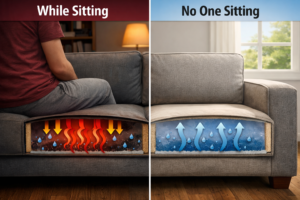
When a couch is drying, attention often stays on airflow or time. Body heat is easy to overlook because it feels natural and harmless. Still, warmth from sitting can quietly influence how moisture moves and settles inside cushions and padding. Related discussions often focus on how repeated sitting can push moisture deeper rather than allowing it to dissipate naturally.
Before assuming that sitting is neutral once the surface feels dry, it helps to pause. Heat does not always speed things up in the way people expect.
What to Do Immediately
If a couch is still drying, limiting prolonged sitting is usually the least disruptive choice. Body heat builds gradually and can affect internal layers even when the fabric feels normal to the touch. Avoiding contact for a while reduces one more variable during an already sensitive period.
It can feel overly cautious to step back just because of warmth. Still, choosing to wait instead of testing the couch with normal use often keeps conditions more predictable.
A Careful Use Approach
Body heat does not act alone. When combined with pressure from sitting, warmth can soften materials and change how moisture shifts inside the cushion. This does not mean heat always causes damage, but it can make moisture more mobile rather than helping it disappear. Questions about whether sitting slows internal drying often overlap with how heat changes moisture behavior.
A careful approach focuses on reducing duration rather than eliminating all use. Short, infrequent contact interferes less than long periods of sitting that allow heat to build and linger. If uncertainty remains, pausing use altogether is a reasonable option.
It also helps to notice how the couch responds after sitting. If areas feel warmer longer than expected, smell different, or recover more slowly, stopping early is often easier than pushing forward.
Common Mistakes That Feel Logical
One common assumption is that warmth helps things dry. Similar assumptions often appear when comparing daytime and nighttime use during the drying process. While that can be true in some situations, body heat is uneven and localized. Instead of drawing moisture out, it can encourage it to move deeper or spread sideways within the cushion.
Another mistake is assuming that comfort equals safety. A couch may feel pleasant to sit on even while internal layers are still adjusting. Wanting to return to normal use is understandable, but comfort does not always reflect what is happening inside.
Slowing down can feel unnecessary when nothing looks wrong. Still, restraint at this stage often prevents subtle changes from becoming harder to manage.
When This Approach Is Not Enough
If the couch consistently changes after sitting—such as developing stronger odors, feeling heavier in certain spots, or losing resilience—body heat may be contributing to internal moisture movement. In those cases, continued use is unlikely to help things settle.
There are times when the safest response is to remove heat and pressure entirely by stopping use for a while. Trying to balance drying and comfort at the same time can lead to mixed signals inside the cushions. Accepting a pause can be simpler than correcting changes later.
Not every situation has a clear endpoint, and that uncertainty can be frustrating. Still, forcing normal use rarely makes drying more predictable.
FAQ
Does body heat always affect moisture inside a couch?
Not always, but it can. Heat can change how moisture moves, especially when combined with pressure. When unsure, limiting contact usually interferes less.
If the couch feels dry, why would heat matter?
Surface dryness does not reflect internal conditions. Heat can influence deeper layers even when the fabric feels normal. Pausing use helps avoid pushing moisture into less visible areas.
Is short sitting different from long sitting?
Yes. Longer sitting allows more heat to build and remain in one spot. Short, infrequent contact generally has less impact than extended use.
How do you know body heat is part of the problem?
If changes appear after sitting—such as warmth lingering, odors increasing, or cushions recovering slowly—that can be a signal to stop. Responding early by slowing down is often the safer choice.
Body heat is subtle because it feels natural. When a couch is still drying, choosing restraint over reassurance often keeps moisture behavior simpler and easier to manage.