
A dryer that heats and finishes cycles can feel reassuring, even if something seems slightly off. Warm air, dry clothes, and familiar sounds suggest normal operation. However, continued heating does not always mean safe operation, and slowing down to reassess can reduce risks that are easy to overlook.
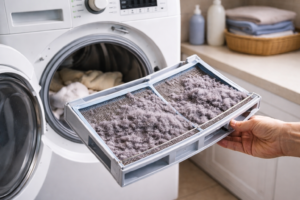
What to Prioritize First
The immediate priority is awareness rather than action. Recognizing that heat alone does not confirm safety can help prevent rushed decisions. A similar assumption often appears when appliances continue running despite underlying risks.
It may feel logical to assume that a dryer doing its main job is fine, but that assumption can hide developing problems.
At this point, restraint matters. Allowing time to notice patterns, smells, or changes without forcing the dryer to keep running can be a reasonable choice. If uncertainty is present, pausing use can be safer than pushing forward to maintain routine.
Why Heating Can Be Misleading
Dryers are designed so heat is only one part of safe operation. Airflow, internal clearances, and containment all play roles that are not visible from the outside. A dryer may continue to heat even when other conditions are no longer ideal.
Because heating is expected, it often masks trouble rather than revealing it. Problems that appear and disappear can make risk harder to recognize.
When something feels slightly different but hard to explain, it can be wise to treat that uncertainty as meaningful instead of dismissing it.
Common Mistakes That Feel Logical
One common reaction is continuing to use the dryer “just for now” because it still dries clothes. Another is assuming that a short cycle or lighter load avoids risk. These choices feel careful but still rely on incomplete information.
Another mistake is focusing only on performance. Dry clothes at the end of a cycle can create a false sense of security. When decisions start feeling improvised or justified by convenience, it is often a signal to slow down rather than proceed.
How Fire Risk Can Develop Quietly
Fire risk in dryers often develops gradually rather than suddenly. Conditions inside the appliance can change over time while outward performance stays the same. Similar hidden damage can occur in other appliances long before it becomes obvious.
Heat may build in places that are not meant to handle it, even if no warning signs are obvious.
This kind of risk rarely announces itself clearly. That uncertainty is exactly why continued use deserves caution. Accepting that not all dangers are visible can help guide more careful choices.
Why Continued Use Can Increase Uncertainty
Each additional cycle adds heat and movement to an already uncertain situation. Even if nothing goes wrong immediately, repeated use can narrow the margin for error. Over time, repeated use can quietly shift risk in the wrong direction.
Over time, small issues can compound rather than stabilize.
There is also the added factor of unattended operation. Dryers are often left running without close supervision, which increases uncertainty when conditions are not fully understood. Reducing use until clarity improves can limit how much risk accumulates.
When This Is Not a Quick Fix
If concerns persist despite the dryer appearing functional, the situation is likely beyond a simple adjustment. Surface checks or assumptions based on past behavior may not address what is happening internally.
Choosing not to rush toward a solution can feel uncomfortable, especially when laundry needs pile up. Pausing can be a practical way to limit risk while uncertainty remains.
However, waiting and allowing uncertainty to guide caution can prevent a manageable concern from becoming something more serious.
FAQ
Can a dryer be dangerous even if it still heats normally?
Yes. Heating alone does not reflect all safety conditions inside a dryer, and it is reasonable to remain cautious.
Does a lack of visible problems mean there is no fire risk?
Not necessarily. Some risks develop internally and do not show clear external signs right away.
Is it safer to keep loads small or cycles short?
Adjusting usage does not remove uncertainty. Pausing use can reduce risk more reliably than modifying habits.
Should concern be ignored if the dryer has worked this way before?
Past performance does not guarantee current safety. When doubt exists, slowing down is a valid response.