
Fixing an appliance symptom often feels like progress. A noise stops, a leak slows, or performance briefly improves. These changes can be reassuring, especially when the appliance appears to return to normal. It is often worth slowing down at this point, because symptom relief does not always mean the underlying problem was addressed.
This article looks at gray-zone decisions where treating what is visible or annoying can unintentionally worsen the real issue underneath. Understanding how this happens can help avoid actions that feel productive but shift damage into less visible places.
Why Symptoms Are So Tempting to Fix
Symptoms demand attention. They are disruptive, inconvenient, or concerning, which creates pressure to act. When a specific symptom stands out, it naturally becomes the focus.
Because symptoms are measurable and immediate, fixing them feels concrete. The deeper cause may be abstract, hidden, or uncertain. Pausing before acting on the most obvious signal can help keep decisions from narrowing too quickly.
What is easiest to see often becomes easiest to treat.
How Symptom Fixes Can Redirect Stress
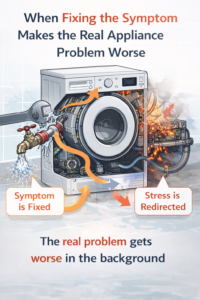
When a symptom is reduced, the appliance does not necessarily return to its original state. Internal forces such as load, heat, or moisture still need to go somewhere. Removing one outlet can push stress into another area. This is a common reason why temporary appliance fixes often make long-term damage worse instead of resolving the underlying issue.
This redirection may not show immediate effects. The appliance may run more quietly or smoothly for a time. Slowing down after improvement can help recognize that stress may have shifted rather than disappeared.
Silencing one signal can amplify another.
Why Temporary Improvement Can Be Misleading
A successful symptom fix often creates confidence. The absence of the original problem suggests resolution, even if nothing fundamental changed. This confidence can delay further observation.
During this quiet period, internal conditions may continue to degrade. By the time new symptoms appear, the problem may be broader or harder to isolate. Hesitating before declaring success can preserve awareness.
Improvement is not the same as correction.
When Fixes Increase Dependency on Compensation
Appliances are designed to compensate within limits. Symptom-focused adjustments often rely on this compensation instead of restoring balance. Over time, more components may be involved in maintaining normal operation.
As compensation spreads, the system becomes less resilient. Small changes can trigger larger responses. Slowing down to consider whether the appliance is working harder to appear normal can reveal hidden strain.
Compensation keeps things running, not stable.
How Repeated Symptom Fixes Change the Problem
When symptoms are treated repeatedly, the original problem can evolve. This evolution mirrors how repeated minor appliance issues lead to sudden breakdown after a series of seemingly helpful adjustments. Each adjustment alters conditions slightly, which can change how damage progresses. The issue may become less recognizable than it was initially.
This evolution makes later diagnosis harder. What began as a clear fault turns into a pattern of shifting behavior. Pausing before applying another fix can prevent the problem from becoming untraceable.
Each fix rewrites the context.
Why the Root Cause Becomes Harder to Find
As symptoms are managed, the trail back to the cause fades. The appliance’s behavior no longer reflects the original fault clearly. New signs may appear that seem unrelated.
This disconnect can lead to confusion or escalating responses. Slowing down when explanations stop lining up can signal that the approach needs reevaluation.
Distance from the cause grows with every workaround.
When Doing Less Is the Smarter Decision
In some cases, resisting the urge to fix a symptom immediately can prevent deeper harm. Allowing time to observe patterns may feel uncomfortable, but it can preserve clarity.
Doing less does not mean ignoring the issue. It can mean choosing not to interfere until the situation is better understood. Slowing down can keep the problem from being reshaped in unhelpful ways.
Not every symptom requires an immediate response.
Why These Decisions Feel Reasonable at the Time
Most symptom fixes are made with good intentions. They are based on visible feedback and practical needs. In the moment, they often seem like the responsible choice.
Understanding that reasonable decisions can still have unintended effects can reduce hindsight frustration. Pausing earlier does not require perfect insight, only restraint.
Gray zones exist because outcomes are not obvious.
When the Situation Has Quietly Changed
If an appliance no longer behaves the way it did before the symptom fix, that change matters. Even if performance seems acceptable, the internal situation may be different. At this stage, a small appliance fault can turn into a system failure without clear warning signs.
Recognizing this shift can help reset expectations. Slowing down after noticing change can prevent reliance on outdated assumptions.
A quieter appliance is not always a healthier one.
FAQ
Why can fixing a symptom make things worse?
Because symptoms often act as release points. Removing them can redirect stress internally. Pausing to consider where that stress goes can help avoid escalation.
Is it wrong to fix obvious problems?
Not always. The risk increases when fixes rely on compensation rather than addressing causes. Hesitation can help clarify which situation applies.
Why do problems seem harder to diagnose later?
Repeated fixes change behavior patterns. Slowing down early can preserve clearer signals.
What’s the safest response when unsure?
Restraint. Doing less while observing can reduce the chance of reshaping the problem in harmful ways.