
Hardwood floors often give reassuring feedback right after cleaning. The surface looks even, the color appears refreshed, and there are no obvious signs of trouble. Weeks can pass with no visible change, reinforcing the belief that the cleaning method was safe. When problems finally appear months later, the connection to that earlier cleaning is easy to miss. Understanding why this delay happens helps explain why hardwood floors can fail long after they seem fine.
Immediate Appearance Is a Poor Indicator of Safety
Hardwood floors are good at hiding stress in the short term. A clean surface reflects light evenly, which can mask subtle changes beneath the finish. After cleaning, the floor may feel smooth and stable, creating confidence that nothing harmful occurred. That confidence can make it harder to slow down and reassess.
The issue is that most cleaning-related damage doesn’t announce itself immediately. The surface appearance only shows what’s happening at the top layer. Beneath that, small changes can already be underway. Pausing to remember that appearance is not the same as condition can prevent misplaced certainty. This reflects why couch cleaning is more about restraint than technique when materials hide early stress.
Hardwood Reacts Gradually, Not All at Once
Wood is a slow-reacting material. This is also why steam mop use on hardwood floors can seem safe before delayed problems appear. It expands, contracts, and adjusts over time in response to moisture, heat, and pressure. When cleaning introduces stress, the wood doesn’t usually respond with instant warping or cracking. Instead, it absorbs the impact gradually.
Moisture can migrate into seams or microscopic gaps and linger long after the surface feels dry. Heat can soften finishes temporarily, changing how they protect the wood beneath. These effects may stabilize at first, giving the impression that everything is fine. Allowing time for observation, rather than assuming success, is often the safer approach.
Why Finishes Can Hide Early Damage
Floor finishes are designed to protect and to look good. They can conceal early warning signs by maintaining a uniform appearance even as the wood beneath them changes. A finish may stretch slightly as boards shift, masking movement that would otherwise be visible.
Over time, that flexibility can decrease. Once the finish can no longer adapt, problems surface as dull patches, cracking, or peeling. By the time these signs appear, the underlying stress has usually been present for months. Recognizing that finishes can delay visible feedback helps explain why damage feels sudden when it finally shows.
Repeated Mild Stress Adds Up
Cleaning rarely causes failure through a single event. More often, it introduces mild stress repeatedly. Each cleaning may seem harmless on its own, especially when there’s no immediate consequence. Over months, those small stresses accumulate. This is often when doing nothing is better than cleaning to avoid compounding stress.
Moisture cycles, even light ones, can slowly widen seams or weaken bonds between boards and subfloor. Heat exposure can gradually reduce finish resilience. None of this is dramatic at first. Choosing restraint early—by reducing frequency or pausing altogether—can limit how much cumulative stress builds before it becomes irreversible.
Environmental Factors Delay the Outcome
Hardwood floors exist within changing environments. Seasonal humidity shifts, temperature changes, and daily use all interact with the effects of cleaning. A floor cleaned during a dry season may not show problems until humidity rises months later.
When boards expand under new conditions, earlier stress points can become failure points. The cleaning didn’t cause the seasonal change, but it may have reduced the floor’s ability to tolerate it. Waiting to see how a floor responds across time and seasons can reveal risks that aren’t visible right after cleaning.
Why Damage Is Often Misattributed
When failure appears months later, it’s rarely linked back to cleaning. The gap in time encourages other explanations: age, weather, normal wear, or installation quality. While those factors can contribute, cleaning-related stress is often part of the chain.
This misattribution keeps the same cleaning habits in place, allowing further damage to develop. Questioning past actions—even ones that seemed successful—can be uncomfortable, but it can also prevent repeating patterns that quietly shorten a floor’s lifespan.
Subtle Early Signs That Are Easy to Ignore
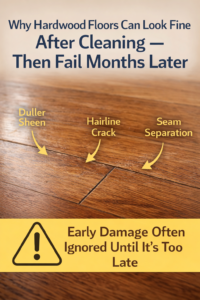
Before major failure, there are often small changes that feel insignificant. A slightly duller sheen in certain areas. Boards that sound different underfoot. Seams that catch the light differently than before. These signs are easy to dismiss because they don’t interfere with daily use.
Stopping or slowing down at this stage can make a difference. Continuing to clean aggressively because the floor still “looks fine” can push it past a point where stabilization is possible. Paying attention to small inconsistencies often matters more than waiting for obvious damage.
Why Patience Matters More Than Results
Cleaning success is often judged by immediate results. A floor that looks good right away is assumed to be healthy. Hardwood doesn’t work that way. Its true response unfolds over time.
Patience allows cause and effect to become clearer. Giving a floor time to respond without added intervention can reveal whether it’s recovering or deteriorating. Acting less, even when the urge is to maintain appearances, can protect long-term stability more effectively than frequent cleaning.
The Role of Overconfidence in Delayed Failure
Confidence grows when actions appear to work. With hardwood floors, that confidence can become risky. When cleaning produces no immediate downside, it feels validated. Over months, that confidence can lead to repeated exposure that the floor cannot sustain indefinitely.
Questioning success is difficult, especially when there’s no obvious problem. But restraint often begins with doubt. Accepting that a good-looking result doesn’t guarantee safety helps keep decisions grounded in long-term thinking rather than short-term reassurance.
Understanding Failure as a Process, Not an Event
Hardwood floor failure rarely happens all at once. It’s usually the end result of a process that started long before symptoms appeared. This mirrors why no single method works for every couch when outcomes depend on time and conditions. Cleaning can be one part of that process, even if it didn’t seem harmful at the time.
Viewing failure as gradual rather than sudden changes how cleaning decisions are evaluated. It encourages observation, spacing out interventions, and accepting that less frequent action can preserve stability better than constant upkeep.
FAQ
Why do hardwood floors look fine right after cleaning?
Because finishes and surface drying can hide underlying stress that develops slowly.
What kind of problems appear months later?
Dull finishes, widened seams, subtle warping, or cracking often emerge over time.
Is cleaning always the cause of delayed failure?
Not always, but cleaning can contribute by reducing the floor’s tolerance to environmental changes.
Can early signs be reversed?
Sometimes stabilization is possible if intervention stops early. Continued stress makes reversal less likely.
What’s the safest mindset after cleaning hardwood floors?
Observation and restraint. Time often reveals more than immediate results.