
When a couch stays damp longer than expected, attention often turns to cleaning methods or visible spills. Less often considered is the role of heating cycles inside a home. Heating systems do not provide steady conditions; they turn on and off, warming and cooling the room in repeated waves. These cycles can quietly change how moisture behaves inside a couch over time. Slowing down to understand this pattern can help explain why drying feels inconsistent or incomplete.
Why Heating Feels Like a Stable Background
Heating is usually experienced as comfort rather than a process. Once a room feels warm, it is easy to assume conditions are stable. Because heating is part of everyday life, its effects fade into the background. Indoor climate factors often influence couch drying more than individual actions. This makes it tempting to view heating as neutral during couch drying.
However, heating rarely maintains a constant temperature. Instead, it creates cycles of warming and cooling that repeat throughout the day and night. Pausing to notice this rhythm can reveal why moisture does not behave as expected.
What Heating Cycles Actually Do to Air
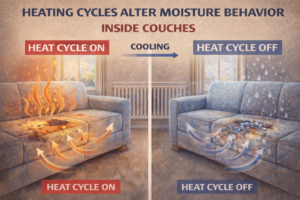
When a heating system turns on, air temperature rises. Warm air can hold more moisture, which can encourage evaporation from surfaces. Changes in air moisture capacity directly affect how couch materials release moisture. When the system turns off, air cools again, changing how moisture is held and released. These shifts happen repeatedly, even if the room feels generally warm.
This on-and-off pattern means moisture inside a couch is constantly responding to changing conditions. Rather than moving steadily outward, moisture may advance, pause, or redistribute with each cycle. Accepting that drying is not linear under heating can reduce confusion.
Surface Drying Versus Internal Response
Heating cycles often dry the surface of a couch quickly. Fabric exposed to warm air may feel dry soon after heating begins. This can create confidence that moisture has been removed. Internally, however, cushions and padding respond more slowly. Moisture inside couch cushions can remain long after the surface feels dry.
As heating turns off and temperatures dip, internal moisture may lose momentum. Instead of continuing outward, it can settle or spread sideways within the couch. Waiting longer than surface cues suggest can help avoid misreading this imbalance.
Expansion, Contraction, and Moisture Movement
Materials inside a couch expand slightly when warmed and contract as they cool. These small shifts may seem insignificant, but over repeated heating cycles they can influence moisture movement. Expansion can open pathways that allow moisture to move, while contraction can slow or redirect it.
Because these changes are subtle, they often go unnoticed. Over time, though, they can contribute to uneven drying or pockets of lingering dampness. Slowing down and allowing cycles to pass without interference can reduce disruption.
Why Drying Can Stall Overnight
Heating cycles often change overnight. Systems may run less frequently, or room temperatures may drop between cycles. This can slow evaporation just as moisture was beginning to move. As a result, progress made during the day can feel lost by morning.
This does not mean the couch became wetter overnight. Instead, moisture movement may have paused. Recognizing this pause can prevent unnecessary adjustments or repeated cleaning attempts.
Cushion Density and Heat Sensitivity
Cushions are more affected by heating cycles than surface fabric. Dense materials warm and cool more slowly, lagging behind room air changes. While the room responds quickly to heating, cushions may still be adjusting to previous conditions.
This delay means cushions can remain damp internally even as the room feels dry and comfortable. Assuming cushions need more time than the room itself can prevent premature use or intervention.
Heating Can Redistribute Moisture, Not Remove It
Heating is often expected to remove moisture, but it can also redistribute it. Warm air may draw moisture toward certain areas while cooler phases slow its escape. Over multiple cycles, moisture may concentrate in less ventilated parts of the couch.
Because the couch often looks fine during this process, the redistribution can go unnoticed. Choosing patience over active adjustment can help moisture find its way out naturally.
When Heating Cycles Matter Most
Heating cycles tend to matter more during colder seasons, in tightly sealed homes, or when a couch has been thoroughly cleaned. In these situations, temperature swings are more pronounced, and moisture loads are higher. Under these conditions, drying may take longer than expected.
It is reasonable to accept slower progress rather than trying to override heating behavior. Doing less often protects the couch better than forcing faster results.
Resisting the Urge to Correct Each Change
When drying feels inconsistent, it is tempting to react to each change by adjusting heat, airflow, or cleaning approach. These reactions can interrupt the natural rhythm of moisture movement created by heating cycles. Sometimes, the safest response is to allow the system to continue without interference.
Letting time pass can feel unproductive, but it often prevents uneven outcomes. Stability, even if imperfect, can be more helpful than constant correction.
FAQ
Do heating cycles actually slow couch drying?
They can. Heating can help at times but also pause or redirect moisture movement during cooling phases.
Why does the couch feel dry when the heat is on but not later?
Surface fabric responds quickly to warmth, while internal moisture moves more slowly and may stall as temperatures change.
Is it better to keep heating constant?
There is no simple answer. Heating systems rarely stay constant, and forcing stability is not always practical or helpful.
Should heating be avoided altogether during drying?
Not necessarily. Understanding its cycling effect is more useful than trying to eliminate it.