
Sometimes a couch seems stuck in an endless drying phase. Days pass, the surface feels mostly dry, yet something never fully resolves. Cushions remain heavy, faint odors linger, or the couch feels cool long after cleaning. In these situations, the problem is often not the cleaning itself, but the home conditions surrounding the couch. This creates a gray zone: continued waiting feels patient, repeated action feels disruptive, and neither option clearly works. Understanding how home conditions can quietly prevent full drying helps explain why some couches never seem to recover.
Why Drying Feels Like It Should Eventually Finish
Drying is usually thought of as a simple, linear process. Water goes in, time passes, water leaves. This expectation makes it hard to accept that drying might stall indefinitely. When a couch remains damp-feeling for too long, it feels like something must be wrong.
This belief pushes decisions in unhelpful directions. Either people keep waiting, assuming completion is inevitable, or they intervene repeatedly, trying to force an ending. Both responses can miss the underlying issue.
The Hidden Role of Indoor Humidity
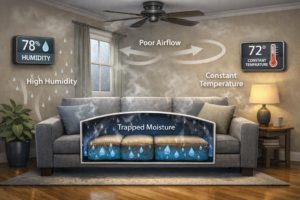
One of the most limiting home conditions is consistently high indoor humidity. When the surrounding air already holds a lot of moisture, the couch has nowhere to release its own. High indoor humidity directly affects how couch fabric and padding release moisture. Drying slows, then plateaus.
In these conditions, moisture may move internally without ever fully leaving. The couch is not actively drying; it is hovering in a semi-damp state. Waiting longer does not change this balance, but the lack of visible wetness makes the problem easy to underestimate.
Stable Temperatures Can Stall Evaporation
Homes designed for comfort often maintain very stable temperatures. While this feels pleasant, it can reduce the natural drivers of evaporation. Drying benefits from change—subtle temperature shifts that encourage moisture to move out.
When temperatures stay constant, moisture can become static as well. The couch may feel “almost dry” indefinitely. This creates a decision failure where no clear next step feels justified.
Limited Airflow That Never Improves
Some rooms simply do not move air well. Airflow patterns inside a room can remain stagnant regardless of time passing. Furniture placement, room shape, closed doors, and limited ventilation can create zones of stillness. A couch sitting in one of these zones may receive almost no meaningful airflow, even if windows are opened elsewhere.
Because airflow limitations are structural, they do not improve with time. Waiting feels reasonable, but nothing is actually changing. The couch remains in the same environment that prevented drying in the first place.
Why Normal Adjustments Don’t Solve the Problem
When drying stalls, small adjustments are often tried: opening windows longer, turning on a fan occasionally, shifting cushions. These actions feel helpful but may not alter the core conditions.
In some homes, these adjustments simply reshuffle moisture internally. They change how the couch feels without allowing moisture to exit. This reinforces the false sense that progress is being made, even when the system remains stuck.
The Illusion of “Almost Dry”
A couch that is never fully dry often lives in an “almost dry” state. The surface feels fine, and only subtle signs suggest something is off. This makes the situation easy to tolerate for long periods.
Because the couch is usable, the urgency fades. Yet this prolonged semi-damp condition can slowly lead to odor development, material fatigue, or internal breakdown. The harm is quiet and gradual.
Why Repeated Waiting Becomes Its Own Decision Failure
Waiting is often chosen because it feels safest. Letting a couch air out without changing conditions can quietly allow problems to persist. However, when home conditions are actively preventing drying, waiting becomes a decision with consequences. Each day spent in a damp equilibrium increases the chance of secondary issues.
This is difficult to recognize because waiting does not feel like action. The lack of intervention hides the fact that the couch is still responding to its environment in unhelpful ways.
When Action Feels Risky Too
Ironically, in these situations, acting can also feel risky. Re-cleaning adds moisture. Adding heat or airflow may redistribute moisture. Moving the couch may disrupt the room. With no clear safe option, people remain stuck.
This is the core gray zone. The environment is the problem, but changing it feels complicated or unrealistic. Understanding this tension helps explain why the issue persists.
Homes That Create Chronic Drying Problems
Apartments with limited ventilation, homes in humid climates, basement rooms, and tightly sealed modern buildings are more likely to prevent full drying. In these spaces, couches may never experience conditions that allow internal moisture to fully escape.
Because the couch worked fine in the past, this possibility is often overlooked. Changes in season, building use, or cleaning depth can push the environment past a threshold without obvious warning.
Why the Couch Is Not “Defective”
When drying never finishes, it is tempting to blame the couch. Materials get criticized, cushions feel faulty, and quality is questioned. In reality, many couches simply cannot overcome certain home conditions on their own.
Recognizing this shifts the focus away from the furniture and toward the system it sits in. The couch is responding logically to its environment.
Accepting That Some Conditions Require Structural Change
In some cases, full drying cannot happen without changing the environment. This might mean altering airflow patterns, adjusting humidity levels, or relocating the couch temporarily. These steps feel larger than expected, which is why they are often delayed.
Accepting that the issue is environmental—not procedural—can clarify why smaller efforts failed. It also explains why patience alone did not work.
Understanding the Cost of Permanent “Almost Dry”
A couch that never fully dries may remain usable for a long time. This makes the cost easy to ignore. Over time, however, internal moisture can shorten material lifespan, affect comfort, and make odors more persistent.
Seeing this as a slow trade-off rather than an immediate failure helps explain why the problem feels tolerable until it suddenly isn’t.
FAQ
Can a couch really never fully dry in some homes?
Yes. Certain combinations of humidity, airflow, and temperature can prevent full internal drying.
Why doesn’t more time solve the problem?
If conditions stay the same, moisture has no incentive to leave. Time alone does not change the balance.
Is re-cleaning helpful in this situation?
Usually not. It often adds moisture without addressing the environmental cause.
Does this mean the couch is ruined?
Not necessarily. But without environmental change, ongoing issues are more likely over time.