
Water stains on upholstery are confusing because water itself seems harmless. Many people assume adding more water will rinse the mark away, but water stains are not caused by dirt or spills. They form when fabric dries unevenly or when minerals and residues are redistributed as moisture evaporates. Adding more water often makes the mark larger or causes it to reappear after seeming to disappear. This is why water stains often seem gone while damp but return clearly once the fabric dries completely.
These stains frequently look lighter when the fabric is damp, creating a false sense of success. Once the area dries completely, the mark returns—sometimes more visible than before. This cycle frustrates people who believe they are cleaning incorrectly, when in reality water stains behave differently than most upholstery problems.
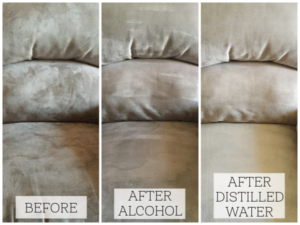
Why Water Stains Behave Differently on Couches
Water stains are changes in appearance, not contamination. When water soaks into upholstery, it carries dissolved minerals, detergent residue, oils, or dust toward the edges of the wet area. As the moisture evaporates, these substances concentrate where drying stops, forming rings or patches.
Upholstery fabrics also contain finishes applied during manufacturing. Water can disturb these finishes unevenly, leaving differences in sheen or texture even after drying. On fabrics like microfiber or velvet, water can flatten or redirect fibers, creating visible marks that are textural rather than dirty.
Hard water worsens the problem. Minerals such as calcium and magnesium remain after evaporation, forming chalky residue. Distilled water reduces this risk, but it still redistributes whatever was already present in the fabric.
How Water Stains Form: Wicking, Minerals, and Uneven Drying
Wicking occurs when moisture pulls dissolved material outward through fabric fibers. As the water dries, residue is deposited at the boundary, creating a visible ring. Moisture can also wick vertically from foam padding and return to the surface during drying. Trapped moisture inside cushions is one of the main reasons stains and odors keep coming back over time.
Mineral residue is left behind when tap water evaporates. These deposits bond to fibers, especially natural ones like cotton or linen, and can appear white, cloudy, or stiff.
Uneven drying creates marks even without residue. If one area dries faster due to airflow, heat, or sunlight, fabric texture changes unevenly. Forced drying with hairdryers or heaters increases this risk by creating sharp moisture boundaries.
How Home Remedies Are Used (and Their Limits)
Home remedies usually involve re-wetting the stain to redistribute residue, then controlling drying.
Distilled water is commonly used to re-dampen the area and reduce rings. It can work on fresh mineral stains but often spreads the mark if drying conditions are not ideal.
Vinegar may dissolve mineral deposits but risks dye bleeding, fiber weakening, and lingering odor. Rinsing it properly without over-wetting upholstery is difficult.
Steam can relax flattened pile on microfiber or velvet, improving texture-based marks, but heat can also set stains or alter fabric finishes permanently.
Rubbing alcohol dries quickly and may reduce rings on some fabrics, but it can strip dye or leave shiny patches.
The main limitation of home remedies is that they recreate the same conditions that caused the stain. Multiple attempts often enlarge the affected area rather than resolve it. This usually happens when moisture is added without proper control of drying conditions.
How Commercial Upholstery Cleaners Address Water Stains
Commercial cleaners approach water stains by treating larger areas evenly rather than spot-cleaning. Upholstery fabric cleaning codes help determine whether water-based or solvent-based methods are appropriate.
Fabric refreshers and upholstery shampoos clean and recondition the entire cushion face, eliminating sharp boundaries that cause rings. They work best on water-safe fabrics and require uniform drying.
Mineral deposit removers dissolve hard water residue more effectively than vinegar, using controlled pH formulas that reduce residue risk.
Dry-cleaning solvents avoid water entirely and are used on solvent-only fabrics, though their effectiveness is limited when the stain is caused by water itself.
Commercial products provide clearer guidance and more controlled formulations, but they are not guaranteed solutions—especially if the fabric finish has been permanently altered.
Direct Comparison: Home Remedies vs Commercial Cleaners
| Factor | Home Remedies | Commercial Cleaners |
|---|---|---|
| Effectiveness | Inconsistent | More reliable |
| Risk of new rings | High | Moderate |
| Fabric safety | Unpredictable | Better when matched to fabric code |
| Residue risk | Moderate to high | Lower |
| Reappearing stains | Common | Less common |
| Cost | Low | Moderate |
When Home Remedies Are Acceptable
-
Fresh spills caught immediately
-
Small stains on low-value, water-safe fabrics
-
Light mineral marks with known cause
They should be avoided on expensive, delicate, or older upholstery, or when stains have already resisted treatment.
When Commercial Cleaners Are the Better Option
-
Stains that reappear after drying
-
Multiple water marks on the same cushion
-
Valuable or delicate fabrics
-
Unknown cleaning codes
Even commercial products cannot reverse permanent finish or dye changes.
Common Mistakes People Make
-
Using tap water instead of distilled
-
Scrubbing instead of blotting
-
Over-wetting the fabric
-
Forcing drying with heat
-
Treating only the visible ring
-
Mixing home remedies and products
-
Judging results before full drying
These mistakes usually make water stains larger and harder to fix.
Neutral, Realistic Conclusion
No method guarantees water stain removal from a couch. Home remedies are accessible but risky and often worsen the problem through repeated re-wetting. Commercial cleaners offer more control and consistency, especially when treating entire surfaces, but they cannot undo permanent fabric changes.
The safest approach is early blotting, minimal moisture, treating larger areas evenly, and allowing slow, natural drying. If one or two careful attempts fail, further DIY treatment often causes more harm than good. In many cases, reducing visibility rather than achieving perfection is the most realistic outcome.