
When a couch needs cleaning, its age is often overlooked. Newer couches tend to feel sturdy and forgiving, while older ones may already show wear. However, age affects more than appearance. As a couch gets older, the materials inside it change in subtle ways that can make cleaning riskier than expected. Understanding how age influences cleaning safety helps explain why slowing down or doing less is often the wiser choice.
Why Age Changes How a Couch Responds to Cleaning
A couch does not remain static over time. Daily use, exposure to air, light, and previous cleanings all alter how materials behave. Fibers gradually lose elasticity, finishes wear down, and internal layers become less resilient. These age-related changes interact closely with material differences, as explained in How Fabric Type Determines How a Couch Should Be Cleaned.
Because these changes happen slowly, it is easy to assume a couch will respond the same way it always has. That assumption can lead to overconfidence. Pausing to consider age before cleaning can prevent damage that only becomes obvious after it is too late.
Newer Couches and False Confidence
New couches often feel durable. Fabrics appear firm, colors are even, and cushions bounce back easily. This can create a sense that cleaning is low risk. In reality, newer couches may still have sensitive finishes or treatments that are easily disturbed.
These finishes often protect the fabric’s appearance, but they are not always designed for repeated moisture or friction. Acting gently and stopping early, even on a newer couch, helps avoid stripping away protection that cannot be replaced.
How Older Fabrics Lose Their Tolerance
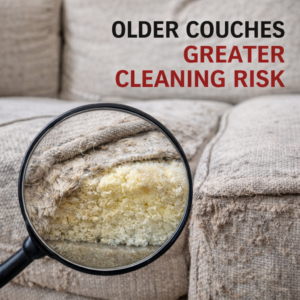
As fabric ages, fibers weaken and become less flexible. textile aging and material degradation They may no longer spring back after being pressed or rubbed. This means that actions that once seemed harmless can now cause visible texture changes or uneven wear.
Older fabric may also absorb moisture differently. Liquids can travel more quickly into areas that are slow to dry. Recognizing this reduced tolerance is a reason to hesitate rather than push forward with cleaning.
Cushion Aging and Hidden Risk
Cushions change significantly with age, even if they still feel comfortable. Foam and padding compress over time, creating spaces where moisture can linger. Once moisture reaches these inner layers, it becomes harder to remove safely.
Because this process is hidden, the risk is easy to underestimate. Allowing more time between cleanings, or choosing not to clean at all, can reduce the chance of driving problems deeper into the couch.
Why Previous Cleanings Matter More as a Couch Ages
Every cleaning leaves a small imprint on a couch. Over time, these effects accumulate. This cumulative effect is central to Why Repeated Cleaning Starts to Damage a Couch. Residue buildup, fiber disturbance, and internal moisture all alter how the couch reacts to future cleaning.
As a couch ages, its margin for error shrinks. What worked once may no longer be safe. Treating uncertainty as a signal to pause rather than repeat old habits can prevent compounding damage.
Aging Adhesives and Structural Changes
Many couches rely on adhesives to hold layers together. With age, these adhesives can dry out or weaken. Moisture introduced during cleaning can affect them unpredictably, leading to loosened layers or subtle sagging.
These structural changes may not appear immediately. Because the damage is delayed, it is often mistaken for normal aging. Choosing restraint helps avoid triggering changes that cannot be undone.
Why Drying Takes Longer Over Time
Older couches tend to dry more slowly. Fabrics may be more absorbent, and internal airflow is often reduced due to compression and wear. A surface that feels dry may still hide moisture inside. This hidden moisture risk is explored further in Why Over-Wetting a Couch Causes Long-Term Damage.
This slow drying increases the risk of odors, stiffness, and long-term damage. Giving the couch time to rest, or deciding not to clean further, is often safer than adding more moisture in hopes of faster results.
When Age Makes “Gentle” Cleaning Risky
It is common to assume that gentle cleaning is always safe. With older couches, even light handling can stress materials that are already compromised. Repeated blotting or light scrubbing may still cause visible change.
If a couch’s age creates doubt about how it will respond, that hesitation deserves attention. Stopping early respects the limits imposed by time and wear.
Why Aging Creates Uneven Results
As couches age, materials do not degrade evenly. Some areas may be more worn than others. Cleaning can highlight these differences, making certain spots look darker, lighter, or more textured.
These uneven results are not a sign to keep cleaning. They are often a signal that the couch has reached a point where intervention causes more change than improvement. Accepting this can prevent further imbalance.
When Doing Less Protects an Older Couch
Older couches often benefit more from rest than from repeated cleaning. Allowing materials to remain undisturbed reduces stress and preserves what remains intact.
Doing less can feel unsatisfying, especially when a couch shows signs of age. Still, restraint is often the most protective approach once materials have lost their original resilience.
Why Age Should Lower the Threshold for Stopping
As a couch ages, the threshold for stopping should become lower, not higher. Uncertainty, slow drying, or minor changes are stronger signals than they would be on a newer couch.
Recognizing that age changes the rules helps prevent decisions based on past experience alone. Pausing earlier preserves the couch better than trying to restore it to a previous state.
FAQ
Is it riskier to clean an older couch than a new one?
Often, yes. Older materials have less tolerance for moisture and friction, which increases risk.
Can age-related damage appear after cleaning seems successful?
Yes. Delayed changes are common, especially as moisture moves through weakened materials.
Does this mean older couches should never be cleaned?
Not necessarily, but caution matters more. Doing less or stopping early is often safer.
Why does a couch seem to “change” after years of cleaning the same way?
Because age alters fibers, padding, and structure. Past success does not guarantee future safety.