
Cleaning advice often sounds universal. A product or method is labeled “safe,” and it’s assumed to apply to any floor that looks similar. What’s rarely acknowledged is how much a floor’s age changes what safety actually means. A cleaning approach that works without issue on a newer floor can quietly cause problems on an older one. Understanding how floors age helps explain why “safe cleaning” is not a fixed standard.
Floors Change Long Before They Look Old
Floors don’t need to look worn to behave differently. Aging begins as soon as a floor is installed. Finishes start to thin, materials respond to seasonal changes, and microscopic wear accumulates under normal use. These changes aren’t obvious at first, which makes it easy to assume a floor is still as resilient as it was when new. This helps explain why identical floor materials react differently to the same cleaning method over time.
Because the surface often looks consistent, it’s tempting to continue cleaning the same way year after year. Slowing down to consider how long a floor has been in place can reveal why results start to shift even when routines stay the same.
Why New Floors Tolerate More Stress
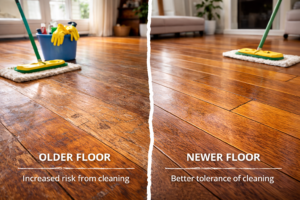
Newer floors usually have intact finishes, tighter seams, and fewer micro-gaps. Protective layers are at their thickest and most uniform. This gives them a higher tolerance for moisture, friction, and chemical exposure.
When a cleaning method is tested on a new floor, it often performs well. That early success can build confidence in the method itself rather than in the condition of the floor. Pausing before generalizing that success helps prevent applying new-floor standards to aging surfaces.
Aging Finishes Redefine “Gentle”
As floors age, finishes thin unevenly. High-traffic areas lose protection faster, while low-use zones may remain relatively intact. A cleaner or technique that once felt gentle can become abrasive simply because less protection remains.
This is often how repeated floor cleaning breaks down protective finishes as floors age.
This shift is subtle. Floors may still feel smooth and look clean after cleaning, masking the fact that the finish is no longer buffering stress. Recognizing that “gentle” is relative—and changes over time—can prevent pushing an aging finish beyond its limit.
Micro-Damage Accumulates Over Years
Older floors carry a history of small, often forgotten events: past spills, previous cleaning routines, furniture movement, or refinishing work. Each event leaves behind minor changes that affect how the floor responds going forward.
These layers of micro-damage don’t usually cause immediate issues. They quietly lower tolerance. When cleaning continues as if the floor were new, stress accumulates faster. Taking a moment to acknowledge what a floor has already endured can clarify why it reacts differently now.
Seams and Gaps Become More Sensitive
With age, seams can widen slightly and materials can shift. These changes create new pathways for moisture and residue to move below the surface. A method that once dried quickly on a tight, new floor may linger longer in older seams.
Because the surface still dries, it’s easy to underestimate this effect. Waiting and observing how long a floor truly takes to stabilize after cleaning can reveal age-related sensitivity that wasn’t there before.
“Safe” Labels Don’t Account for Time
Product labels and general advice usually assume average conditions. They rarely account for years of wear, environmental exposure, or previous maintenance. A product can be technically safe for a floor type while still being risky for a floor at a certain stage of its lifespan. This is similar to why “safe for upholstery” labels can be misleading when context is ignored.
Relying solely on labels ignores the role of aging. It’s often safer to adjust frequency and intensity based on the floor’s condition rather than trusting that a label applies indefinitely.
Why Problems Appear Later, Not Immediately
Age-related vulnerability explains why damage often appears long after cleaning feels successful. The floor may tolerate stress for a while, then cross a threshold where finishes fail or materials react more dramatically.
This delay can make it seem like deterioration came out of nowhere.
This explains why floors sometimes feel clean but start deteriorating afterward despite familiar routines. In reality, aging reduced the margin for error over time. Recognizing this pattern can prevent blaming isolated events instead of cumulative wear.
Older Floors Benefit More From Restraint
As floors age, restraint becomes more protective than precision. Perfect technique can’t replace lost protection. Cleaning less often, using lighter methods, and allowing longer recovery periods can extend the usable life of an older floor.
This doesn’t mean neglecting cleanliness. It means adjusting expectations. Older floors often last longer when cleaning decisions prioritize preservation over restoring a “like-new” feel.
When Comparing Old and New Floors Misleads
Seeing a newer floor handle a cleaning method well can create pressure to treat older floors the same way. These comparisons overlook the role of age entirely. What’s safe for one floor at year two may be stressful for another at year fifteen.
Resisting comparison helps protect aging floors. Each floor’s age creates its own context for what safety looks like.
Redefining Safe Cleaning Over Time
Safe cleaning isn’t a fixed rule—it’s a moving target that shifts as floors age. What matters most is not what worked before, but how the floor responds now. Observing changes, slowing routines, and accepting limitations often preserves floors longer than sticking rigidly to past habits.
Understanding that age changes the rules allows for more thoughtful care. Floors don’t fail because cleaning suddenly became unsafe; they fail because safety was never adjusted as they grew older.
FAQ
Does floor age really affect cleaning safety?
Yes. Aging reduces finishes, increases sensitivity, and lowers tolerance to stress.
Can the same product become unsafe over time?
It can become riskier as protective layers thin and materials change.
How can you tell when a floor needs gentler care?
Faster dulling, longer drying times, and increased sensitivity to moisture are common signs.
Is it better to stop cleaning older floors?
No, but reducing frequency and intensity often helps preserve them.
What’s the safest first adjustment to make?
Cleaning less often and observing how the floor responds over time is usually a good starting point.