
After a couch has been cleaned or exposed to moisture, drying is often expected to follow a simple, steady path. Once the surface feels dry, normal use usually resumes. What is less obvious is that repeated use does not just sit on top of the cushions—it gradually reshapes how moisture behaves inside them.
Cushions are layered systems. Foam, fiber, fabric, and internal seams all respond differently to pressure and rest. When use becomes repetitive, drying patterns can shift in subtle but lasting ways. Slowing down expectations about how drying “should” progress can make these changes easier to understand.
Drying Is a Pattern, Not a Moment
Drying inside a cushion does not happen all at once. Moisture moves through layers over time, influenced by airflow, gravity, and internal material density. Early dryness at the surface can give the impression that the process is complete, even while deeper layers are still adjusting.
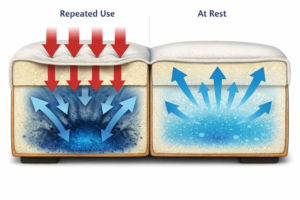
Repeated use interrupts this pattern. Normal daily use continues reshaping how moisture distributes inside the couch even after surface dryness appears complete. Each compression and release cycle alters how moisture redistributes. Instead of moving steadily toward evaporation, moisture may follow new internal paths created by repetition.
Allowing longer stretches without interaction can help reveal whether the internal pattern is stabilizing or being continually reshaped.
How Repetition Redirects Internal Flow
When cushions are used in the same ways repeatedly—similar seating positions, similar weight distribution—pressure patterns become consistent. Moisture tends to follow these patterns.
Repeated compression can encourage moisture to migrate toward areas of lower resistance or slower airflow. In some cases, repeated sitting can push moisture deeper into cushion layers instead of allowing it to evaporate evenly. Over time, these areas may hold moisture longer than surrounding sections. The result is not always visible immediately, but it may appear later as uneven firmness or subtle odor differences.
Reducing repetition, even temporarily, can limit how strongly these internal pathways become established.
The Role of Compression Cycles
Every time someone sits and stands, the cushion compresses and expands. These cycles influence internal airflow and material spacing. When moisture is present, compression can temporarily reduce airflow, slowing evaporation in certain zones.
Expansion draws air back in, but moisture does not always return to its original location. Repeated cycles keep internal conditions in motion. Without adequate rest, the system may never fully settle.
Choosing longer rest periods between uses can support more consistent drying patterns.
Why Changes Often Appear Gradually
Altered drying patterns do not usually show up after a single use. They develop over time through repetition. Because the process is gradual, early signs are often subtle.
You might notice that one cushion feels slightly cooler, slower to recover, or carries a faint odor that was not present before. These signals often reflect internal redistribution rather than new contamination.
Reacting immediately with more cleaning or more use can introduce additional moisture or pressure. Sometimes the clearer response is simply to pause and observe.
Uneven Drying Across Multiple Cushions
Repeated use often focuses on certain cushions more than others. This can create different drying timelines within the same couch. One cushion may stabilize quickly, while another continues adjusting.
Comparing cushions side by side can make these differences more noticeable. However, trying to “balance” use across them does not always correct internal shifts. Rest, rather than rotation alone, often has a greater impact.
Accepting uneven timelines can prevent unnecessary intervention.
Heat Combined With Repetition
Repeated use also introduces warmth. Even if subtle, body heat can soften materials slightly, making it easier for moisture to move during compression. Over time, this combination of heat and pressure reinforces new drying patterns.
This does not mean normal use is harmful. It does mean that repetition influences internal conditions. If uncertainty arises, limiting duration rather than eliminating use entirely may reduce variability.
Slowing the cycle can sometimes shorten the overall adjustment period.
Why “Back to Normal” Can Extend the Process
Resuming full, repetitive use immediately after cleaning often restarts internal redistribution. Each interaction nudges moisture into new positions. The cushion may seem almost dry, yet repeated use keeps the system active.
This can extend the period of subtle changes. Odors may fluctuate, firmness may vary slightly, and recovery may feel inconsistent. Reducing repetition, even temporarily, often allows the system to settle more predictably.
Doing less during this stage often produces more stable results.
When Repeated Use Becomes a Clear Influence
Signs that repeated use is altering drying patterns include persistent cool spots, uneven firmness, lingering odors that appear after sitting, or cushions that recover more slowly over time.
When these appear, continuing the same usage pattern rarely resolves them. A period of reduced interaction can clarify whether the cushion is stabilizing or still shifting internally.
Acknowledging these signals early often prevents prolonged uncertainty.
Viewing Cushions as Dynamic Systems
Cushions are dynamic, not static. Their internal structure responds to every interaction. Drying patterns are shaped not only by initial moisture but also by how the cushions are used afterward.
Understanding this system perspective reduces the urge to chase isolated symptoms. Instead of focusing only on surface dryness, it becomes easier to consider how repetition influences the deeper layers.
Sometimes the most effective support for drying is restraint. Allowing cushions longer intervals without repeated compression often gives internal moisture fewer reasons to keep moving.
FAQ
Does repeated use always disrupt drying?
Not always, but it often influences moisture movement when internal layers are still adjusting. Reducing repetition typically interferes less.
Is rotating cushions enough to fix uneven drying?
Rotation may help with wear, but it does not always address internal moisture redistribution. Rest often plays a larger role.
Why do changes show up days later?
Repeated compression gradually reshapes internal pathways. The effects often become noticeable only after patterns are established.
Should cushions be avoided completely while drying?
Not in every case. However, longer rest periods generally allow drying patterns to stabilize more predictably than frequent use.
Repeated use is subtle but consistent in its influence. When drying patterns inside cushions seem inconsistent, slowing down interaction often provides clearer results than increasing it.