
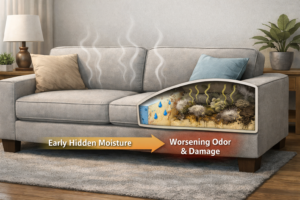
Mild couch odors are easy to dismiss. The smell is faint, intermittent, or only noticeable up close. It does not feel urgent, and daily life continues without disruption. In this moment, ignoring the odor feels reasonable—almost responsible. Acting might feel like overreacting. This is a classic gray zone decision. In many cases, however, mild odors are early signals of internal conditions that worsen quietly over time. Understanding why ignoring them can lead to bigger problems helps explain damage that feels sudden but was developing all along.
Why Mild Odors Feel Safe to Ignore
Strong smells trigger action. Mild ones do not. A light musty note or a vague “off” smell feels tolerable, especially if it comes and goes. Because the couch still looks clean and functions normally, the odor is mentally downgraded. Mild odors sometimes originate from earlier fresh water spills that did not fully dry or resolve internally.
This downgrade is important. Once an odor is classified as minor, it stops influencing decisions. The absence of discomfort becomes evidence that nothing serious is happening, even when subtle internal changes are underway.
The Gray Zone Between Normal and Problematic
Mild odors sit between two clear categories. They are not strong enough to demand action, but they are not completely absent either. This in-between state creates uncertainty. Acting feels unnecessary; ignoring feels harmless.
This is where decision failures occur. The lack of clarity pushes toward inaction, not because it is correct, but because it is easier to justify. Over time, this choice allows conditions to evolve without interruption.
What Mild Odors Usually Indicate
Light odors often signal lingering moisture, residue, or early microbial activity inside cushions or padding. Internal moisture can spread and intensify conditions that produce odor over time. These conditions do not always worsen quickly, but they rarely resolve instantly on their own.
Because the smell is mild, it is easy to assume it will fade. In some cases, it might. In others, it slowly strengthens as internal conditions stabilize in the wrong direction. Waiting without understanding the cause turns uncertainty into risk.
Why Odors Rarely Stay at the Same Level
Odors tend to change, not remain static. Couch problems often appear only after early signals are overlooked. Environmental shifts, temperature changes, humidity fluctuations, and normal use all influence how smells behave. A couch that smells slightly one week may smell noticeably different the next, even without any new event.
This progression feels surprising only because the early signal was ignored. The change itself is gradual, but perception jumps once a threshold is crossed.
The Illusion of “It Hasn’t Gotten Worse Yet”
One of the strongest reasons mild odors are ignored is the belief that no change equals no problem. Days pass, and the smell seems the same. This reinforces the idea that waiting is working.
Internally, however, processes may still be active. Moisture can redistribute, materials can break down slowly, and odor-causing compounds can accumulate. The lack of immediate escalation hides the trajectory.
How Normal Use Amplifies Hidden Issues
Daily use introduces pressure, heat, and friction. When mild odors are present, these factors can accelerate internal changes. Sitting compresses cushions, warmth activates odor compounds, and movement alters airflow inside the couch.
Because these actions are normal, they are rarely questioned. The role they play in amplifying a mild problem goes unnoticed until the problem is no longer mild.
When Odors Shift From Background to Center Stage
At some point, a mild odor becomes noticeable enough to demand attention. This moment feels abrupt. The couch “suddenly” smells bad. In reality, this is often the first time the issue crosses a personal tolerance threshold.
By the time this happens, internal conditions may be more established and harder to reverse. What could have been a simple observation earlier now feels like a bigger problem.
Why Late Action Often Feels Ineffective
When action is finally taken, results can be disappointing. Cleaning, airing out, or deodorizing may provide only temporary relief. This creates frustration and confusion about why the problem is stubborn.
The reason is timing. Early signals are easier to interpret and respond to. Late signals reflect compounded conditions. Ignoring the mild stage removes the opportunity for simpler resolution.
The Cost of Choosing Comfort Over Clarity
Ignoring mild odors often comes from a desire for comfort—not wanting to worry, not wanting to overthink. This is understandable. However, comfort in the short term can trade away clarity in the long term.
By the time clarity arrives, the situation feels more complex and less controllable. Recognizing this trade-off helps explain why small decisions matter more than they seem.
When Ignoring Odors Is Most Risky
Ignoring mild odors is riskier after recent cleaning, in humid environments, in homes with limited airflow, or when cushions are thick and slow to dry. In these contexts, odors are more likely to reflect ongoing internal imbalance.
Because these factors are not always obvious, the same choice can have very different outcomes in different homes. This unpredictability reinforces the gray zone.
Why Ignoring Is Still a Decision
Doing nothing feels neutral, but it is still a choice. It allows existing conditions to continue without interruption. In some cases, that is fine. In others, it quietly enables escalation.
Recognizing ignoring as an active decision—not a default—helps reframe responsibility without assigning blame.
Accepting Mild Odors as Information, Not Alarms
Mild odors do not need to cause panic. They do need to be acknowledged. Treating them as information rather than alarms creates space for observation without overreaction.
This balanced response avoids both extremes: aggressive action and total dismissal. In gray zones, awareness often matters more than immediate intervention.
FAQ
Are mild couch odors always a problem?
Not always. Some fade naturally. The risk is assuming they all will.
Why do mild odors sometimes turn into strong ones?
Internal moisture, use, and environmental changes can gradually intensify odor-causing conditions.
Is it better to act right away when I notice a smell?
Not necessarily to act, but to pay attention. Awareness allows better timing.
Can ignoring odors actually cause damage?
Indirectly, yes. Ignoring early signals allows conditions that contribute to damage to persist and grow.