
After a spill or cleaning session, one of the most common decisions is to simply let the couch dry on its own. The logic feels sound. Air exists, time passes, and moisture should evaporate naturally. In many minor cases, this approach works without noticeable consequences.
However, there are situations where “doing nothing” becomes the wrong call. The challenge is that the couch may not look urgent. It may not feel soaked. It may even appear to be improving. The risk often sits in the middle zone—where moisture is present but not obvious. Slowing down assumptions at this stage can prevent quiet, long-term damage.
The Comfort of Passive Waiting
Letting something dry naturally feels safe. It avoids overreaction. It avoids introducing more moisture or chemicals. It feels restrained.
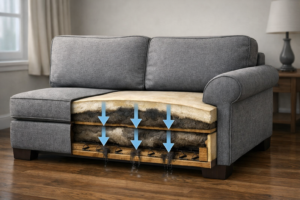
But restraint and inaction are not always the same thing. A couch is not a flat surface; it is a layered structure. Moisture does not evaporate evenly from dense foam, internal batting, and enclosed frame areas.
If internal layers receive little airflow, moisture may remain trapped even while the surface feels dry. Waiting without evaluating conditions can allow that moisture to settle deeper.
When Airflow Is Limited
Rooms with minimal circulation create conditions where “drying on its own” is slow and uneven. Closed windows, heavy cushions, or tightly fitted upholstery reduce airflow to internal materials.
Surface fabric may dry because it is exposed. Internal frame components may stay damp longer than fabric suggests, especially in enclosed areas. Internal foam and frame components may not. When airflow is insufficient, moisture can linger long enough to alter padding texture, weaken adhesives, or shift structural alignment.
In these cases, passive waiting may extend the problem rather than resolve it.
The Illusion of Surface Recovery
A couch can look normal long before it is internally stable. Damage often appears after drying seems complete because internal adjustments continue quietly. Fabric dries first. Cushions may regain their shape. Odors may fade temporarily.
This visible recovery can signal that no further action is needed. Yet internal shrinkage, tension shifts, or moisture redistribution may still be underway.
Choosing to assume completion too early can allow hidden stress to settle into permanent distortion.
Gravity and Downward Migration
Moisture naturally moves downward through layers. When left entirely on its own, water may settle toward the lowest structural points.
This can concentrate dampness near internal frames or dense foam bases. These areas dry more slowly and are less exposed to air. Over time, concentrated dampness may create odor, stiffness, or uneven firmness.
Occasional repositioning or limited intervention can interrupt this downward concentration. Leaving everything untouched sometimes accelerates it.
When Time Alone Increases Risk
Time is often viewed as the cure. In some cases, extended time without airflow or pressure changes allows moisture to stagnate.
Stagnant moisture behaves differently than evaporating moisture. It may contribute to odor development or adhesive weakening. Once structural bonds shift, the effect can remain even after drying completes.
Waiting is not always harmful. Waiting without awareness can be.
The Middle Zone: Not Soaked, Not Safe
The most deceptive stage occurs when the couch is no longer visibly wet but not fully dry internally. It feels safe to leave alone. It does not seem serious enough to justify extra effort.
This middle zone is where moisture often redistributes into less ventilated areas. Doing absolutely nothing may allow internal pathways to form that prolong uneven drying.
Moderate, thoughtful intervention—such as improving airflow or limiting compression—can reduce this risk.
When Letting It Dry Is Appropriate
It is important to recognize that natural drying is not inherently wrong. Small surface spills in well-ventilated areas often resolve without complication.
The key distinction lies in depth and exposure. If moisture remained shallow and airflow is consistent, passive drying may be sufficient.
The decision becomes questionable when moisture penetrates deeply, the room lacks circulation, or the couch structure is dense and enclosed.
Signs Passive Drying May Be Failing
Certain indicators suggest that waiting alone may not be enough:
- Persistent coolness in cushions
- Odor that returns after fading
- Uneven firmness developing over time
- Subtle fabric tension changes
When these appear, continuing to rely on time alone often prolongs internal adjustment.
Reducing use and improving air movement may be more balanced than total inaction.
Overcorrection Is Also a Risk
While passive waiting can be problematic, aggressive overcorrection introduces its own risks. Excessive heat or heavy mechanical drying may stress materials further.
The solution is rarely extreme action. It is often measured adjustment—recognizing when time needs assistance, not force.
Acting thoughtfully rather than reactively protects both structure and materials.
Seeing Drying as a Managed Process
Drying is not just the absence of water. It is a transitional phase where materials expand, contract, and realign. Treating it as a managed process rather than a background event reduces missteps.
Letting a couch “dry on its own” becomes the wrong call when internal conditions require more awareness than passive waiting provides. Not every situation demands intervention, but some do.
The difference lies in recognizing the middle zone and responding before hidden changes settle permanently.
FAQ
Is it usually safe to let a couch dry naturally?
For minor surface moisture in well-ventilated conditions, yes. The risk increases when moisture penetrates deeper layers.
How do you know if passive drying is not enough?
Persistent coolness, recurring odor, or developing uneven firmness suggest internal moisture remains active.
Does waiting longer always solve the problem?
Not necessarily. Without adequate airflow or reduced compression, time alone may allow moisture to concentrate.
Should drastic drying methods be used instead?
Extreme heat or force can stress materials. Measured airflow and limited use are typically safer adjustments.
Letting a couch dry on its own can be appropriate. It becomes the wrong call when internal moisture lacks the conditions it needs to evaporate evenly. Recognizing that distinction often prevents subtle, long-term damage.