
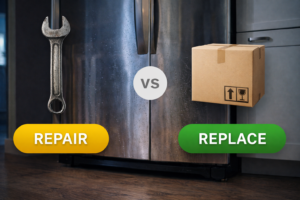
Deciding whether to repair or replace a refrigerator often feels straightforward at first. When something breaks, fixing it can seem cheaper and less disruptive. As a refrigerator ages, however, the logic behind that decision can change quietly. Age affects reliability, efficiency, and predictability in ways that are not always obvious when focusing only on the current problem.
Why Age Is Easy to Underestimate
Refrigerators are built to last, and many continue operating for years without major issues. When an older unit still cools and runs daily, it can feel reasonable to treat it the same as a newer one. This familiarity makes age easy to overlook as a meaningful factor.
Age itself is not a flaw, but it changes context. Components that have been working continuously for a long time are under different conditions than newer parts. Pausing to acknowledge that difference can shift how repair decisions are understood.
How Age Changes the Repair Equation
Early in a refrigerator’s life, repairs often restore stability. Parts are less worn overall, and fixing one issue may return the appliance to a predictable state. As age increases, repairs are more likely to address isolated symptoms rather than the broader condition of the system. Leaks that appear later in a refrigerator’s life often reflect broader internal wear.
This does not mean repairs stop working. It means their impact changes. A repair may solve the immediate issue without improving long-term reliability. Recognizing this shift can prevent repeated fixes from feeling confusing or disappointing.
The Decline of Predictability Over Time
One of the most important effects of age is reduced predictability. Older refrigerators can behave inconsistently even after repairs. Cooling patterns may vary, new issues may appear, or previous problems may resurface. Temperature instability is one way deeper structural issues can affect predictability.
Predictability matters because it affects trust. When outcomes feel uncertain, the value of each repair decreases. Slowing down to assess how predictable the refrigerator feels overall can be more informative than focusing on any single malfunction.
When Repairs Stop Restoring Confidence
Repairs are most valuable when they restore confidence in the appliance. Over time, that confidence can erode even if the refrigerator technically works. If each fix is followed by new doubts or emerging issues, the balance begins to change.
This does not force an immediate replacement decision. It signals that the role of repair has shifted. Pausing when confidence no longer returns can prevent further investment from becoming automatic.
Age, Efficiency, and Hidden Costs
As refrigerators age, efficiency often declines. Internal wear can cause systems to work harder to maintain temperature. These changes may not cause failure, but they can increase operating costs quietly. Long-term cost increases are often one of the first signs that age is changing the equation.
Repairs rarely reverse age-related efficiency loss. When energy use rises gradually, it becomes part of the long-term cost of keeping an older appliance. Considering these hidden costs alongside repair expenses can change the overall picture.
The Compounding Effect of Multiple Repairs
A single repair rarely defines the decision. The issue arises when repairs begin to accumulate. Each additional fix adds cost, time, and uncertainty. Over time, these factors can outweigh the perceived benefit of keeping the refrigerator running.
This compounding effect is easy to miss when repairs are spaced out. Looking at them collectively rather than individually can clarify whether repair is still serving its intended purpose.
Replacement as a Shift, Not a Failure
Replacement is often framed as giving up. In reality, it can be a logical response to changing conditions. When age alters reliability and cost patterns, replacement becomes part of the decision landscape rather than an extreme option.
Choosing replacement does not erase the value of past repairs. It reflects that the context has changed. Allowing that possibility without pressure can make the decision less emotional and more grounded.
When Doing Less Helps the Decision
When uncertainty grows, the instinct is often to act quickly. Another repair, another adjustment, another attempt to restore normalcy. Sometimes, doing less provides clearer information.
Pausing repairs temporarily can reveal whether issues stabilize or continue emerging. This restraint can prevent rushed decisions in either direction and preserve options while patterns become clearer.
Age as a Decision Lens, Not a Rule
There is no universal age at which a refrigerator should be replaced. Age is not a cutoff; it is a lens. It changes how repairs behave, how costs accumulate, and how predictable outcomes feel.
Using age as context rather than a rule allows more nuanced decisions. It encourages assessment rather than assumption, which can be especially helpful when the answer is not obvious.
FAQ
Does refrigerator age automatically mean replacement is better?
No. Some older refrigerators remain reliable. Age changes the decision logic but does not dictate the outcome.
Why do repairs feel less effective as a refrigerator gets older?
Because wear affects multiple systems. Fixing one issue may not restore overall stability.
Is it wrong to keep repairing an aging refrigerator?
Not necessarily. It becomes less effective when confidence and predictability do not return after repairs.
How can age be factored into the decision calmly?
By observing patterns over time, considering hidden costs, and allowing pauses instead of reacting to each issue in isolation.