
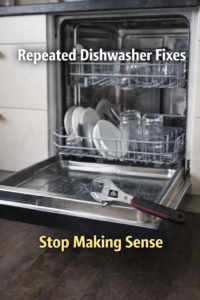
A dishwasher that needs repeated fixes can slowly shift from a convenience to a question mark. Each issue on its own may seem manageable, especially if the appliance still runs and produces clean dishes. Over time, however, repeated repairs can change the logic of keeping the dishwasher in service. What once felt reasonable can begin to feel uncertain, even before a clear failure appears.
Why the First Repair Usually Feels Justified
The first repair often restores confidence. The problem is identified, addressed, and daily use returns to normal. At this stage, repair feels like the obvious choice, particularly if the dishwasher has otherwise been reliable.
This response makes sense. Early fixes usually target isolated issues, and the appliance may behave predictably afterward. Still, it can be useful to slow down and notice how long that sense of stability actually lasts before the next concern appears.
How Repetition Changes the Equation
When repairs start to repeat, the situation changes subtly. Each new issue adds another variable to the system. Even if fixes are successful individually, the dishwasher may feel less predictable as a whole.
Repetition matters more than severity. Minor dishwasher issues often escalate into repeated fixes when early signals are ignored.
Several small fixes spread out over time can be more informative than one major repair. Pausing to consider how often attention is needed can reveal whether the appliance is becoming harder to keep stable.
The Hidden Cost of Ongoing Fixes
Repeated fixes carry costs beyond the immediate expense. Time, disruption, and mental effort accumulate. Each repair requires scheduling, waiting, and readjusting expectations. These indirect costs are easy to overlook because they are spread out. Ongoing dishwasher problems can also create damage beyond the appliance itself.
Over time, the dishwasher may demand more attention than it used to. Noticing this shift can help clarify whether continued repair is still serving its original purpose or simply maintaining momentum.
When Fixes Address Symptoms, Not Systems
As dishwashers age, repairs increasingly focus on symptoms rather than underlying condition. A leak may be resolved without improving overall sealing. Internal failures are often masked when repairs focus only on visible symptoms.
A noise may stop without restoring full alignment. The appliance works, but the system behind it remains stressed.
This pattern can lead to short-lived improvements followed by new issues. When fixes stop restoring confidence and instead create temporary relief, it may be a sign that the logic has changed. Slowing down rather than rushing into the next fix can prevent escalation.
Predictability as a Decision Marker
Predictability is a key factor in deciding whether fixes still make sense. A dishwasher that behaves consistently after repair offers reassurance. One that develops new quirks or uncertainties does not.
Loss of predictability increases risk, even if no single problem seems serious. When outcomes become harder to anticipate, each repair carries less value. Taking time to assess overall reliability, rather than focusing on the latest issue, can bring clarity.
The Role of Accumulated Wear
Repeated fixes often coincide with accumulated wear. Internal components age together, even if only one is addressed at a time. Fixing one area does not reset the others.
This means that each repair may be working against a broader trend. Recognizing this does not force a replacement decision, but it does change expectations. Continued restraint can prevent overinvestment while understanding catches up.
When Repair Becomes Habit Instead of Choice
At some point, fixing the dishwasher can become automatic. A problem appears, it gets fixed, and the cycle continues without reassessment. Habit can replace evaluation.
Breaking that habit does not require action. It can start with a pause. Asking whether the repair still makes sense in context can be more useful than asking whether it is technically possible.
Replacement as a Logical Shift
Replacement is often framed as an admission of defeat. In reality, it can reflect a change in logic rather than a failure. This same shift often occurs when appliance age changes repair outcomes.
When repeated fixes no longer restore stability or confidence, replacement enters the conversation naturally.
This shift does not erase the value of past repairs. It acknowledges that conditions have changed. Allowing that possibility without urgency can make the decision less stressful.
Why Doing Less Can Clarify the Choice
When uncertainty grows, the instinct is often to fix something quickly. Another repair can feel like progress. Sometimes, doing less offers better information.
Pausing repairs briefly can show whether issues stabilize or continue emerging. This restraint can prevent decisions driven by frustration and preserve options while patterns become clearer.
Cost Is Not Just About Money
The point where fixes stop making sense is not defined by a single number. It involves cost, predictability, effort, and confidence together. Even inexpensive fixes can lose value if they no longer restore trust in the appliance.
Looking at the full picture rather than individual repairs can make the decision feel less reactive. Slowing down helps keep the process grounded.
FAQ
How many repairs are too many?
There is no fixed number. Frequency, predictability, and confidence matter more than count.
Is it wrong to keep fixing a dishwasher that still works?
Not necessarily. It becomes less reasonable when fixes stop improving overall reliability.
Why do repeated repairs feel more frustrating over time?
Because uncertainty and effort accumulate, even if each repair seems minor.
How can the decision be approached calmly?
By observing patterns, allowing pauses, and considering whether repairs still restore confidence rather than just function.