
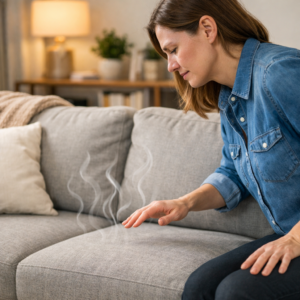
A couch that feels dry but carries a faint odor can be confusing. This often happens when odor remains trapped below the surface even though the fabric itself feels dry. The surface suggests everything is fine, while the smell raises doubt. This situation often happens after cleaning or exposure to moisture, and it tends to push people into quick decisions that may not be helpful.
Before assuming the couch is safe or unsafe, it helps to slow down. A faint odor is often a signal to pause rather than a clear answer.
What to Do Immediately
The first response does not need to involve action at all. If the couch feels dry but smells slightly off, reducing use for a short period can be the most cautious choice. Avoiding immediate sitting limits pressure, warmth, and friction that can change what is happening inside the cushions. Questions about whether it is safe to sit too soon usually focus on similar risks, even when the couch appears dry.
It can feel inconvenient to leave a couch unused, especially when it looks normal. Still, choosing to wait rather than test it right away often prevents small issues from becoming harder to reverse. Pausing is a valid response, even if the odor seems minor.
A Careful Use Approach
If the couch must be used, lighter and less frequent contact is generally safer than normal use. Brief contact places less pressure on internal layers than extended sitting or repeated use in the same spot. This approach is about reducing stress on the materials, not fixing the odor.
It is also worth paying attention to whether the smell changes with use. Odors that become stronger after sitting are often a sign that something deeper is still affected. In that case, continuing to use the couch may not be the best idea. Stopping early is often easier than dealing with lingering problems later.
Common Mistakes That Feel Logical
One common mistake is trusting dryness alone. Fabric can feel dry while inner padding or structural layers are still holding moisture. Sitting adds weight and warmth, which can push that moisture deeper or spread it unevenly.
Another mistake is assuming faint odors will fade on their own with use. This assumption is common after fresh water spills, where the absence of visible moisture makes it easy to underestimate what remains inside the couch. In some cases, regular use actually reinforces smells by warming and compressing the areas where odor-causing residue remains. It may feel reasonable to “get back to normal,” but normal use is not always neutral in this situation.
It is understandable to want closure, yet acting too confidently too soon often removes the option to simply wait and reassess.
When This Approach Is Not Enough
If the odor persists, returns after each use, or slowly becomes more noticeable, continued sitting is unlikely to help. These patterns often suggest that the issue is not limited to the surface. At that point, using the couch less, not more, is usually the safer direction.
There are also situations where no amount of cautious use makes a difference. When that becomes clear, it can be better to stop interacting with the couch and reassess later rather than experimenting further. Accepting uncertainty can prevent unnecessary damage.
FAQ
Is a faint odor always a problem?
Not always, but it is rarely meaningless. Even mild smells can indicate changes below the surface. Treating them as a reason to pause rather than panic is usually sensible.
If the couch feels completely dry, why would sitting matter?
Dryness at the surface does not reflect what is happening internally. Pressure from sitting can shift moisture or residues in ways that are not immediately visible. When unsure, less interaction is often safer.
Can short sitting sessions help “air it out”?
Sitting generally adds warmth and pressure rather than airflow. While it may seem harmless, it does not usually improve internal conditions. Waiting without use often does less harm.
When is it clearly unsafe to keep using the couch?
If odors intensify, spread, or come back repeatedly after sitting, continued use is unlikely to be beneficial. In those cases, stopping use is often the more cautious choice, even if the couch looks fine.
Taking a step back can feel unnecessary when nothing looks wrong. Still, faint odors are often early signals, and listening to them by slowing down is sometimes the most protective response available.