
Temporary appliance fixes are appealing because they promise quick relief. A workaround quiets a noise, a reset restores function, or a small adjustment brings performance back—at least for now. When the appliance starts working again, it feels reasonable to move on. Over time, however, temporary fixes often make long-term damage worse by allowing underlying problems to continue developing unnoticed.
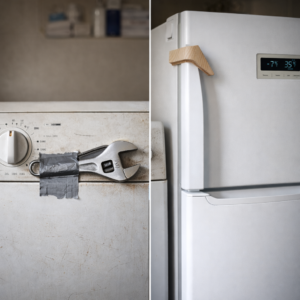
Why Temporary Fixes Feel Like Solutions
Temporary fixes offer immediate feedback. The appliance runs, the issue appears gone, and daily routines resume. This quick return to normal creates a strong sense of success, even if nothing structural has changed.
Because the disruption ends, urgency fades. Slowing down at this point can feel unnecessary, but it is often when restraint matters most. A fix that restores function without restoring stability may only be postponing the real problem.
The Difference Between Restoring Function and Restoring Health
Function is visible. An appliance either turns on or it does not. Health is less obvious. It involves internal balance, tolerance, and how systems respond under stress.
Temporary fixes usually target function, not health. As appliances age, temporary fixes are less likely to restore overall stability.
They bypass symptoms rather than resolving causes. When the appliance is put back into regular use, internal stress often continues, sometimes at a higher level than before. Pausing to consider whether a fix improved overall condition can prevent false reassurance.
How Temporary Fixes Can Redirect Stress
When a symptom is suppressed without addressing its source, stress does not disappear—it moves. A workaround may reduce noise while increasing vibration elsewhere. A reset may restore operation while masking an unstable component.
This redirection is subtle. The appliance seems improved, but internally it may be working harder to compensate. Over time, this extra strain can accelerate wear in areas that were previously unaffected. Choosing to do less instead of relying on repeated workarounds can limit how far this stress spreads.
Why Repetition Is a Warning Sign
A single temporary fix may not be meaningful. Repeated reliance on the same or similar fixes is different. Each repetition suggests the underlying condition remains unresolved.
When temporary solutions become routine, they normalize instability. Repeated fixes often indicate that underlying problems remain unresolved.
The appliance works, but only with ongoing intervention. Recognizing repetition as information rather than inconvenience can help shift perspective before damage compounds.
The Risk of Masking Gradual Deterioration
Temporary fixes often smooth out early warning signs. Intermittent issues are especially easy to overlook when quick fixes are available.
Performance looks acceptable, and visible symptoms stay controlled. This masking effect can delay awareness while deterioration continues underneath.
By the time the appliance shows a clear failure, multiple systems may be affected. What felt like a sudden breakdown is often the result of long-term strain. Allowing pauses instead of constant patching can keep warning signs visible.
Why “It’s Fine for Now” Can Be Costly
Temporary fixes encourage short-term thinking. If the appliance works today, tomorrow feels manageable. This mindset reduces pressure to reassess and increases tolerance for uncertainty.
Over time, “fine for now” can quietly become worse than addressing the issue earlier. Not because action was required, but because awareness was delayed. Slowing down instead of accepting provisional fixes can reduce this hidden cost.
When Temporary Fixes Change Decision Logic
The longer an appliance runs on temporary solutions, the harder decisions become. Each fix increases investment—time, effort, and expectation. This investment can make it emotionally harder to stop and reassess.
At this stage, fixes serve continuity more than improvement. Recognizing when a solution exists only to keep things going can help break that cycle without forcing an immediate choice.
Why Doing Less Can Protect the Appliance
Reducing use after a temporary fix can prevent additional strain while understanding develops. It allows observation without reinforcing the same stress patterns that caused the issue.
Doing less is not inaction. It is a way to limit damage while clarity improves. In many cases, restraint does more to protect long-term condition than another quick adjustment.
Temporary Fixes vs. Temporary Pauses
There is a difference between a temporary fix and a temporary pause. A fix alters behavior to keep going. A pause creates space to observe what happens when stress is reduced.
Pauses can reveal whether an issue stabilizes or continues to reappear. This information is often more valuable than another short-term solution. Choosing a pause over a patch can change the long-term outcome.
FAQ
Are temporary fixes always harmful?
No. Some are appropriate in the short term. Risk increases when they become the primary way an appliance keeps functioning.
Why do temporary fixes lead to more damage over time?
Because they allow underlying stress to continue or spread while masking warning signs.
Is it better to stop using an appliance after a temporary fix?
Not always, but reducing use can limit strain while patterns become clearer.
How can temporary issues be handled more safely?
By observing repetition, avoiding normalization, and allowing pauses instead of relying solely on quick solutions.