
When a couch develops an unpleasant smell, the instinct to neutralize it is strong. Odor sprays, powders, home remedies, or quick fixes promise relief without the disruption of deeper intervention. In many cases, these efforts seem reasonable and restrained. The smell is addressed, the couch remains usable, and the problem feels contained. This is a gray zone decision. Unfortunately, attempts to neutralize odors can sometimes lock them in, turning a temporary issue into a persistent one. Understanding why this happens helps explain why smells sometimes become harder to remove after “fixing” them.
Why Neutralizing Odors Feels Like the Smart Middle Ground
Neutralizing odors feels balanced. Re-cleaning is often chosen later when odor neutralization fails to solve the underlying issue. It avoids aggressive cleaning while still taking action. Compared to re-cleaning or replacing furniture, it seems minimal and thoughtful. This makes it especially appealing when the odor is noticeable but not overwhelming.
The issue is that neutralizing focuses on perception, not cause. Slowing down to consider where the odor originates can matter more than how it smells in the moment.
The Gray Zone Between Masking and Solving
Odor neutralization sits between masking and solving. It is often described as “removing” smells, but many methods simply interact with odor molecules at the surface. This creates uncertainty about whether the problem is gone or just altered.
In this gray zone, success is judged by immediate improvement. If the couch smells better, the action feels validated. Long-term effects are rarely considered at this stage.
How Neutralizers Interact With Moisture
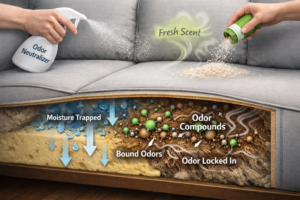
Many odor-neutralizing products introduce some level of moisture, even if they feel dry quickly. Trying to finish drying while adding new products can unintentionally worsen internal conditions. Sprays, mists, and foams can penetrate fabric and padding. When internal moisture is already present, this added moisture can reactivate or redistribute odor-causing compounds. Moisture left behind after fresh water spills can become more problematic when additional products are applied.
Instead of leaving the couch, odors may bind more deeply to internal materials. Waiting before adding anything new can sometimes be safer than immediate treatment.
Why Binding Can Be Worse Than Smelling
Some neutralizers work by binding odor molecules rather than removing them. This can reduce smell temporarily while anchoring the compounds in place. Once bound, these odors may release later under heat, pressure, or humidity changes.
This delayed return feels confusing. The odor was “fixed,” so its reappearance feels like a failure rather than a consequence of the earlier choice.
The Illusion of Immediate Success
Immediate improvement is persuasive. A couch that smells better right away creates relief and closure. This relief often ends observation. Attention moves on, and the couch fades back into normal use.
This pause in awareness is important. If internal conditions are still active, the neutralization may simply delay the signal rather than resolve it. When the smell returns, it is often stronger or more diffuse.
Layering Products Compounds the Problem
When odors return, additional neutralizers are often applied. Each layer adds new substances and potentially more moisture. Over time, the couch accumulates residues that interact unpredictably.
This layering can make odors more complex and harder to identify. What began as a simple smell becomes a mixture, complicating any later response.
Why Heat and Use Reactivate “Neutralized” Odors
Normal use introduces heat and pressure. These forces can release odor compounds that were previously bound or dormant. A couch may smell fine when untouched but develop odor when sat on.
Because neutralization happened earlier, this reaction feels unexpected. The connection between everyday use and odor return is rarely made.
When Neutralizing Delays Real Diagnosis
Neutralizing odors can postpone understanding the real issue. By altering the symptom, it removes feedback. Ignoring mild odors early often leads to stronger interventions later. Without the smell as a signal, internal moisture, residue, or environmental factors continue unnoticed.
This delay matters. Early signals are easier to interpret than late ones. Neutralizing too soon can remove the opportunity for clearer assessment.
Situations Where Neutralizing Is Most Risky
Neutralizing odors is riskier after recent cleaning, when moisture may still be present, or in homes with high humidity and limited airflow. In these conditions, odors are more likely to reflect ongoing internal imbalance.
Because these factors are not obvious, neutralizing feels equally safe everywhere. This false consistency increases the chance of unintended permanence.
Why Doing Nothing Can Sometimes Be Better
Resisting the urge to neutralize can feel uncomfortable. Odors demand attention. However, waiting briefly while observing changes can reveal whether the smell is fading, stabilizing, or worsening.
This pause does not mean neglect. It means allowing information to surface before acting. In gray zones, information is often more valuable than immediate comfort.
Accepting That Some Fixes Create Commitment
Once odors are neutralized repeatedly, the couch’s internal state changes. Reversing these changes may require more effort than if the odor had been left alone initially.
Recognizing that small interventions can create long-term commitments helps explain why some smells become permanent. The mistake is not caring—it is acting before understanding.
FAQ
Why did the odor come back after neutralizing it?
Neutralizers can bind or redistribute odor compounds rather than remove them, allowing return later.
Does this mean odor sprays are always bad?
No. They can be helpful in some cases. The risk is using them when internal moisture or imbalance is still present.
Why does the couch smell when I sit on it but not otherwise?
Heat and pressure can release odors that were previously dormant or bound.
Is it better to wait before neutralizing a smell?
Often, yes. Waiting can provide clearer information about whether the odor is resolving on its own or signaling a deeper issue.