
Waiting often feels like the safest response when something about a couch seems uncertain. There is no obvious spill, no dramatic odor, no visible damage. Acting feels risky; waiting feels cautious. This is one of the most common gray zone decisions around couch care. In many cases, however, waiting does not preserve the situation. Instead, it allows internal conditions to settle into a state that makes damage more likely and harder to reverse. Understanding how waiting can quietly lock in damage helps explain why problems sometimes feel unavoidable later.
Why Waiting Feels Like the Responsible Choice
Waiting aligns with restraint. It avoids unnecessary action, prevents overreaction, and respects uncertainty. When information is incomplete, doing nothing feels neutral and careful.
This sense of responsibility is powerful. Without clear warning signs, waiting feels like the option least likely to cause harm. The problem is that waiting still interacts with internal processes that do not pause just because action does.
The Assumption That Time Is Always Helpful
Time is often treated as a solution by default. If something is not clearly wrong, it is assumed that time will resolve it. This belief makes waiting feel productive even when nothing is actively improving. After fresh water spills, waiting alone can allow hidden moisture to settle instead of being resolved early.
In reality, time only helps when conditions are moving in the right direction. When internal moisture, residue, or stress is present, time can allow these factors to stabilize into a damaging pattern rather than dissipate.
How Damage Becomes “Set” Internally
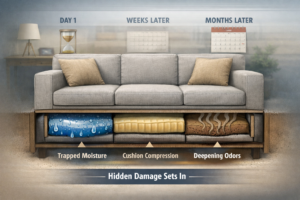
Certain internal changes become harder to reverse the longer they persist. Moisture can redistribute into denser layers, odors can bind more firmly to materials, and cushion compression can become semi-permanent.
Waiting allows these processes to progress uninterrupted. By the time damage becomes visible or noticeable, it is no longer fresh or flexible. What might have been temporary becomes established.
Why the Surface Sends the Wrong Signal
Surfaces change quickly. Fabric dries, looks normal, and feels comfortable. These cues strongly influence judgment and reinforce the belief that waiting is working.
Internally, however, changes happen slowly and without signals. Trusting surface feedback alone creates a false sense of stability. Pausing to question what cannot be seen can prevent misplaced confidence.
The Quiet Role of Environment During Waiting
While waiting, the couch remains exposed to its environment. Humidity, temperature cycles, and airflow patterns continue to act on internal materials. Home conditions can quietly prevent a couch from ever fully drying during long waiting periods. These forces do not stop simply because no action is taken.
In some environments, waiting allows unfavorable conditions to dominate. Instead of recovery, the couch experiences slow degradation shaped by the room it sits in.
Why Waiting Often Replaces Decision-Making
Waiting can become a way to avoid choosing. When no option feels clearly right, postponing the decision feels easier than committing to action.
Over time, this postponement becomes the decision. The couch continues along a path shaped by inaction. Recognizing waiting as an active choice—not a pause—changes how responsibility is understood.
When Waiting Turns Minor Issues Into Major Ones
Small issues are most responsive early. Mild odors, slight dampness, or subtle texture changes are easier to interpret before they escalate. Ignoring mild couch odors often allows these early signals to develop into larger problems.
Waiting allows these signals to fade into the background. When they finally demand attention, they often represent compounded effects rather than a simple problem. The scale of response required increases with time.
Why Later Interventions Feel Ineffective
Once damage is locked in, later attempts to fix it often disappoint. Cleaning, airing out, or adjusting conditions may produce limited results. Attempts to finish drying after long waiting periods often make outcomes worse. This creates frustration and the sense that nothing works.
The issue is not that interventions are useless. It is that they are being applied after internal conditions have settled. Timing matters as much as method.
The Psychological Comfort of Delay
Waiting provides emotional relief. It postpones worry and avoids disruption. This comfort is real and understandable.
The cost of this comfort is delayed awareness. By the time discomfort returns in the form of odor, damage, or decline, the situation feels more complex and less controllable.
Situations Where Waiting Is Most Risky
Waiting is riskier after recent cleaning, in humid environments, when airflow is limited, or when cushions are thick and slow to dry. In these cases, internal conditions are more likely to worsen quietly.
Because these factors are not always visible, waiting feels equally safe everywhere. This false uniformity makes gray zone decisions harder to evaluate.
Why Acting Less Does Not Always Mean Doing Nothing
Avoiding overreaction does not require total inaction. Observation, gentle monitoring, and awareness can coexist with restraint.
Waiting without attention is different from waiting with awareness. The latter allows for adjustment before damage becomes fixed.
Accepting That Safety Can Be Misleading
Waiting feels safe because it avoids immediate risk. However, safety based on comfort rather than understanding can be misleading.
Recognizing that some risks are delayed helps reframe patience. True caution includes considering what time itself is doing to the situation.
FAQ
Is waiting always a bad choice?
No. Waiting can be appropriate when conditions are clearly improving. The risk is waiting when nothing is changing.
How can waiting lock in damage?
It allows internal moisture, odors, or stress to settle into stable patterns that are harder to reverse.
Why does damage feel sudden later?
Because it developed gradually during the waiting period and only became noticeable after crossing a threshold.
What’s the alternative to waiting or acting aggressively?
Attentive restraint—slowing down while staying aware of subtle changes rather than ignoring them.