
Appliance problems rarely stay the same over time. What begins as a small irregularity—a noise, a delay, a minor leak—often feels stable enough to monitor rather than address. Waiting can seem reasonable, especially when the appliance continues to function. It is often worth slowing down here, because delay does not simply extend the same problem. Over time, waiting can change what the problem actually is.
This article explores how postponing attention alters the nature of appliance issues. What starts as a contained situation can gradually transform into something broader, less predictable, and harder to interpret.
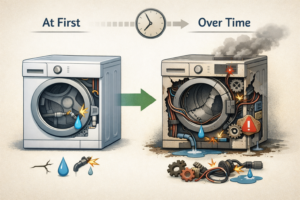
Why Waiting Feels Harmless at First
Early-stage appliance problems often appear manageable. The issue may be intermittent, mild, or easy to ignore. When nothing gets worse immediately, waiting feels justified.
This sense of safety is reinforced when the appliance continues performing its basic role. Pausing to recognize that stability does not equal neutrality can help challenge the assumption that nothing is changing during the wait.
Time is active, even when symptoms are quiet.
How Delay Allows Conditions to Shift
While attention is deferred, internal conditions continue evolving. Loads redistribute, materials adapt, and compensatory behaviors increase. None of these changes require visible failure to progress.
As these shifts accumulate, the original problem becomes less representative of the current state. Slowing down to consider what may be changing beneath the surface can explain why delayed problems feel different later.
Waiting changes context, not just timing.
Why Symptoms Lose Their Original Meaning
Early symptoms often point relatively clearly toward a cause. Over time, those same symptoms may fade, transform, or be replaced by others.
This does not mean the issue resolved. This is similar to cases where fixing the symptom makes the real appliance problem worse by allowing deeper conditions to persist. It means the system adapted. Pausing to notice when symptoms stop matching earlier explanations can help identify that the problem itself has evolved.
Symptoms are messages, and messages change when conditions do.
How Small Imbalances Become Structural Ones
What begins as a minor imbalance can gradually affect surrounding components. A slight vibration alters wear patterns. A small moisture presence affects adjacent materials. A modest delay in operation changes thermal or mechanical stress.
These changes rarely stay isolated. This progression mirrors how repeated minor appliance issues lead to sudden breakdown after extended delay. Slowing down to recognize how small imbalances propagate can clarify why later-stage problems feel more complex than expected.
Propagation is gradual, but its effects are not.
Why Waiting Increases Interdependence
As issues persist, more parts of the appliance become involved in compensating. Components that were not part of the original problem begin sharing the load.
This interdependence means that addressing one element later may affect several others. Pausing to see the appliance as a system rather than a collection of parts can help explain why late-stage problems resist simple framing.
Systems remember prolonged stress.
How Delay Blurs Cause and Effect
The longer a problem persists, the harder it becomes to trace cause and effect. New behaviors emerge that seem unrelated to the original issue.
This blurring can create uncertainty and frustration. Slowing down to acknowledge that clarity decreases with time can prevent forcing inaccurate explanations onto a changed situation.
Clarity is time-sensitive.
Why “It Hasn’t Gotten Worse” Can Be Misleading
Waiting is often justified by the belief that nothing has deteriorated. However, absence of visible escalation does not mean absence of change.
Some forms of progression reduce visibility before increasing impact. Pausing to question what “worse” actually means can help reveal hidden shifts.
Not all progression is loud.
How Delay Changes Decision Types
Early appliance problems invite tactical decisions: fix, adjust, monitor. As time passes, decisions become strategic, involving tradeoffs, uncertainty, and broader consequences. This shift reflects when appliance damage has moved beyond a single repair decision rather than remaining a simple fix.
Recognizing when the decision type has changed can reduce frustration. Slowing down to reassess the nature of the choice—not just the problem—can restore perspective.
The decision evolves along with the damage.
Why Late Attention Often Feels Overwhelming
When attention finally turns back to the appliance, the situation may feel disproportionate to the original issue. Multiple concerns appear at once, and the path forward feels unclear.
This overwhelm often reflects accumulated complexity, not sudden failure. Pausing to separate timeline from intensity can make the situation feel more understandable.
Delayed complexity is not sudden chaos.
When Waiting Becomes a Turning Point
There is often a moment when waiting shifts from neutral to consequential. This point is rarely obvious when it occurs. It becomes clear only in hindsight.
Slowing down to recognize that waiting itself is an action—not the absence of one—can help frame responsibility more realistically.
Inaction still shapes outcomes.
Why Doing Less Earlier Can Mean Doing More Later
Delaying attention can feel like conserving effort. In reality, it often redistributes effort into a later, more complex stage.
Pausing earlier does not require immediate intervention. It requires awareness that waiting changes the terrain. Slowing down to observe without disengaging can preserve options.
Timing influences effort as much as action.
FAQ
Why does waiting change the nature of appliance problems?
Because internal conditions continue evolving. Pausing to consider unseen changes helps explain the shift.
Is waiting always a mistake?
Not always. The risk lies in assuming waiting is neutral. Awareness during delay matters.
Why do problems feel harder to understand later?
Because cause and effect blur over time. Slowing down earlier preserves clarity.
What’s the safest approach when unsure?
Restraint combined with observation. Doing less while staying attentive can prevent the problem from quietly changing shape.