
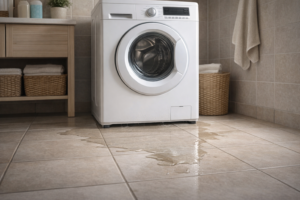
A puddle under a washing machine often looks like a simple hose issue, especially when the machine still turns on and finishes cycles. That assumption can push people to act too quickly. In some cases, a leak is not a surface problem at all, and slowing down can prevent much larger damage.
What to Prioritize First
The first priority is limiting additional water exposure rather than trying to fix anything right away. Reducing how much water reaches the floor or surrounding areas often matters more than taking immediate action. This kind of restraint-first thinking appears across many home maintenance situations.
It may feel productive to start tightening connections or restarting a cycle, but pausing usually lowers the chance of spreading damage.
At this stage, observation matters more than intervention. Noting where water appears and when it shows up can be useful later. If uncertainty sets in, stopping early is reasonable and often safer than continuing to investigate under pressure.
A Careful First Check
External hoses and visible connections are usually the first things people think of, and it is fine to look without forcing adjustments. If nothing appears loose, cracked, or obviously displaced, that absence of evidence matters. Leaks that do not clearly trace back to an external line often point inward.
It can be tempting to move the machine or tilt it to “see underneath.” That kind of handling can spread water into areas that were previously dry. If access feels awkward or unclear, backing off is a valid choice rather than pushing for certainty.
Common Mistakes That Feel Logical
One common reaction is to run another short cycle to confirm the leak. Repeated operation can introduce more water into the same failing area, even if the machine seems stable. Continued use also means electricity and moisture remain in close proximity, which adds another layer of uncertainty without being obvious.
Another instinct is wiping everything dry and assuming the problem is solved if no water appears immediately afterward. Some internal leaks only show during specific phases and disappear briefly. Using towels to absorb water under the machine can also create a false sense of resolution, since removing visible water does not stop internal seepage.
When actions feel rushed or improvised, it is often a sign to slow down rather than escalate. Similar patterns appear when well-intended actions compound damage instead of containing it.
When a Loose Hose Is Not the Problem
Leaks that appear away from hose connections, reappear after drying, or worsen over time often involve internal components. Seals, internal hoses, or structural parts can fail gradually while the machine still runs. These failures may release water only under pressure or motion, making them easy to misread.
Continuing to operate a leaking machine can allow water to reach flooring, subflooring, or nearby walls. In some cases, damage that appears cosmetic at first can later reveal deeper structural problems.
At that point, the damage may extend beyond the appliance itself. If the source cannot be clearly identified from the outside, stopping use is often the least risky option, even if it feels inconvenient.
When This Situation Is Not a Quick Fix
If water continues to appear despite checking visible connections, the situation has likely moved beyond simple adjustment. Internal leaks are rarely resolved by surface-level actions and can worsen without obvious warning. Advice that sounds simple often breaks down once real-world variables are involved.
It is reasonable to decide that further DIY attempts are not appropriate.
Choosing not to act immediately is sometimes the most responsible decision. Waiting, documenting what is seen, or simply pausing use can prevent a small leak from becoming a much larger problem.
FAQ
Can a washing machine leak even if hoses look fine?
Yes. Some leaks originate from internal parts that are not visible, and it is okay to stop investigating if nothing obvious appears.
Is it safe to keep using the machine if the leak is small?
Small leaks can be unpredictable, and water can spread to places that are not immediately visible. Continuing use adds uncertainty, especially when the source is not clearly understood.
Does drying the area mean the problem is gone?
Drying only removes visible water. Internal moisture may still be present, and it is reasonable to remain cautious.
Should the machine be moved to check underneath?
Moving the machine can spread water and stress components. If moving it feels risky, choosing not to is a valid decision.